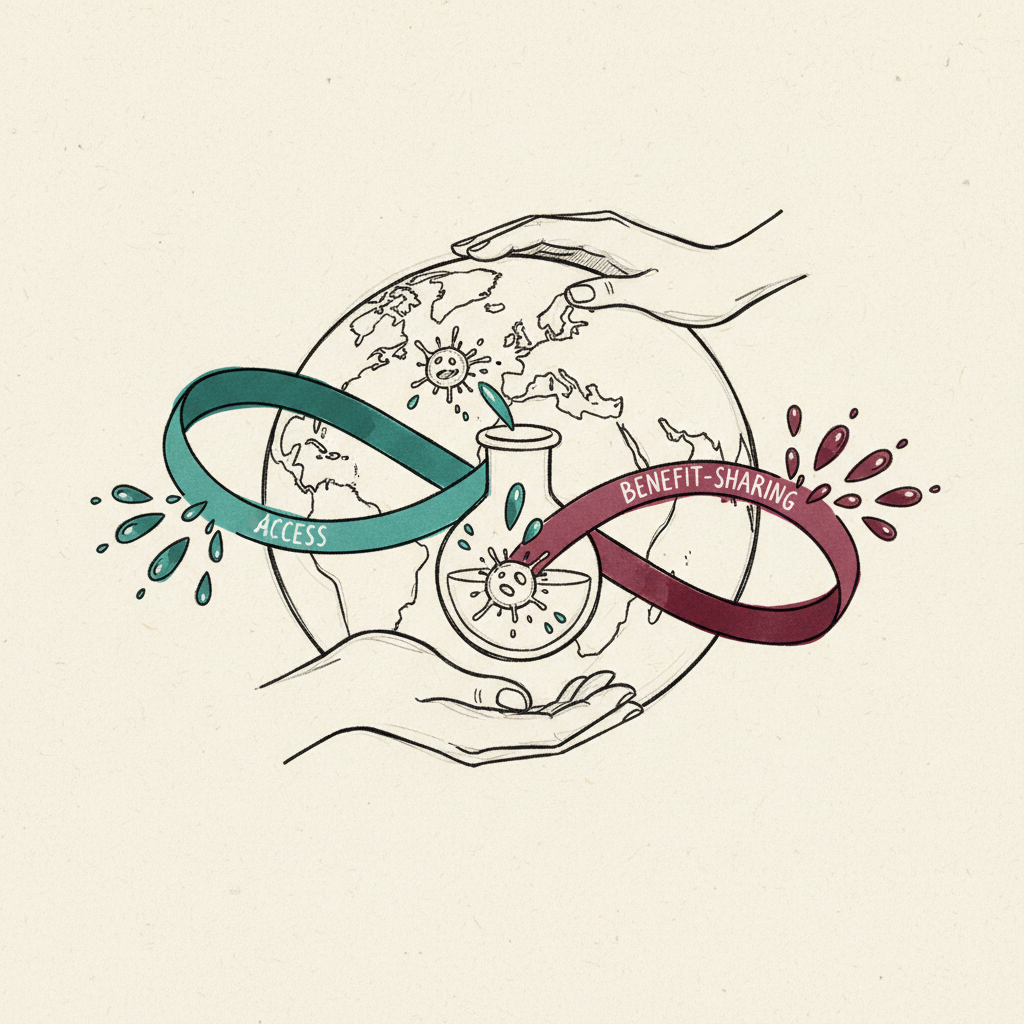
Pathogen Access and Benefit-Sharing
Deadlocked WHO Pandemic Agreement annex; DRC shares sequences with no treaty-guaranteed vaccine access as negotiations slip to 2027.
The pathogen-sharing annex missed another Deadline on 18 September 2026, when the eighth Geneva session closed without an agreed text, leaving the treaty it completes unsignable until at least May 2027.
Last refreshed: 4 October 2026 · Appears in 1 active topic
Can PABS survive being bypassed in real time as DRC shares sequences with no return guarantee?
Timeline for Pathogen Access and Benefit-Sharing
Remained without an agreed text after IGWG8
Pandemics and Biosecurity: WHO talks on pathogen sharing fail againMissed its fourth adoption deadline at IGWG7
Pandemics and Biosecurity: PABS annex slips a fourth deadlineMentioned in: PABS talks reopen under a deadline
Pandemics and BiosecurityMentioned in: Africa CDC wins direct pandemic funding
Pandemics and BiosecurityUS widens Ebola ban to green-card holders
Pandemics and BiosecurityBackground
Pathogen Access and Benefit-Sharing (PABS) is the annex that would make the WHO Pandemic Agreement work. It pairs two duties. Countries would share pathogen samples and genetic sequences quickly during an emergency. Manufacturers that use them would return a share of the resulting vaccines and medicines to the countries that supplied them. Until the annex passes, governments cannot sign the May 2025 Agreement at all.
The annex has been the main fault line since treaty talks began in 2022. Lower-income countries, led by the African Group, demand mandatory dose-sharing, technology transfer and intellectual-property waivers as the price of rapid sharing. High-income states and industry prefer voluntary, market-based commitments. Knowledge Ecology International has proposed tying benefit-sharing to a product's market registration rather than to proof that shared material was used.
The dispute predates the 2025 treaty by almost 20 years. Indonesia stopped sharing H5N1 samples with WHO in late 2006, on the ground that the resulting vaccines cost more than it could pay; the voluntary Pandemic Influenza Preparedness Framework followed only in May 2011. Lower-income countries regard that model as having failed them during COVID-19.
The annex keeps missing its deadlines
The 79th World Health Assembly deferred adoption of the annex on 19 May 2026, moving the target to May 2027 or a special session. The seventh negotiating session opened on 6 July under a 17 July Deadline set by Brazil's President Lula and WHO's Tedros, and closed with no text, the fourth deferral since May 2025. The Africa Group, speaking through Algeria, backed a federated network of national laboratories with binding access conditions; the EU and other industrialised states backed a more centralised hybrid model.
The eighth session closed on 18 September without a text either. On 25 September a UN General Assembly declaration on pandemics left the annex's May 2027 target unchanged.
Bundibugyo exposes the missing guarantee
The Bundibugyo Ebola emergency, declared on 17 May 2026, is the first test of what the absent annex costs. No licensed vaccine, antibody or antiviral works against the Bundibugyo species; Ervebo, Inmazeb and Ebanga all target Zaire ebolavirus.
DR Congo shares the virus's sequence data in real time through existing channels. Without the annex, nothing binds a manufacturer to return doses of any product built on it. A $62m Coalition launched on 1 June to fast-track three Bundibugyo vaccines, which needed 12 to 18 months before any human dosing. Any vaccine that results will reach the country that supplied the samples on commercial or donor terms, not by treaty right.