Skip to content
Welcome, thoughtbot's Giant Robots listeners!Start here
Pandemics and Biosecurity
3OCT

US Ebola entry ban nears expiry

3 min read
13:42UTC

The 30-day US entry ban on DRC, Uganda and South Sudan nationals, widened to green-card holders on 5 June, expires around 17 June with no announced lift. Africa CDC calls it of 'little, if any, benefit'.

ScienceDeveloping
Key takeaway

The US Ebola entry ban reaches its 17 June expiry unresolved, while Washington funds the response it restricts.

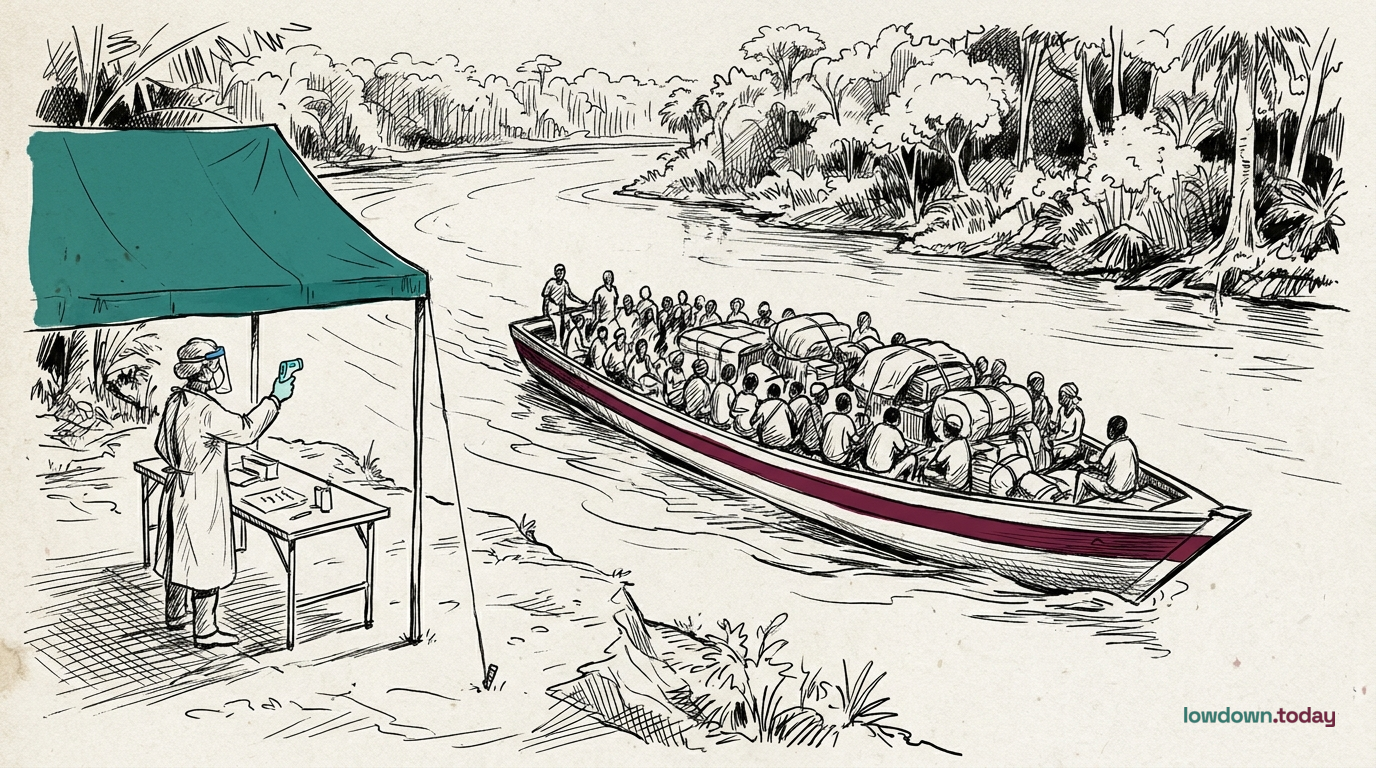
A 30-day US entry ban on nationals of the Democratic Republic of the Congo, Uganda and South Sudan, expanded on 5 June to include green-card holders, expires around 17 June with no announced extension, modification or lift as of publication. The ban is administered by the US Department of Health and Human Services, the federal department overseeing public health. The Africa CDC Emergency Consultative Group, the continental agency's scientific advisory body on outbreaks, calls the restriction of "little, if any, benefit"⁠1.

The scientific case against entry bans is settled and has been since the 2014 West Africa epidemic. They delay rather than prevent importation, they displace travel through unscreened overland routes, and they deter the surveillance cooperation that lets responders see a virus coming. The original order, issued 18 May, rests on the same reasoning that the evidence rejects.

The same administration funding hundreds of millions of dollars of the response is restricting movement through the borders that response depends on partners keeping open. As of publication the border restriction stands as established fact; its fate at expiry is genuinely open, neither a reported lift nor a confirmed extension.

Deep Analysis

In plain English

The United States imposed a ban on 18 May preventing nationals of DRC, Uganda and South Sudan from entering the country. On 5 June it was expanded to include green-card holders, people WHO live legally in the US, from those same countries. The ban was due to expire around 17 June, but as of publication, no announcement had been made about whether it would be lifted, renewed or changed. Public health experts, including the WHO and Africa CDC, are against entry bans because they do not actually prevent the virus from reaching other countries. What they do is push travellers to take indirect routes through countries with less screening, and they make it harder for healthcare workers and scientists to travel to and from the outbreak zone. The US is simultaneously spending $270 million to fight the outbreak it is restricting people from fleeing.

Deep Analysis
Root Causes

Two structural forces sustain entry bans despite their epidemiological ineffectiveness. Domestic political risk calculus: elected governments face asymmetric accountability, if a banned national imports the virus, the absence of the ban becomes the explanatory variable in public and legislative discourse, regardless of screening capacity at borders. The cost of being seen to have permitted importation is politically higher than the cost of maintaining a restriction that impedes response.

A legal architecture gap reinforces the political dynamic. The IHR Temporary Recommendations issued 22 May explicitly advise against travel and trade restrictions, but the IHR has no enforcement mechanism. States that impose restrictions contrary to Temporary Recommendations face no formal consequence beyond WHO censure; the US's $270 million bilateral funding commitment demonstrates that the DRC and Ugandan governments are not in a position to impose a symmetrical diplomatic penalty.

What could happen next?
  • Consequence

    If the ban is extended past 17 June, it risks reducing the flow of outbreak-trained DRC and Ugandan epidemiologists to international conferences and WHO technical meetings, compounding the surveillance cooperation gap that the WHO Pandemic Agreement's deadlocked PABS annex (ID:4053) already creates.

    Short term · Reported
  • Precedent

    A 30-day ban that runs through PHEIC declaration and generates no documented importation-prevention evidence, while coexisting with $270 million in bilateral response funding, establishes a domestic-politics-over-epidemiology precedent that other governments may cite in future outbreak declarations.

    Long term · Reported
  • Risk

    The ban's displacement effect, pushing DRC and Ugandan nationals through unscreened third-country routes, may generate importation events in countries with less detection capacity than the US, creating secondary spread that the ban was nominally designed to prevent.

    Short term · Reported
First Reported In

Update #7 · Bundibugyo's fork stays open

Africa CDC· 16 Jun 2026
Read original →
Different Perspectives
IGWG co-chair Tovar da Silva Nunes
The Brazilian co-chair closed the eighth pathogen-sharing session on 18 September without an agreed annex text, the second session in a row to end that way. He presented the outcome as continued commitment, with adoption due at the World Health Assembly in May 2027.
Fraport
Fraport
The Frankfurt Airport operator has told staff to watch for fever, hessenschau reported, after six airport workers caught malaria. Germany does not require insecticide spraying of arriving aircraft cabins, and parasite genotyping to trace the source is due at the end of October.
European Centre for Disease Prevention and Control
ECDC reported the eight Frankfurt Airport malaria cases on 18 September and considers repeated arrivals of infected mosquitoes on aircraft likely. It has not ruled out local mosquitoes, and awaits genotyping due at the end of October.
Pan American Health Organization
PAHO counted 53,957 measles cases in the Americas by 19 September and is supporting Peru's response in Puno and Arequipa. It warns that October's Señor de los Milagros festivities and Pope Leo XIV's November visit could increase transmission.
Bangladesh Directorate General of Health Services
The DGHS recorded 1,030 measles-related deaths and 172,720 suspected cases by 14 September, after a campaign that reached 19.75 million children. Its disease-control director, Halimur Rashid, said further vaccination rounds were expected within two weeks.
Minapharm
Minapharm
The Egyptian drugmaker and its Berlin subsidiary ProBioGen were awarded up to US$16.5m by CEPI on 27 August to take a Bundibugyo vaccine into a Phase 1 trial in Africa. Final manufacture is planned for Cairo, making it CEPI's first Bundibugyo candidate with an African producer.
