Skip to content
Briefings are running a touch slower this week while we rebuild the foundations.See roadmap
Iran Conflict 2026
16MAY

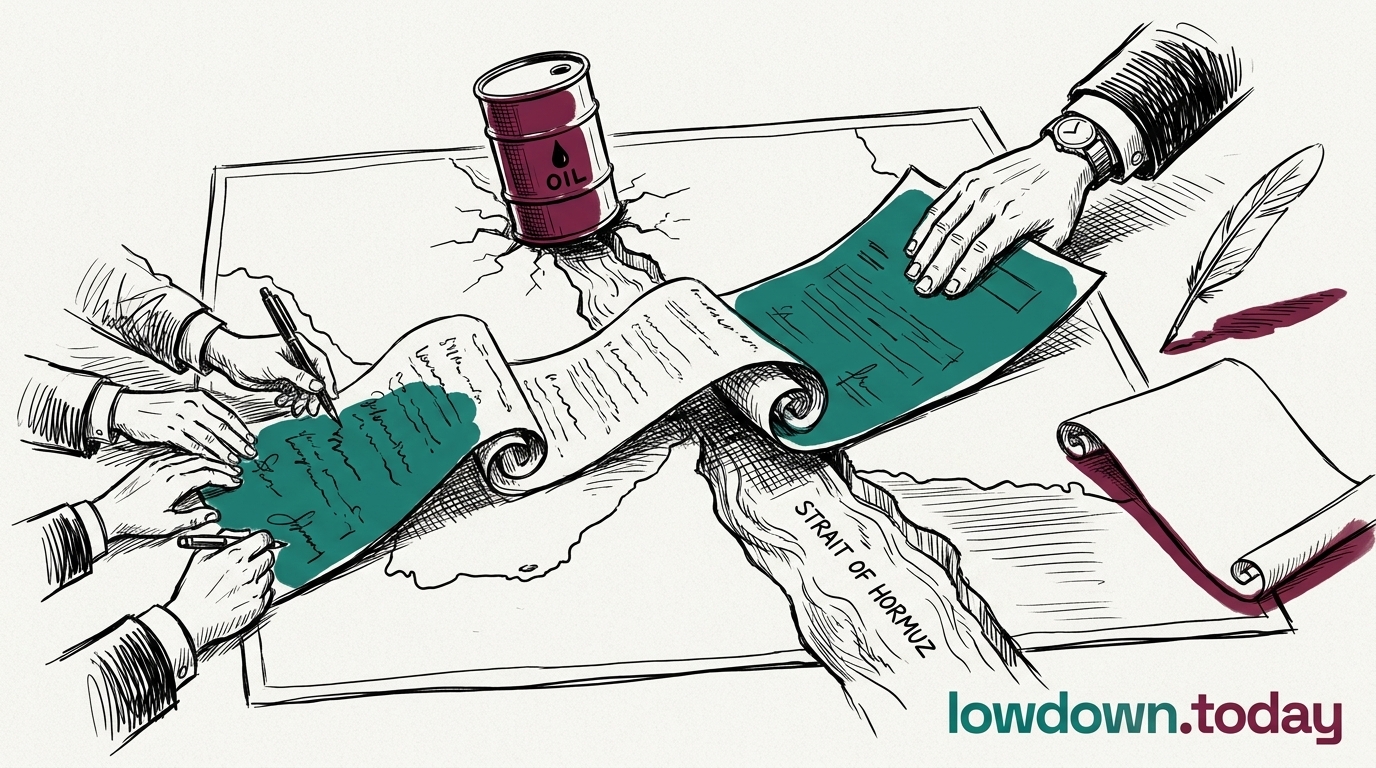
EU rejects Trump's Hormuz toll venture

2 min read
12:41UTC

Brussels cited UNCLOS transit rights to dismiss a US-Iran joint venture on strait fees.

ConflictDeveloping
Key takeaway

Europe sees Hormuz tolls as a threat to the entire maritime order, not a single waterway dispute.

The European Union rejected Donald Trump's suggestion of a US-Iran "joint venture" on Hormuz toll collection. Under UNCLOS (United Nations Convention on the Law of the Sea), which applies as customary international law to non-signatories including both Iran and the United States, ships enjoy transit passage that "shall not be impeded" and fees may only be charged for specific services rendered, not by reason of passage alone.

No post-1945 precedent exists for a coastal state imposing mandatory tolls on a natural international strait. Just Security assessed Iran's blanket selective toll as a "clear violation" of international norms. Iran's Islamabad proposal included a fee structure tied to vessel passage, as detailed in the Hormuz traffic event above.

Trump had previously called the toll concept "a beautiful thing." That language sits uncomfortably alongside the US's historical role as guarantor of freedom of navigation. The EU's rejection is a legal rebuke, but it has no operational teeth: Russia and China co-vetoed the UNSC Hormuz reopening resolution 11-2 , blocking the only multilateral enforcement route for free navigation.

If tolls are formalised, the precedent extends far beyond Hormuz. Turkey could apply the same logic to the Bosphorus, Egypt could renegotiate Suez terms, Indonesia and Malaysia could toll the strait of Malacca. The EU's objection is not about Iran alone; it is about preventing the rewrite of a maritime order that underpins European trade.

Deep Analysis

In plain English

Trump suggested that the US and Iran could run a 'joint venture' together to collect fees from ships passing through the Strait of Hormuz. He called the idea 'a beautiful thing'. The EU immediately rejected it. Under international law, countries cannot charge ships simply for passing through international straits. Ships have a right to pass freely. Fees are only allowed for specific services, like a pilot to navigate a difficult channel. Iran charging a blanket toll for permission to pass is, in the view of almost every international law scholar, illegal. The EU's rejection matters because European ships are among those currently stranded or blocked. But the EU has no military means to enforce its legal position in the strait, so the rejection is a principled statement rather than an operational one.

Deep Analysis
Root Causes

The EU's UNCLOS position reflects a genuine institutional commitment to rules-based maritime order that European states depend on for trade flows through multiple global chokepoints.

Trump's willingness to entertain a toll joint venture reflects a transactional approach to international law: rules are useful when they serve US interests and renegotiable when they do not. The US's own freedom-of-navigation programme, which has operated since the 1970s, was built on exactly the principle the Hormuz toll would undermine.

What could happen next?
  • Precedent

    Trump's positive framing of a US-Iran Hormuz toll joint venture, if pursued, would be the first US endorsement of a coastal state transit fee on a natural international strait, directly undermining the freedom-of-navigation doctrine the US has defended militarily for 70 years.

  • Consequence

    The transatlantic split on the Hormuz toll question, US treating it as potentially 'beautiful', EU rejecting it as UNCLOS-incompatible, reduces the coherence of any Western negotiating position and gives Iran leverage to play the two sides against each other.

First Reported In

Update #66 · Islamabad collapses: 10 days to expiry

Just Security· 12 Apr 2026
Read original
Causes and effects
This Event
EU rejects Trump's Hormuz toll venture
The EU rejection exposes a transatlantic split: Trump entertained a toll concept that violates the maritime law framework Europe considers binding.
Different Perspectives
India (BRICS meeting host, grey-market beneficiary)
New Delhi hosted the BRICS foreign ministers' meeting on 14 May that Araghchi attended under the Minab168 designation, giving India a front-row seat to Iran's diplomatic positioning. India's state refiners have been absorbing discounted Iranian crude through grey-market routing since April; Brent at $109.30 means every barrel sourced outside the formal market generates a structural saving.
Hengaw / Kurdish human rights monitors
Hengaw's daily reports from Iran's Kurdish provinces remain the sole independent cross-check on Iran's judicial activity during the conflict. Two executions across Qom and Karaj Central prisons on 15 May and five Kurdish detentions on 15-16 May indicate the wartime judicial pipeline is operating independently of military tempo.
Pakistan (mediator and bilateral partner)
Islamabad spent its diplomatic capital as the US-Iran MOU carrier to secure LNG passage for two Qatari vessels through a bilateral Pakistan-Iran agreement, spending its mediation credit for direct economic gain. China's public endorsement of Pakistan's mediatory role on 13 May is the structural reward.
China and BRICS bloc
Beijing endorsed Pakistan's mediatory role on 13 May, one day after the BRICS foreign ministers' meeting in New Delhi. Chinese state banks are processing PGSA yuan toll payments; China has not commented on its vessels' continued Hormuz passage, but benefits structurally from a non-dollar toll system it did not design.
Iraq (bilateral passage partner)
Baghdad negotiated a 2-million-barrel VLCC transit without paying PGSA yuan tolls, offering political alignment in lieu of cash. Iraq's position inside Iran's adjacent bloc makes it the natural first bilateral partner and a template for how Tehran structures passage deals with states that cannot afford Western coalition membership.
Bahrain and Qatar (Gulf signatories)
Both signed the Western coalition paper while hosting US Fifth Fleet and CENTCOM's Al Udeid base, respectively. Qatar occupies the sharpest contradiction: it is on coalition paper while simultaneously receiving LNG passage through the bilateral Iran-Pakistan track, a position Doha has tacitly accepted from both sides.