Skip to content
Briefings are running a touch slower this week while we rebuild the foundations.See roadmap
Iran Conflict 2026
3MAY

Trump ties Xi summit to Hormuz passage

4 min read
10:26UTC

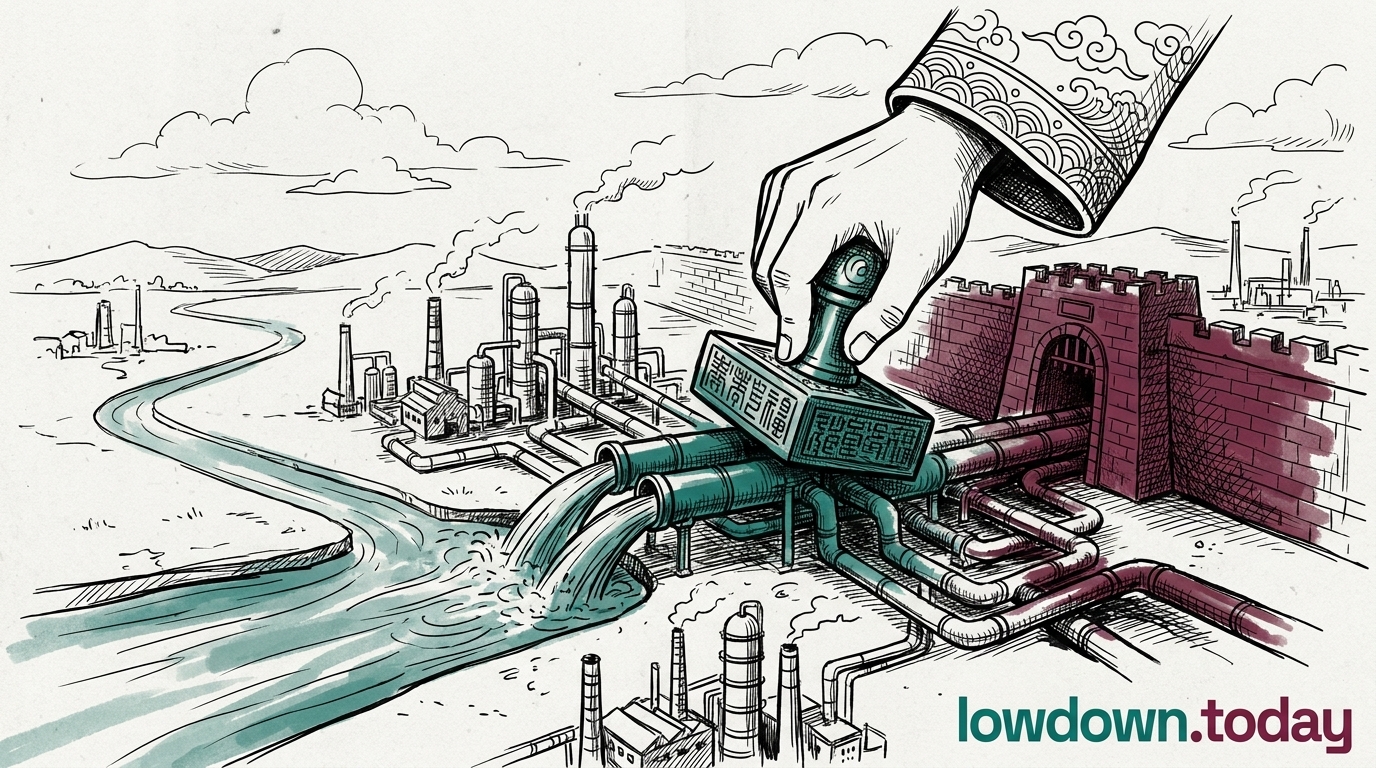
Trump threatened to postpone his summit with Xi Jinping unless China helps open the Strait of Hormuz — but China is the one country whose oil supply the blockade has not disrupted.

ConflictDeveloping
Key takeaway

China needs Hormuz open but cannot publicly comply with US coercion without setting a dangerous precedent.

Trump threatened to delay his summit with Chinese President Xi Jinping — scheduled for 31 March to 2 April — unless China helps secure passage through the strait of Hormuz 1. China imports roughly 11 million barrels per day through the strait, making it the world's single largest consumer of Gulf oil.

The threat arrives in a context that works against its intended purpose. China has spent the first sixteen days of this war positioning itself as a beneficiary, not a victim, of the Hormuz disruption. 11.7 million barrels of Iranian crude have transited the strait since 28 February, all bound for China, tracked by satellite by TankerTrackers.com co-founder Samir Madani . Ships claiming Chinese or "Muslim" ownership have received de facto IRGC protection from interdiction — a two-tier passage system Iran controls . Beijing deployed a naval fleet to The Gulf on 8 March that included the Liaowang-1, a 30,000-tonne signals intelligence vessel collecting real-time data on US and Israeli naval operations . China's special envoy Zhai Jun is touring the region pursuing mediation — a diplomatic role, not a military one .

Trump is asking China to help dismantle an arrangement from which China currently profits. Beijing gets discounted Iranian crude, intelligence on American military operations, and diplomatic leverage in Tehran — all of which it would forfeit by joining Washington's escort Coalition. The summit's acceptance was, by most accounts, already reluctant. Threatening to withdraw an invitation the other party was ambivalent about provides limited leverage. If Beijing concludes the summit is not worth the concessions demanded, the threat accelerates the dynamic it was designed to prevent: pushing China deeper into its energy corridor with Iran at precisely the moment Washington needs Chinese cooperation.

The 15-day window before the summit deadline coincides with compounding military and economic pressures. Brent crude closed Friday at $103.14 . Three hundred ships remain stranded in the Gulf . The IEA's record 400-million-barrel strategic reserve release failed to hold prices below $100 . China will weigh the cost of helping Washington against the cost of a broken oil market — but Beijing's own supply, uniquely, is not broken.

Deep Analysis

In plain English

The Strait of Hormuz is a narrow waterway through which roughly a fifth of global oil flows daily. Trump is threatening to cancel a major diplomatic summit with China's leader unless Beijing helps keep it open. China genuinely needs Hormuz open — its economy depends on it. But publicly yielding to a US ultimatum would signal to Beijing's own public, and to every other nation, that Washington's pressure works against China. That precedent is something Beijing views as more strategically dangerous than any short-term shipping disruption. So China faces a situation where its economic interests and its political interests point in opposite directions.

Deep Analysis
Synthesis

The summit-linkage threat exposes a trilemma the body does not name: Washington is simultaneously trying to contain China strategically, wage war on Iran, and rely on China to manage that war's maritime consequences. These three objectives are structurally incompatible. Meaningful Chinese co-operation on Hormuz would require US concessions — on Taiwan, technology exports, or Ukraine — that the administration cannot offer domestically. The threat therefore has no viable compliance pathway and functions as a signal to a domestic audience rather than a workable diplomatic instrument.

Root Causes

The US is not asking China to share a burden from a position of strength. Washington has already described Hormuz as beyond its solo capacity — the coalition ask is to cover a gap US planners failed to provision for. China's Belt and Road investments across the Gulf give it independent interests in Hormuz stability, but those interests do not translate into willingness to act under US instruction, particularly when compliance would establish a coercion precedent for Taiwan and Korean Peninsula scenarios.

Escalation

Chinese IR doctrine treats public ultimatums as requiring demonstrative rejection to preserve deterrence credibility. A plausible Beijing response before 31 March is to announce a Sino-Iranian Hormuz corridor arrangement — simultaneously securing Chinese oil flows on Chinese terms while publicly rebuking the ultimatum. This would be the exact outcome the threat sought to prevent.

What could happen next?
  • Risk

    China may respond to the ultimatum by formalising a Sino-Iranian Hormuz corridor arrangement before 31 March, securing oil flows on Beijing's terms while publicly rebuking US coercion.

    Short term · Suggested
  • Consequence

    Zero allied warship pledges plus Chinese non-compliance would leave the US solely responsible for maritime security it has already described as beyond current operational capacity.

    Immediate · Assessed
  • Precedent

    Using summit access as coercive leverage against China over a third-party military conflict establishes a template that could be applied or countered symmetrically in future Taiwan or Korean Peninsula crises.

    Long term · Suggested
  • Meaning

    The absence of any diplomatic option that allows China public compliance reveals that the ultimatum has no viable resolution pathway and primarily functions as domestic US signalling.

    Immediate · Assessed
First Reported In

Update #37 · Six more weeks of strikes; Hormuz deal dead

Bloomberg· 16 Mar 2026
Read original
Causes and effects
This Event
Trump ties Xi summit to Hormuz passage
China is the primary beneficiary of the Hormuz disruption — receiving discounted Iranian crude, collecting intelligence on US naval operations, and building diplomatic leverage in Tehran. Threatening a summit Beijing accepted reluctantly is unlikely to alter that calculus and risks accelerating Chinese-Iranian alignment at the moment Washington most needs Chinese cooperation.
Different Perspectives
International human rights monitors (NetBlocks, IHR, Hengaw)
NetBlocks recorded 1,704 cumulative hours of near-total internet blackout for roughly 90 million Iranians on Day 74, while IHR documented ongoing executions under emergency provisions. These organisations are the only active monitoring windows into a civilian population cut off from the global internet for 71 consecutive days.
UK / France coalition
The Royal Navy confirmed HMS Dragon's Hormuz deployment on its own website on 11 May, converting a press-reported presence into declared force posture; UK and French defence ministers hosted a coalition meeting the same day. Britain and France are now the only named contributors to a Hormuz escort mission all five allies Trump originally asked had declined.
Saudi Aramco / Gulf producers
Saudi Aramco CEO Amin Nasser warned on 11 May that a Hormuz closure could remove 100 million barrels of weekly supply from global markets (roughly 15 million barrels per day for a week), a figure that dwarfs any OPEC+ swing capacity. The warning functions as both a price-floor signal and a public pressure on Washington to protect transit.
Beijing / Chinese Government
China has not publicly acknowledged the four Hong Kong-registered entities designated on 11 May or extended MOFCOM's Blocking Rules cover to HK-domiciled firms. Xi Jinping hosts Trump on 14–15 May having already de-risked state-bank balance sheets via NFRA's quiet loan halt, entering the summit partially compliant before any negotiation.
Tehran / Iranian Government
Foreign Minister Araghchi described Iran's 10-point counter-proposal as 'reasonable and responsible' via spokesman Baqaei on 11 May, and widened the mediator pool by meeting Turkish, Egyptian, and Dutch counterparts in a single day. Tehran is buying procedural runway while Trump's verbal rejection went unmatched by any written US counter.
Trump White House
Trump White House
Trump called the ceasefire 'on massive life support' and dismissed Iran's 10-point counter-proposal as 'a piece of garbage' on 11 May, while departing for Beijing two days later with no signed Iran instrument to show Congress. The verbal maximum and the paper void coexist: the administration is running a legal pressure campaign through Treasury while the president free-lances the rhetoric.