Skip to content
Briefings are running a touch slower this week while we rebuild the foundations.See roadmap
Iran Conflict 2026
15MAR

Beijing sends envoy, not warships

3 min read
04:55UTC

China's special envoy Zhai Jun is touring the Middle East seeking mediation — the same week Trump publicly demanded Chinese warships in the Strait of Hormuz. Beijing has answered with diplomacy while its navy collects intelligence and its tankers transit the strait under IRGC protection.

ConflictDeveloping
Key takeaway

China mediates to protect its own oil supply, not to resolve the war.

China's special envoy Zhai Jun began a tour of Middle Eastern capitals this week, seeking to mediate between Iran, the United States, and Israel 1. The mission coincides with — and directly contradicts — President Trump's public call for China to send warships to keep the strait of Hormuz open 2.

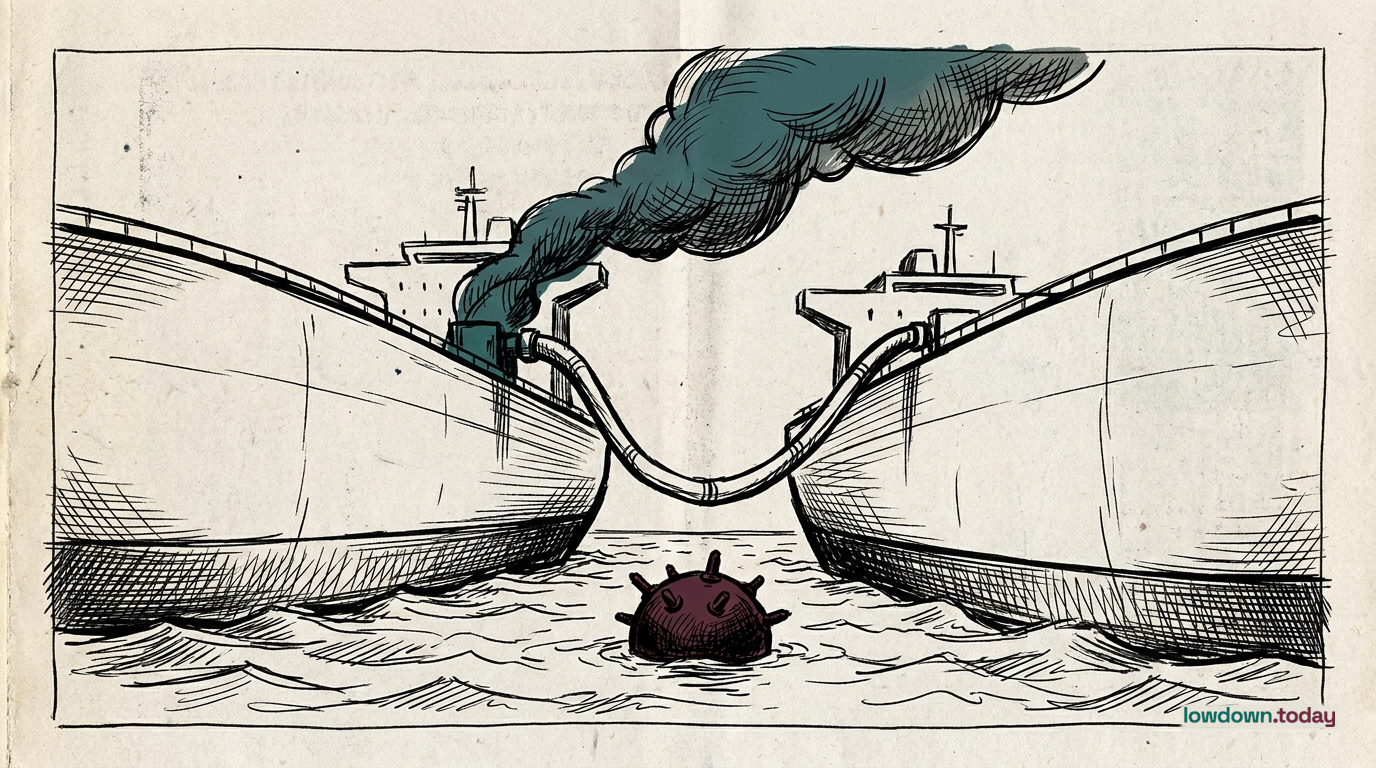
Beijing has responded to the war on every track except the one Washington requested. The 48th PLA Navy fleet — destroyer Tangshan, frigate Daqing, supply ship Taihu, and the 30,000-tonne signals intelligence vessel Liaowang-1 — deployed to The Gulf to collect data on US and Israeli naval operations, not to escort tankers . Chinese and Iranian naval forces are running joint Maritime Security Belt exercises in the strait . Chinese-operated tankers have received de facto IRGC protection, with 11.7 million barrels of Iranian crude transiting Hormuz since 28 February — all bound for China, all unmolested, while other shipping is attacked or stranded .

Zhai Jun's tour follows Foreign Minister Wang Yi's statement at the National People's Congress that "plotting colour revolution or seeking regime change will find no popular support" — a direct rejection of the war aim Netanyahu articulated on 8 March. China's position has been internally consistent throughout: oppose the war publicly, protect its energy supply chain operationally, gather intelligence on US force posture, and offer mediation. Each element reinforces the others.

The structural obstacles to any deal are severe. Washington demands unconditional surrender. Tehran's conditions — recognition of its nuclear programme, reparations, binding security guarantees against future attack — are incompatible with that demand. China has no leverage over Israel, limited influence over the IRGC's operational decisions, and a relationship with the Trump administration built on transaction rather than trust. Zhai Jun may return with nothing. But the tour costs Beijing little and positions it as the major power seeking peace while the United States prosecutes a war at $1.4 billion per day (Event 16) and oil trades above $100 — a price that strains China's economy but falls far harder on import-dependent states in Europe, South Asia, and sub-Saharan Africa.

Deep Analysis

In plain English

China imports roughly half of all the oil it needs from the Middle East. If the Strait of Hormuz closes or the Gulf stays at war, Chinese factories, transport, and heating face real disruption. Beijing is sending a senior diplomat not out of altruism but to protect those economic lifelines. At the same time, China wants the world to see it as a responsible power capable of brokering peace — a role it is trying to claim away from the United States. The complication is that China also buys large volumes of Iranian oil under sanctions-circumventing arrangements, making it a partner of one of the belligerents and therefore not a neutral referee.

Deep Analysis
Synthesis

Zhai Jun's tour exposes a structural contradiction at the heart of Chinese regional policy: Beijing is simultaneously Iran's largest trading partner (providing economic oxygen that sustains the IRGC's capacity) and the self-nominated honest broker seeking to end IRGC attacks. No other mediator in modern history has tried to broker a ceasefire while commercially sustaining one side's war effort. Gulf states are watching whether China will use that leverage or merely talk.

Root Causes

China's mediation posture rests on two structural drivers absent from the body. First, the Belt and Road Initiative has committed an estimated $150bn+ in Gulf infrastructure — a war-disrupted region threatens returns on those sunk investments. Second, Beijing's global positioning strategy requires demonstrating that a non-Western security architecture can produce stability; this conflict is its highest-profile test case yet.

Escalation

China's diplomatic track is structurally de-escalatory in intent but faces a near-insurmountable obstacle: the IRGC has defied Iran's own elected president on Gulf strikes. Beijing has no coercive leverage over an institution that answers to the Supreme Leader, not the civilian government Zhai Jun is engaging. The mediation trajectory is most likely downward in ambition over days as that constraint becomes apparent.

What could happen next?
  • Meaning

    China's mediation posture is driven by oil supply security and great-power positioning, not humanitarian concern — a distinction that shapes what concessions Beijing will or will not offer.

    Immediate · Assessed
  • Risk

    If Gulf states conclude that China is shielding Iran diplomatically while IRGC strikes continue, they may restrict Chinese investment access to ports and infrastructure — reversing Belt and Road gains in the region.

    Short term · Suggested
  • Opportunity

    A Chinese-mediated humanitarian corridor or partial ceasefire — even without a full settlement — would cement Beijing's claim to an alternative global security role and attract Global South diplomatic alignment.

    Medium term · Suggested
  • Precedent

    This is the first instance of China attempting live mediation in an active conflict directly involving US forces — the outcome will define the credibility ceiling of Chinese diplomatic power for a generation.

    Long term · Assessed
First Reported In

Update #36 · Israel plans full Litani seizure

Modern Diplomacy· 15 Mar 2026
Read original
Causes and effects
This Event
Beijing sends envoy, not warships
China is positioning itself as mediator while simultaneously protecting its own energy imports, gathering intelligence on US naval operations, and conducting joint exercises with Iran — a multi-track approach that serves Beijing's interests regardless of whether mediation produces results.
Different Perspectives
Gulf shipping and insurance markets
With Hormuz and Bab el-Mandeb both hostile at once, war-risk underwriters face their first dual-chokepoint pricing problem; the rerouting hedge that absorbed one closure is gone for Israeli-linked hulls. Any deal that reopens Hormuz without a Houthi stand-down clause delivers only partial shipping relief.
Russia and China
Russia and China
Russia and China met IAEA chief Grossi jointly in Geneva on 5 June to coordinate an advance blocking position against Washington's censure resolution, the first documented instance of proactive pre-session obstruction rather than reactive post-vote dissent. Beijing's move came four days after OFAC designated Shanghai Qianye Energy under Iran energy sanctions.
Saudi Arabia
Saudi Arabia
Saudi Arabia was left out of the emergency $4.01 billion Patriot waiver Qatar received on 2 May as its own PAC-3 stocks ran near-empty from intercepting Iranian salvoes over Aramco facilities. Riyadh is on a standard 18-month FMS queue behind a production line booked through 2030, with no equivalent priority to Qatar's Al Udeid basing role.
Houthis (Ansar Allah)
The Houthis declared a complete ban on Israeli Red Sea navigation on 8 June and struck Jaffa, their first attack on Israeli territory since April, seven days after the Tasnim authorisation to activate other fronts including Bab el-Mandeb. The declaration put both chokepoints under hostile authority simultaneously.
Iran
Iran
Iran agreed the 9 June mutual halt after the Mahshahr exchange and coordinated with Russia and China to block Washington's IAEA censure resolution, using the Board as a second front while the bilateral pause held on the military one. Tehran's acceptance of the Lebanon carve-out contradicts the linkage position it stated on 1 June.
Benjamin Netanyahu and the IDF
Israel struck the Karun Petrochemical plant at Mahshahr on 8 June over Trump's explicit objection, then agreed a halt with Iran the following day scoped on Israeli terms with Lebanon carved out. Netanyahu's posture is that the IDF will not accept Iranian missile factories as off-limits regardless of US diplomatic timelines.