Skip to content
Briefings are running a touch slower this week while we rebuild the foundations.See roadmap
Iran Conflict 2026
1MAY

Brent below $100 on ceasefire rumours

4 min read
10:38UTC

Brent crude dropped $12.25 in a single session — the war's largest daily fall — on Trump's claim of productive negotiations with Iran. The supply disruption that drove prices to $126 four days earlier has not changed.

ConflictDeveloping
Key takeaway

Markets priced out $26/barrel of war risk in one session, but a $32 residual premium signals structural Gulf risk persists.

Brent Crude fell $12.25 — 10.9% — to close at $99.94 per barrel, its first settlement below $100 since 11 March and a 14% intraday swing — the largest single-day oil price drop since the war began. WTI fell 10.3% to $88.13. European gas futures dropped 9%. The trigger: Trump's Truth Social post claiming productive conversations with Iran and postponing strikes on Iranian power plants for five days.

Four days earlier, Brent had peaked at $126 . The swing from peak to Monday's close — roughly 21% in under a week — occurred with no change in the physical supply picture. the strait of Hormuz remains under IRGC operational control. The 8-million-barrel-per-day supply disruption documented by the IEA has not eased. More than 3,000 vessels remain stranded across the Middle East . UBS economist Paul Donovan attributed the volatility to "different and at times contradictory assessments of the war" from senior US officials 1 — a diagnosis that applies with equal force to the $126 peak, which was driven by Trump's 48-hour strike ultimatum .

Even after Monday's drop, Brent at $99.94 sits roughly 50% above the pre-war price of $67.41. American households still pay an additional $300 million per day at the pump compared to pre-conflict levels . Goldman Sachs's Daan Struyven had raised US recession probability to 25% at lower price levels than Monday's settlement ; Oxford Economics assessed that sustained Brent at $140 triggers a mild global recession at negative 0.7% GDP .

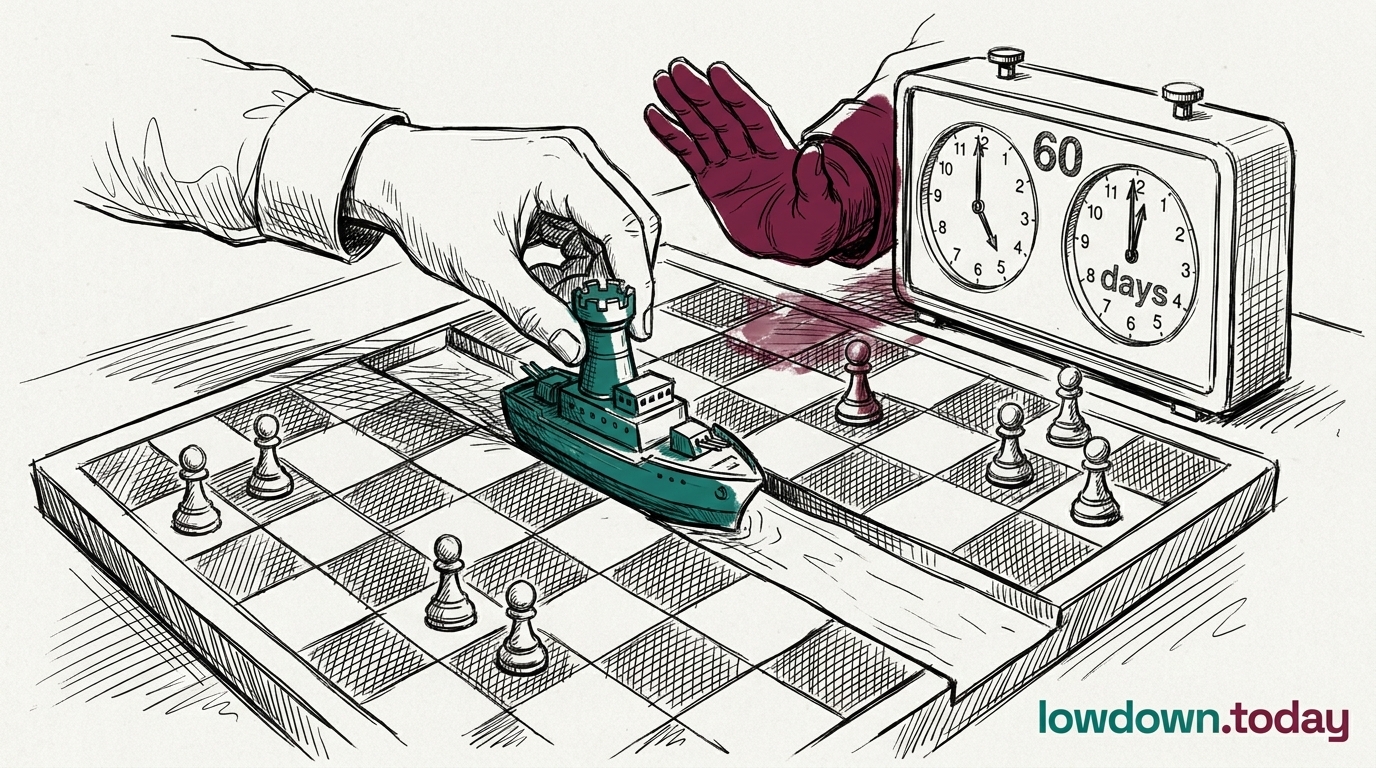
Monday's market priced in a diplomatic resolution that does not yet exist. Iran denies negotiations have occurred. If the proposed Islamabad meeting fails to materialise, or if Trump's five-day postponement expires on 28 March without progress, the conditions that produced $126 remain intact — and the snap-back would be equally abrupt.

Deep Analysis

In plain English

Oil affects almost everything: petrol, heating, food production, shipping, and manufactured goods. When oil falls sharply, costs ripple down through the whole economy over several weeks. Monday's crash happened because Trump announced talks with Iran, causing traders who had bet on continued war to rapidly unwind those positions — creating a cascade of selling. But even after the largest single-day drop since the war began, oil remains 50% above pre-war levels. The economic damage to households and businesses is ongoing; Monday provided relief, not a return to normal.

Deep Analysis
Synthesis

The Russell 2000's 2.7% outperformance versus the S&P 500's 1.1% gain is analytically significant and unremarked in the body. Small-cap domestic US firms are less exposed to energy input costs and international trade disruption than large-cap multinationals. The spread between the two indices is a real-time market verdict on who bears the war's economic burden — Monday's session shows large, globally-exposed firms carry it disproportionately, while domestically-focused US businesses benefit more from any de-escalation signal.

Root Causes

The 14% intraday swing reflects not only the diplomatic news but the forced liquidation of speculative long positions accumulated as Brent rose from $67 to $126. The body attributes volatility to 'contradictory assessments from US officials' — but the structural amplifier is an abnormally crowded long position in crude futures, meaning any de-escalation signal triggered cascading stop-loss selling well beyond what fundamental price adjustment warranted. The speed of the move is diagnostic of leverage unwinding, not sentiment alone.

What could happen next?
  • Risk

    If the talks narrative collapses before 28 March, speculative long positions will rebuild rapidly, potentially driving Brent back toward $120–126 within days.

    Immediate · Assessed
  • Meaning

    The $32/barrel residual premium above pre-war levels signals markets assess the IRGC toll system as a semi-permanent structural feature of Gulf transit, not a transient wartime measure.

    Short term · Assessed
  • Consequence

    Compressed refinery crack spreads following Monday's crude crash may delay consumer petrol price relief by two to four weeks relative to the futures market move.

    Short term · Suggested
  • Opportunity

    Collapsed implied volatility on crude options temporarily reduces forward fuel-hedging costs for airlines and shipping firms, providing operational planning relief even before physical prices normalise.

    Immediate · Suggested
First Reported In

Update #46 · Trump delays strikes; oil crashes to $99

Bloomberg· 24 Mar 2026
Read original
Causes and effects
This Event
Brent below $100 on ceasefire rumours
Energy markets are now a direct transmission mechanism for US presidential statements about the war, with billions of dollars in value moving on a single social media post. The crash briefly took Brent below $100 for the first time since 11 March, but the physical supply disruption — 8 million barrels per day offline, 3,000 vessels stranded, Hormuz under IRGC control — remains identical to the conditions that produced the $126 peak.
Different Perspectives
Oil markets
Oil markets
Brent fell $1.05 to $106.0 on summit Day 1 but remains $5-7 above the post-ceasefire equilibrium analysts modelled in March; the market is pricing a holding pattern, not a breakthrough. OilPrice.com and Aramco CEO Nasser converge on buffer-exhaustion before Hormuz reopens if the blockade extends past mid-June.
Iranian dissidents and human rights monitors
Hengaw documented a five-prison simultaneous execution cluster on 13 May, with Gorgan appearing for the first time in the wartime register. Espionage charges framed as Israel-linked moharebeh now extend across Mashhad, Karaj, and Gorgan, using the war as judicial cover for protest-era detainees.
BRICS / Global South
Araghchi's Delhi appearance positioned Iran as a victim of US aggression before non-Western foreign ministers, with Deputy FM Bagheri Kani calling on BRICS to act against US aggression. India, as the largest non-Chinese user of Iranian-routed crude, faces pressure to balance bloc solidarity against its own shipping and sanctions exposure.
China
China
Beijing accepted the Nvidia chip clearance on summit Day 1 and gave Rubio verbal acknowledgement of Iran as an Asian stability concern, having already put Pakistan on paper as the mediatory channel on 13 May (ID:3253), deflecting the US ask for direct Chinese action without refusing it.
Iran (government and civilian diplomatic track)
Araghchi denied any Hormuz obstruction at BRICS Delhi on 14 May while Iran's SNSC had finalised a Hormuz security plan the day before. Israel Hayom's single-sourced 15-year freeze offer gives Tehran a deployable figure in non-Western forums regardless of corroboration; the state attributed 3,468 wartime deaths with no independent verification.
United States (Trump administration and Senate moderates)
Trump signed a chip clearance for 10 Chinese firms on summit Day 1 and zero Iran instruments across 76 days; Rubio and Vance made verbal Iran asks without paper. Murkowski voted yes on the 49-50 war-powers resolution after Hegseth told the Senate that Article 2 makes an AUMF unnecessary.