Skip to content
Welcome, thoughtbot's Giant Robots listeners!Start here
Iran Conflict 2026
26APR

IDF names Mojtaba Khamenei as target

3 min read
13:59UTC

An Israeli brigadier general names Iran's Supreme Leader as an assassination target on camera — the first time Israel's military has publicly declared a sitting head of state marked for killing.

ConflictDeveloping
Key takeaway

Publicly naming a sitting head of state as an assassination target is without modern interstate precedent.

IDF spokesman Brig. Gen. Effie Defrin stated on camera: "He is not immune. We will pursue him, find him, and neutralise him" — referring to Mojtaba Khamenei, Iran's Supreme Leader⁠1. This is the first time an Israeli military official has publicly named a sitting head of state as an assassination target. Defrin is the same officer who disclosed operational plans extending through Passover and beyond, and who has emerged as the IDF's most forward-leaning public voice on the war's scope and duration.

The declaration carries operational weight because of what preceded it by hours. Netanyahu and Defence Minister Katz granted the IDF and Mossad advance authorisation to carry out targeted killings of senior Iranian and Hezbollah figures without prior political sign-off when time-sensitive intelligence emerges⁠2. A senior Israeli official told Ynet: "This has never happened before." The killing of Hamas political chief Ismail Haniyeh in Tehran in July 2024 required cabinet-level approval. That political check has been removed. Two days before the Larijani strike, the Israeli Air Force destroyed an aircraft used by the late Ali Khamenei and senior officials at Mehrabad Airport in Tehran⁠3. The pattern — destroy transport infrastructure, eliminate surrounding leadership, publicly declare intent against the principal target — is systematic.

Israel's history of targeted killings is extensive, but the targets have been leaders of non-state armed groups: Hamas's Ahmed Yassin and Abdel Aziz al-Rantisi in March and April 2004, separated by twenty-six days; Hezbollah's Imad Mughniyeh in 2008; Haniyeh last year. Publicly declaring the head of state of a sovereign nation with 88 million citizens as a personal target has no precedent in Israeli operations. The closest parallel — coalition strikes on Saddam Hussein's palaces in 2003 — was never accompanied by a named, on-camera commitment from a military spokesman to hunt and kill the leader individually.

For Iran, Defrin's words transform Khamenei's absence from a medical question into a survival imperative. If the leaked audio's account is accurate — that he survived by seconds, with injuries preventing any public appearance — the IDF is publicly hunting a wounded man whose location may be unknown even to some Iranian officials, per Iran International⁠4. Iran faces a forced choice: keep Khamenei hidden indefinitely, which erodes his domestic authority and feeds speculation about whether The Supreme Leader can govern, or produce him publicly, which may expose his location to the intelligence apparatus that killed Larijani, Soleimani, and Karishi within the past 48 hours.

Deep Analysis

In plain English

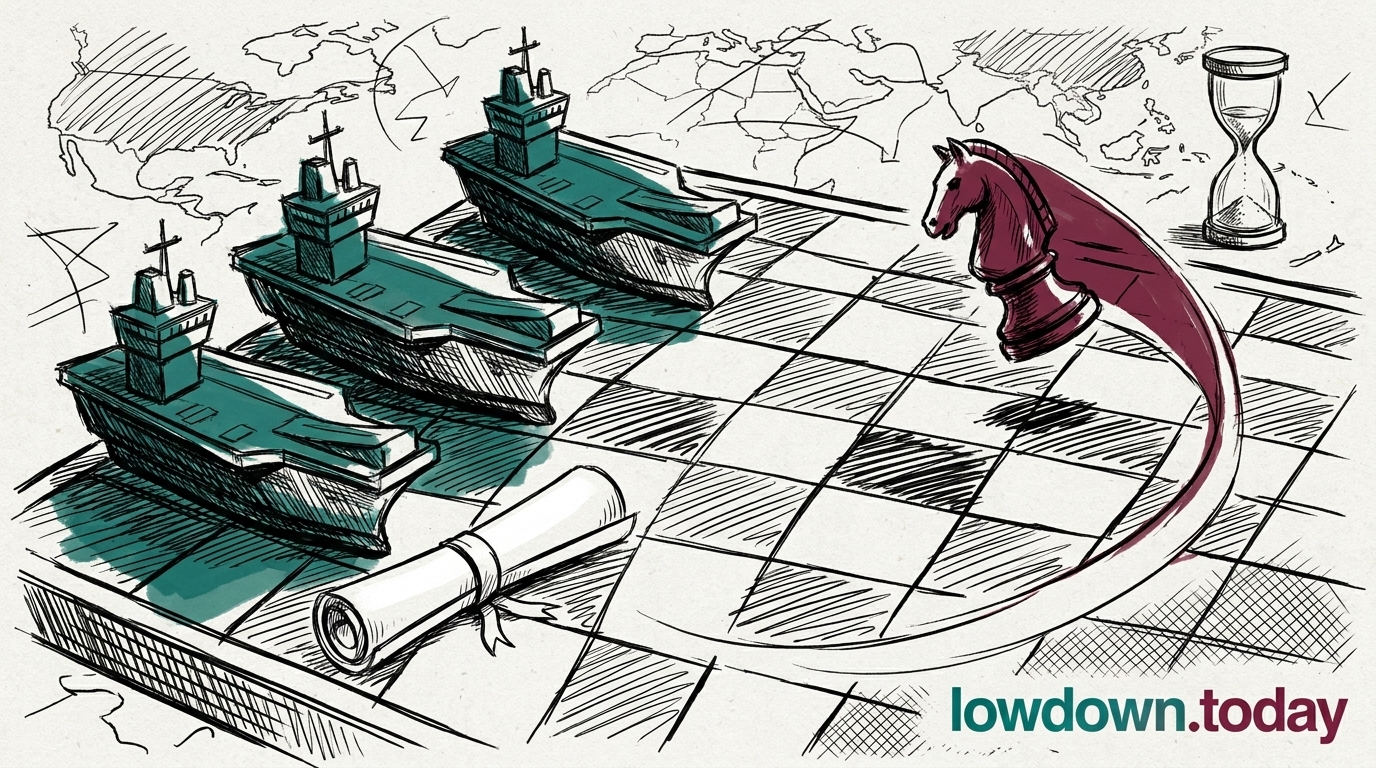
Israel's military spokesman said, on camera, that it intends to hunt down and kill Iran's Supreme Leader by name. This is not how states usually conduct such operations — even when they pursue them. The public declaration serves a different purpose from the operation itself: it is meant to create psychological pressure, force Khamenei's circle to choose between appearing in public (confirming his location) and staying hidden (undermining his authority). It also signals to Iran's population and to Iranian commanders that proximity to The Supreme Leader may be fatal.

Deep Analysis
Synthesis

The public threat functions simultaneously as a psychological operation and a legal-operational construction. Read alongside the advance authorisation granted to the IDF and Mossad (Event 1), the public designation creates a documented record of intent that Israeli law and IDF targeting doctrine require before certain covert operations — the announcement may be procedurally necessary, not merely rhetorical.

Escalation

The public naming closes diplomatic space: any Iranian move toward talks can now be framed domestically as negotiating under an assassination threat, strengthening IRGC hardliners who oppose Araghchi's conditional end-state framing (Event 7). The body records the declaration but not this constraint on Iran's internal politics.

What could happen next?
  • Precedent

    First documented instance of a state military publicly designating a sitting foreign head of state as a named assassination target in an active interstate conflict.

    Immediate · Assessed
  • Risk

    Public commitment makes a failed attempt a significant credibility defeat; if Israel cannot execute, the signal inverts — demonstrating limits rather than reach.

    Medium term · Assessed
  • Consequence

    Iranian domestic opinion may consolidate around Khamenei's person, increasing public support for retaliation and narrowing Pezeshkian's government's room to pursue Araghchi's conditional end-state.

    Short term · Suggested
  • Risk

    The declaration locks Khamenei into continued absence — re-emergence confirms his location — further degrading Iranian command authority at the strategic level.

    Short term · Assessed
First Reported In

Update #40 · Larijani dead; Israel hunts the new leader

Times of Israel· 18 Mar 2026
Read original →
Causes and effects
This Event
IDF names Mojtaba Khamenei as target
First public Israeli military declaration naming a sitting head of state as an assassination target. Combined with the removal of cabinet-level approval for targeted killings, this transforms Israel's decapitation campaign from covert operations to declared policy and forces Iran to choose between hiding its leader and producing him.
Different Perspectives
International Energy Agency
G7 members agreed on 2 October to release up to 100 million barrels through the IEA over four months, front-loading diesel.
China
China
China signed the 15 October text reaffirming the Resolution 2216 arms embargo on the Houthis. The Wall Street Journal reported that Conflict Armament Research found Chinese parts in a Houthi copy of Iran's Kheibarshekan missile.
Russia
Russia
Russia joined the 15 October consensus condemning the Houthis, a month after vetoing a mandate for a UN panel of experts on Iran sanctions on 17 September. One Western official told Bloomberg that Moscow is providing Iran with missiles, and the White House rejected the assessment.
India
India
National Security Adviser Ajit Doval raised seafarer safety with Mohsen Rezaei on 12 October, after a drone hit the Petro Dolphin with 11 Indians aboard at Sohar. External Affairs Minister S. Jaishankar urged that attacks on commercial shipping and seafarers be avoided.
Lebanon
Lebanon
President Joseph Aoun met UN peacekeeping chief Jean-Pierre Lacroix in Beirut on 14 October as UNIFIL winds down before its mandate ends on 31 December. Two days later Qatar's prime minister pledged in Beirut to fund a solar plant for Lebanon.
Kataib Hezbollah
Kataib Hezbollah
The militia announced a halt to operations except against "hostile aircraft" and denied any disarmament deal with Prime Minister Ali al-Zaidi. A day later Quds Force chief Esmail Qaani urged eliminating "remaining traces of the US presence in other arenas".

Written with AI from Lowdown's published reporting. Not individually reviewed by an editor. Editorial standards.