Skip to content
Briefings are running a touch slower this week while we rebuild the foundations.See roadmap
Iran Conflict 2026
23APR

Oil surges past $103 on blockade

3 min read
08:02UTC

Brent crude jumped 8% past $103 on Monday, reversing the post-ceasefire drop and making Goldman Sachs's $120 Q3 severe scenario the operative frame.

ConflictDeveloping
Key takeaway

Goldman Sachs's $120 severe scenario is now the operative frame, not the tail risk.

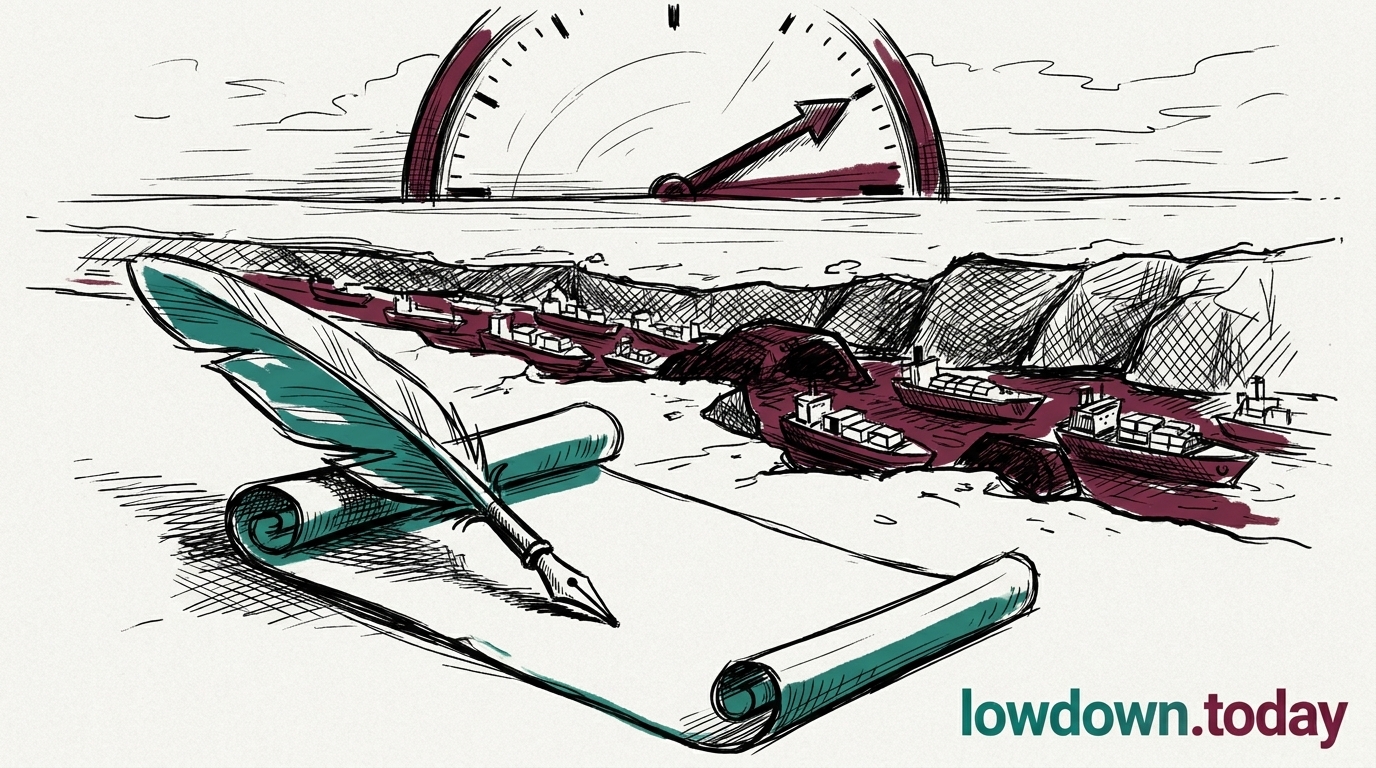
Brent Crude surged 8% above $103 on the blockade announcement, reversing the post-ceasefire drop that had taken prices to $92.21 . Goldman Sachs had cut its Q2 Brent forecast to $90 after the ceasefire was announced. The blockade made that forecast obsolete within a day. Goldman's severe scenario, $120 by Q3, is now the operative frame rather than the tail risk .

Approximately a dozen Iranian supertankers carrying an estimated $2.4 billion of crude sit stationary in The Gulf of Oman, caught between CENTCOM's blockade from one side and Iran's own mine and vetting regime from the other . The $2.4 billion figure derives from operational analysis rather than wire-service confirmation. 325 tankers remain stranded in The Gulf. Hormuz traffic, which had climbed to 17 transits by Saturday, dropped to near zero when enforcement started 1. 20,000 sailors aboard roughly 2,000 vessels are stranded.

Saudi Arabia has insulated itself: its Petroline pipeline, restored to full capacity, now routes all exports via the Red Sea, bypassing Hormuz. That protects Riyadh's revenue but does nothing for the 21 million bpd that normally transits the strait .

Deep Analysis

In plain English

Oil prices shot up sharply on Monday when the blockade was announced. Brent crude , the international benchmark for oil pricing , jumped 8% above $103 per barrel. For context, it had fallen to $92 after the ceasefire last week. Why does this matter to you? Oil prices feed into fuel prices at petrol stations, heating costs, and the cost of transporting goods. When oil goes up, almost everything gets slightly more expensive with a delay of a few weeks. Goldman Sachs, one of the world's largest banks, had previously predicted oil could reach $120 in the worst case. Before Monday, that seemed unlikely. Now analysts say it is possible without anything further going wrong.

What could happen next?
  • Consequence

    April CPI will layer blockade-driven fuel costs on top of March's 0.9% monthly rise , the largest since 1967 , creating a two-month compounding effect that central banks cannot offset without rate rises that would further damage consumer confidence.

    Short term · 0.85
  • Risk

    If Goldman's $120 scenario materialises, US Federal Reserve rate policy is constrained: cutting rates to support the economy while inflation is energy-driven would be politically untenable, forcing a stagflationary choice between growth and price stability.

    Medium term · 0.72
  • Opportunity

    Saudi Arabia, now exporting via Petroline and insulated from Hormuz disruption, benefits from elevated prices without the supply constraint , strengthening Riyadh's fiscal position and reducing its incentive to mediate a Hormuz resolution.

    Short term · 0.8
First Reported In

Update #67 · Trump blockades Iran on a tweet

CENTCOM / Al Jazeera· 13 Apr 2026
Read original
Different Perspectives
International human rights monitors (NetBlocks, IHR, Hengaw)
NetBlocks recorded 1,704 cumulative hours of near-total internet blackout for roughly 90 million Iranians on Day 74, while IHR documented ongoing executions under emergency provisions. These organisations are the only active monitoring windows into a civilian population cut off from the global internet for 71 consecutive days.
UK / France coalition
The Royal Navy confirmed HMS Dragon's Hormuz deployment on its own website on 11 May, converting a press-reported presence into declared force posture; UK and French defence ministers hosted a coalition meeting the same day. Britain and France are now the only named contributors to a Hormuz escort mission all five allies Trump originally asked had declined.
Saudi Aramco / Gulf producers
Saudi Aramco CEO Amin Nasser warned on 11 May that a Hormuz closure could remove 100 million barrels of weekly supply from global markets (roughly 15 million barrels per day for a week), a figure that dwarfs any OPEC+ swing capacity. The warning functions as both a price-floor signal and a public pressure on Washington to protect transit.
Beijing / Chinese Government
China has not publicly acknowledged the four Hong Kong-registered entities designated on 11 May or extended MOFCOM's Blocking Rules cover to HK-domiciled firms. Xi Jinping hosts Trump on 14–15 May having already de-risked state-bank balance sheets via NFRA's quiet loan halt, entering the summit partially compliant before any negotiation.
Tehran / Iranian Government
Foreign Minister Araghchi described Iran's 10-point counter-proposal as 'reasonable and responsible' via spokesman Baqaei on 11 May, and widened the mediator pool by meeting Turkish, Egyptian, and Dutch counterparts in a single day. Tehran is buying procedural runway while Trump's verbal rejection went unmatched by any written US counter.
Trump White House
Trump White House
Trump called the ceasefire 'on massive life support' and dismissed Iran's 10-point counter-proposal as 'a piece of garbage' on 11 May, while departing for Beijing two days later with no signed Iran instrument to show Congress. The verbal maximum and the paper void coexist: the administration is running a legal pressure campaign through Treasury while the president free-lances the rhetoric.