Skip to content
Briefings are running a touch slower this week while we rebuild the foundations.See roadmap
Iran Conflict 2026
22APR

Twenty-seven days since Trump signed on Iran

3 min read
10:22UTC

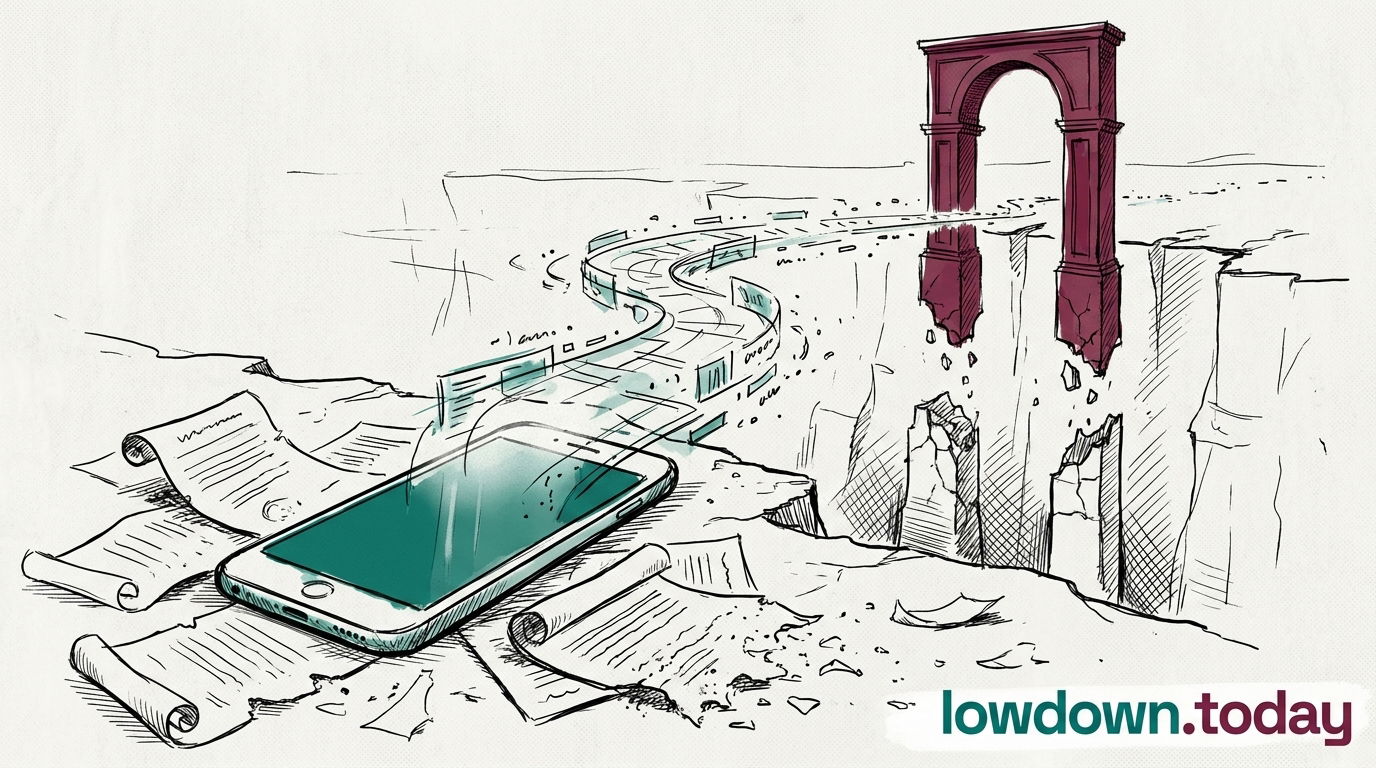
Twenty-seven days have passed since Donald Trump signed any Iran-related instrument. The blockade, the ceasefire and five Hormuz ultimatums all exist on Truth Social posts alone.

ConflictAssessed
Key takeaway

Blockade, ceasefire and toll list all rest on Truth Social posts; no signed presidential directive backs any of them.

Twenty-seven days have passed since Donald Trump put his name to any Iran-related presidential action. A 14 April audit of the White House presidential-actions page confirmed the two signed Iran instruments across 45 days of war remain those of 18 March : a Jones Act waiver for foreign-flagged tankers between US ports, and an authorisation for Venezuela's PDVSA (Petroleos de Venezuela) to resume sales to American refiners 1. Both were oil-price containment measures. Neither was a war-powers instrument. Every escalation since, the blockade order , the toll-interdiction list runs against it in the Senate, the 8 April ceasefire declaration and all five Hormuz ultimatums, exists only as Truth Social posts.

That absence is not a paperwork quibble. A US Navy captain boarding a foreign-flagged vessel on Saturday morning is acting on a social-media post, not a signed directive. Any flag state filing a maritime-law complaint, any master contesting the boarding, any officer later pulled into an accountability review has no presidential instrument to point to as legal cover. Agency counsels at Treasury, State and Defense have no authoritative text to implement, which is how you get Treasury's 25-day silence on GL-U , the CENTCOM operational order narrowing the blockade away from what Trump posted, and the Senate war-powers clock running against an action the White House has never formally filed .

Under the National Security Act and settled case law, a presidential social-media post is not a lawful directive to federal agencies. CENTCOM is operating under its existing statutory authority as an armed-forces command, not under a specific Iran war authority, which means the operational order it issued is self-generated in any legally reviewable sense. Congressional challenge via the War Powers Resolution is procedurally harder when no presidential report starts the statutory clock; Senate Democrats are adapting by forcing a vote anyway. The clock is still running, but it is running against a policy whose authoritative text is a screenshot.

Allies seeking legal assurance of US commitment have the same problem. France and Japan are formally protesting vessels on Trump's toll list that CENTCOM's order omits; neither government has a signed American instrument to negotiate against. Every subsequent ratchet, from Schumer's WPR push to European procurement decisions, is being made against a policy that exists only as posts.

Deep Analysis

In plain English

The United States government has been running a naval blockade of one of the world's most important shipping lanes for more than two weeks. But the president has not signed a single piece of paper authorising it. The blockade exists only as posts on the president's social media account. This matters more than it might sound. When the president signs a formal order, it becomes the law that government agencies, military commanders, courts, and allies must follow. Without a signed order, every part of the US government interprets the policy in its own way. That is why the Navy's actual blockade is narrower than what the president posted, and why the Treasury has been silent for 25 days about what happens to the 325 tanker-loads of Iranian oil covered by a permit that expires this weekend. It also means that other countries have no formal American document to complain about or negotiate against. France and Japan are protesting against a social media post. The US Congress is trying to vote on a war that has no written presidential authorisation. Normal rules do not quite apply.

Deep Analysis
Root Causes

The zero-instrument pattern reflects a specific feature of Trump's governing style: a preference for retaining policy flexibility by avoiding the legal constraints that executive instruments create. A signed order can be challenged in federal court, requires agency implementation rulemaking, and creates a text that Congress can quote back. A Truth Social post creates none of those constraints and all of the political credit.

The second structural cause is institutional fragmentation. Agency counsels at Treasury, State, and Defense have no authoritative text to implement, which means each department interprets the blockade's scope independently.

This is not accidental: the absence of a text permits the administration to endorse CENTCOM's narrowed operational order, deny the toll-interdiction provision that France and Japan are protesting, and claim the ceasefire simultaneously, because no single document contradicts any of those positions.

The War Powers Resolution's procedural architecture was not designed for this scenario. The 60-day clock is normally triggered by the president's congressional notification. With no notification filed, Senate Democrats have had to force a standalone vote to create any congressional record at all.

What could happen next?
  • Risk

    Agency counsels at Treasury, State, and Defense implementing the blockade without a signed presidential text are individually exposed to accountability if the operation produces casualties or illegal boardings.

    Short term · 0.75
  • Precedent

    A successful blockade run entirely on social-media posts would set a precedent that executive war-making requires no formal instrument, materially weakening the War Powers Resolution for all future administrations.

    Long term · 0.8
  • Consequence

    Allies seeking legal assurance of US commitment to the operation have no document to cite; coalition cohesion depends entirely on political trust in a White House that has not produced a signed instrument in 45 days.

    Immediate · 0.9
First Reported In

Update #68 · Sanctioned tankers slip the blockade

The White House· 14 Apr 2026
Read original
Causes and effects
This Event
Twenty-seven days since Trump signed on Iran
A naval blockade of one of the world's busiest shipping lanes is being run without a single signed presidential directive behind it.
Led to
Hormuz opens then closes in 24 hours
The Truth Social blockade post, the only US instrument behind the naval operation, provided the 'breach of trust' Iran cited when reimposing Hormuz restrictions within 24 hours.
Occurred 17 Apr 2026
Read story →
GL-U lapses on a cable-TV quote
The zero-instrument blockade resting on a Truth Social post provided context for Bessent confirming GL-U lapse on cable TV rather than via a Federal Register instrument.
Occurred 16 Apr 2026
Read story →
48 days of war, zero Iran executive instruments
The 17 April White House fetch confirming zero Iran instruments at day 48 escalates the day-45 finding of zero instruments, establishing an unbroken 48-day record.
Occurred 17 Apr 2026
Read story →
Day 50 of Iran war, zero signed instruments
ID:2367 established the 45-day no-instrument baseline; the 50-day milestone with GL-U lapse is a further escalation of the same documented pattern.
Occurred 19 Apr 2026
Read story →
Cooper claims halt; Kpler counts 8
Cooper's 'completely halted' claim sits inside the same instrument-free record the White House audit confirmed on 14 April, extending the gap from presidential to commander level.
Occurred 15 Apr 2026
Read story →
Bessent threat fails; Brent ignores Treasury
The confirmed absence of any Iran executive instrument across 45 days (ID:2367) was the instrument-gap context Bessent's announcement amplified without closing.
Occurred 15 Apr 2026
Read story →
Fetterman breaks Democratic line on Iran
The confirmed zero executive instruments (ID:2367) gave sponsors their procedural case that no presidential text exists for the WPR to replace.
Occurred 15 Apr 2026
Read story →
Different Perspectives
Israel
Israel
The IDF struck a Lebanese army unit on 6 June, killing a colonel, and privately told Moscow that shelling near Bushehr was accidental, per Putin's SPIEF disclosure. Israel is advancing in Lebanon past an unenforced ceasefire text while maintaining a back-channel to Russia on nuclear-site deconfliction.
Lebanon
Lebanon
President Aoun told CNN on 5 June that Iran uses Lebanon as a bargaining chip and urged Hezbollah toward diplomacy; on 6 June an IDF strike killed a Lebanese army colonel on the Khardali-Nabatieh road. The Lebanese state is publicly rejecting Iranian tutelage while the army sustains casualties from Israeli fire and the Washington framework remains unenforced.
Bahrain
Bahrain
Bahrain's US Fifth Fleet headquarters was among the targets in the 5-6 June two-country salvo; its PAC-3 magazine stands at 87 per cent depletion with an 18-month resupply gap and no comparable arms sale has been announced. The state is defending a critical US regional command on a thinning interceptor stock.
Kuwait
Kuwait
Kuwait received a $1.98bn US counter-drone sale approval on the same day IRGC missiles targeted its bases; it expelled two Iranian diplomats on 4 June and filed a formal protest. The arms approval gives Kuwait a future capability but leaves a 6-18 month delivery gap that the salvo tempo is already pressing.
Russia
Russia
Putin reaffirmed Russia's offer to hold Iran's 440.9 kg HEU at SPIEF on 6 June, said Russia is not arming Iran, and disclosed that both the US and Israel privately told Moscow that shelling near Bushehr was accidental. The restatement casts Moscow as the only remaining mediator both sides call, a position serving Russian interests whatever the nuclear file produces.
Iran
Iran
The IRGC, per Iranian state media, fired seven ballistic missiles at US bases in Kuwait and Bahrain, the largest two-country salvo of the war, and framed the launches as lawful retaliation; Foreign Minister Araghchi rejected Aoun's bargaining-chip accusation and Velayati warned Beirut against diplomatic naivety. Tehran has sent no HEU counter-proposal since Araghchi confirmed no progress on 4 June.