Skip to content
Briefings are running a touch slower this week while we rebuild the foundations.See roadmap
Iran Conflict 2026
21APR

Trump orders blockade on a tweet

3 min read
10:51UTC

The US president announced a naval blockade of Iranian ports via Truth Social with no executive order, proclamation, or legal instrument of any kind.

ConflictDeveloping
Key takeaway

A naval blockade announced by social media post has no presidential instrument behind it.

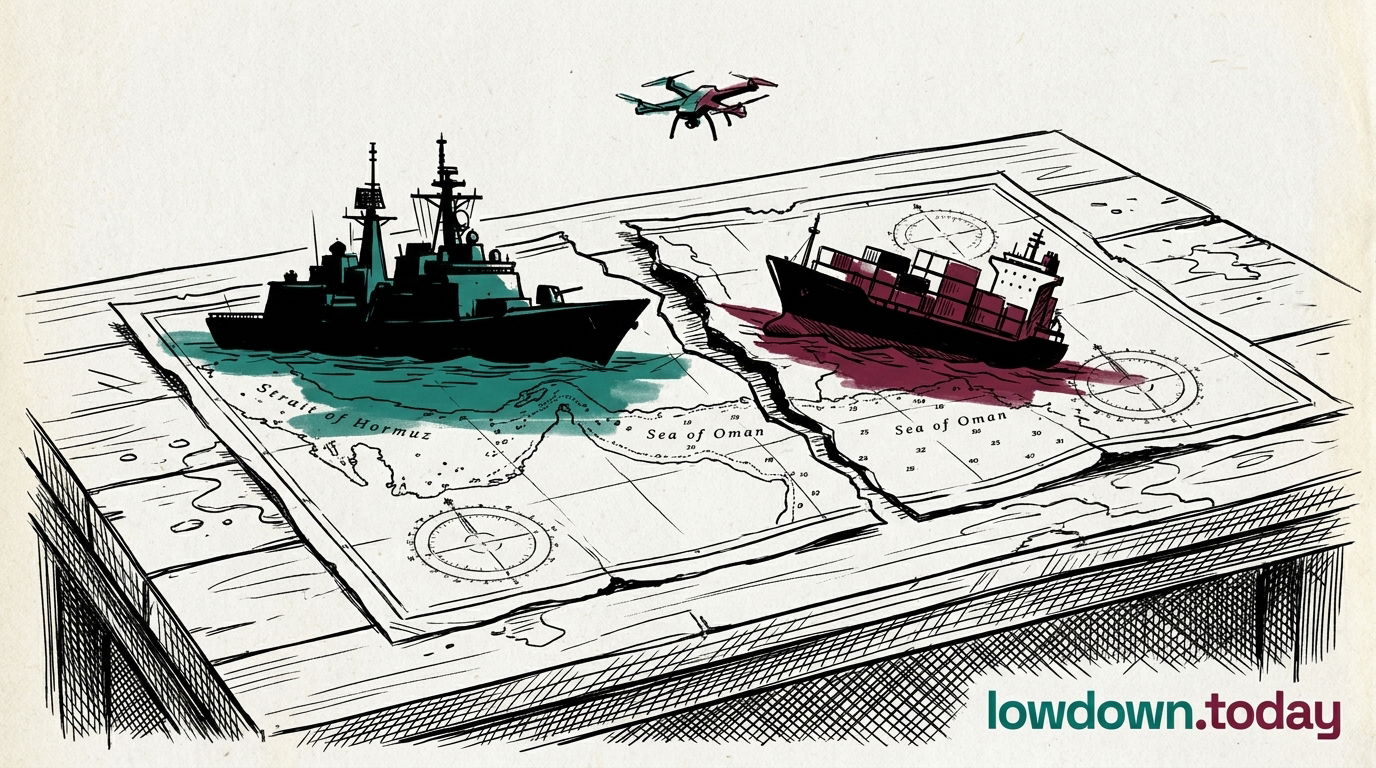
Donald Trump posted on Truth Social on Saturday ordering the US Navy to "begin the process of BLOCKADING any and all Ships trying to enter, or leave, the Strait of Hormuz." He told reporters separately that the ceasefire was "holding well" and that Iran's "whole navy is under water." The two statements, issued hours apart, describe different wars.

After 45 days of conflict, the White House presidential-actions page shows zero Iran-related executive instruments . The pattern has repeated across five Hormuz ultimatums, the ceasefire declaration, and now the blockade . Each action was announced by social media rather than signed instrument. The legal gap is not accidental; it avoids congressional oversight triggers, allied consultation requirements, and judicial review.

Under international law, a blockade of a sovereign state's ports without formal legal authority exposes every interdicted vessel to UNCLOS (United Nations Convention on the Law of the Sea) arbitration. Flag states whose ships are stopped have grounds to file immediately. The legal void extends to every approaching deadline. GL-U (General License U) lapses 19 April , the ceasefire window closes around 22 April, and the WPR (War Powers Resolution) clock approaches its statutory limit near the end of the month. No signed presidential instrument backs any of them.

Deep Analysis

In plain English

On Sunday evening, President Trump posted on Truth Social , his social media platform , that the US Navy would blockade Iranian ports. A blockade means naval ships physically stop other vessels from reaching their destination. Here is the unusual part: normally when a US president orders a naval blockade, they sign a formal legal document called a proclamation or executive order. This creates a paper trail, informs Congress, and tells allied governments what the legal basis is. Trump did not do that. The blockade exists only as a social media post. When the US military (called CENTCOM) went to enforce it, they quietly narrowed the scope , because blockading an entire international waterway used by every nation's ships would have been diplomatically catastrophic. None of this narrowing was published either. The result: one of the most consequential naval actions in decades is operating without any written legal basis that courts, Congress, or allied governments can examine.

Deep Analysis
Root Causes

The zero-instrument pattern across 45 days of war reflects three structural conditions simultaneously.

First, congressional authorisation for military force was never sought. A formal AUMF or presidential proclamation triggers the 48-hour notification clock under the War Powers Resolution and opens the blockade to congressional challenge. The tweet format avoids that trigger while preserving presidential deniability if CENTCOM narrowed the order.

Second, IEEPA , the primary peacetime legal mechanism for economic warfare , requires a formal declaration of national emergency specific to Iran. The administration has been operating on a pre-existing Iran national emergency renewed in March 2026, but has not issued new Iran-specific emergency declarations. This constrains OFAC's ability to issue fresh sanctions and leaves the blockade without a civilian economic enforcement architecture.

Third, allied consultation requirements built into NATO Article 4 and bilateral Status of Forces Agreements are bypassed when no instrument is published. The UK, Germany, Australia, France, and Japan were all informed after the fact, which is why the UK coalition assembled as a counter-response rather than a parallel one.

What could happen next?
  • Risk

    Any country whose flag vessel is stopped under the tweet order has grounds to file UNCLOS arbitration immediately, since no sovereign legal instrument exists to contest , creating a cascade of international legal challenges.

    Short term · 0.82
  • Consequence

    The absence of a congressional notification means the 48-hour WPR clock may not have started, potentially extending the president's unilateral authority window , but also meaning no legal mechanism exists to wind the blockade down without a new tweet.

    Immediate · 0.75
  • Precedent

    If the blockade sustains without legal challenge succeeding, it normalises social-media executive action for future naval operations, eliminating the procedural safeguards that allied consultation and congressional notification were designed to provide.

    Long term · 0.7
First Reported In

Update #67 · Trump blockades Iran on a tweet

CENTCOM / Al Jazeera· 13 Apr 2026
Read original
Different Perspectives
Israel
Israel
IDF Chief Eyal Zamir declared on 3 June there was no ceasefire for his forces, and strikes killed at least 10 civilians and one Israeli soldier on 4 June. The IDF killed Hezbollah's chief engineer and warned three south Lebanon villages to evacuate on 5 June, advancing into ground the unsigned Washington framework has not caught.
Hezbollah / Lebanon
Hezbollah / Lebanon
Naim Qassem rejected the Washington Lebanon framework on 4 June as "absurd, humiliating and insulting", blocking a ceasefire instrument that required Hezbollah to withdraw north of the Litani before any Israeli withdrawal. Over one million Lebanese remain displaced; the framework's collapse prolongs that toll.
Iran
Iran
Foreign Minister Araghchi publicly coupled the Lebanon ceasefire to the Iran-US nuclear track on 4 June, carrying IRGC authority rather than his own civilian mandate. The IRGC delegation has sent no HEU counter-proposal since Araghchi confirmed no progress that same day; Mojtaba Khamenei's 21 May order to keep the 440.9 kg stockpile inside Iran remains operative.
United States
United States
Rubio placed the Iran-US deal at 95 per cent complete on 4 June while the administration signed no Iran instrument and OFAC designated only Cuban targets. Trump separately disclosed and rejected an airlift plan to collect Iran's HEU stockpile, claiming the material is "entombed", a claim the IAEA cannot verify.
China
China
Beijing's MOFCOM Blocking Rules constrain OFAC enforcement on the mainland; China has not corroborated Trump's verbal account of any bilateral summit, and the rial's failure to hold its Rubio bounce, combined with the IRGC's stablecoin rail closure, increases Chinese yuan-denominated oil-payment exposure through Hormuz.
Bahrain
Bahrain
The IRGC struck Bahrain on 3 June as its sirens sounded and its PAC-3 magazine neared exhaustion; excluded from Rubio's 2 May emergency resupply, Bahrain received a 50-round Federal Register notice on 1 June on an 18-month delivery timeline, meaning it is defending the US Fifth Fleet headquarters on the last rounds it has.