Skip to content
You can now search across every topic, entity and event.What's new
Iran Conflict 2026
18APR

Two BAPCO units shut after strike

3 min read
14:57UTC

Commercial monitors report two crude processing units offline at BAPCO Sitra after Thursday's Iranian missile strike. Bahrain insists operations continue normally — a claim the data does not support.

ConflictDeveloping
Key takeaway

The divergence between IIR's commercial monitoring and Bahrain's official statement is itself a market-moving event — the informational uncertainty gap carries an operational cost to logistics and insurance decisions independent of the refinery's actual physical status.

Two crude processing units at Bahrain's BAPCO Sitra refinery have been shut for safety inspection, according to industry monitor Industrial Info Resources. The shutdown follows Thursday's Iranian ballistic missile strike on the facility — the first confirmed Iranian attack on Bahraini energy infrastructure. BAPCO Sitra processes 267,000 to 380,000 barrels per day; the capacity lost depends on which units are offline, a detail neither IIR nor Bahrain has disclosed.

Bahrain's government maintains that "operations continue normally." The gap between official statements and commercial monitoring follows a pattern familiar from prior Gulf incidents — the September 2019 drone and cruise missile strikes on Saudi Aramco's Abqaiq-Khurais facilities saw Saudi officials initially minimise damage that satellite imagery later showed had knocked out 5.7 million barrels per day of processing capacity. In this case, the discrepancy matters less for Bahrain's relatively small output than for what it signals about the reliability of government damage assessments across The Gulf during active hostilities.

The BAPCO strike sits within a deliberate Iranian targeting pattern. Bahrain normalised relations with Israel in 2020 under the Abraham Accords and hosts the US Fifth Fleet headquarters — which itself sustained confirmed structural damage this week, including the destruction of two encrypted satellite communications terminals and a radar unit . Hotels, residential buildings, and now the Israeli embassy compound have also been hit. Tehran is systematically demonstrating that Bahrain's two strategic relationships — with Israel and with the United States — carry a measurable physical cost.

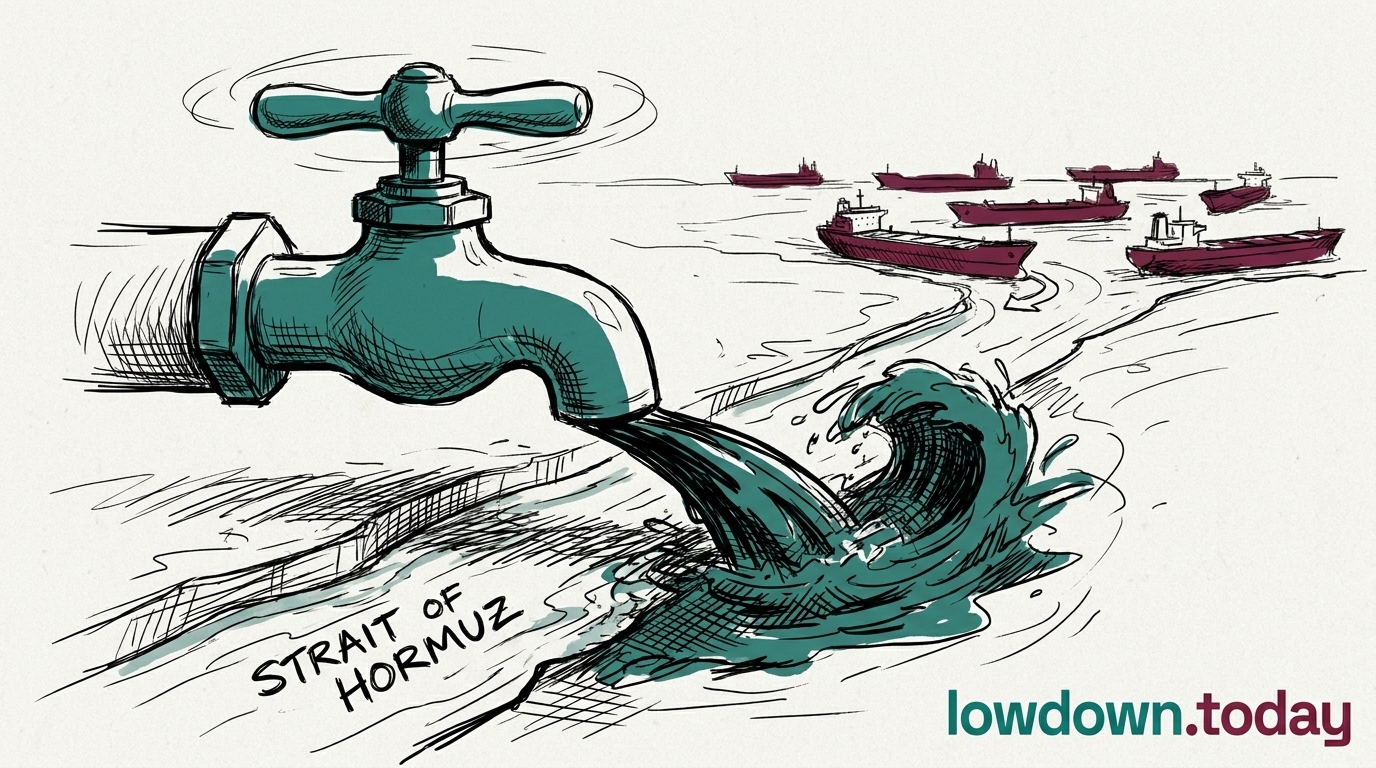
The refinery damage compounds an energy market under acute strain. Iraq has cut output by 1.5 million barrels per day due to export route disruption . Every major P&I club's war risk cover for Hormuz transits expired Thursday at midnight , and no new commercial transit has been documented since. Brent Crude traded above $85 per barrel on Day 7. Each facility taken offline, each insurance policy unrenewed, each day the strait remains effectively closed pushes the market closer to $100–120 per barrel — the range projected if Hormuz remains shut beyond three weeks. Shipping consultancy Simpson Spence Young assessed Navy convoy escorts as "unlikely in the near-term" given simultaneous combat demands on US naval assets; the insurance blockade, once activated, operates on its own timeline regardless of military developments.


Deep Analysis

In plain English

Bahrain's main oil refinery was struck near by an Iranian missile yesterday. A commercial monitoring service that tracks industrial facilities is reporting that two processing units have been shut down for safety checks. The Bahraini government says everything is running normally. That gap matters: energy companies and airlines depend on accurate data to plan fuel purchases and logistics, and when governments downplay damage to critical infrastructure, it can cause more market disruption than the damage itself. Think of it like a hospital claiming 'all systems normal' while a monitoring company reports the emergency generator is offline — the discrepancy forces everyone relying on that hospital to plan for the worst.

Deep Analysis
Synthesis

BAPCO Sitra's primary feedstock is Saudi crude delivered via the Saudi–Bahrain pipeline — any extended outage simultaneously affects Saudi Aramco's downstream throughput and Bahrain's fiscal position, since Bahrain's budget is substantially underpinned by Saudi energy transfers. The 'operations continue normally' statement may therefore carry financial-stability signalling aimed at Riyadh and bond markets as much as factual reassurance to the domestic audience.

Root Causes

Bahrain has strong political incentives to minimise public acknowledgement of Iranian strike effectiveness: the government's stability narrative and investor confidence depend on projecting resilience, and admitting significant infrastructure damage could signal to Tehran that strikes are achieving intended effects, potentially encouraging further targeting. The official-versus-commercial divergence is therefore a predictable response to political incentives rather than operational deception.

What could happen next?
  • Meaning

    The official-versus-commercial information gap forces energy traders and logistics operators to make time-sensitive decisions under structural uncertainty, creating a market-inefficiency cost that operates independently of the refinery's physical damage status.

    Immediate · Assessed
  • Consequence

    Vessels scheduled to load refined products at Sitra face potential cargo rescheduling costs and demurrage exposure while the units' operational status remains unresolved.

    Short term · Assessed
  • Risk

    If the discrepancy is eventually resolved in favour of the commercial-monitor account, Bahrain's credibility with bond markets and GCC partners on infrastructure resilience will be damaged.

    Short term · Suggested
  • Precedent

    Repeated government downplaying of Iranian strike damage to Bahraini infrastructure may cause commercial operators to systematically discount official statements, increasing market volatility on each new strike report regardless of actual severity.

    Medium term · Suggested
First Reported In

Update #24 · Trump demands unconditional surrender

OilPrice.com· 6 Mar 2026
Read original
Causes and effects
This Event
Two BAPCO units shut after strike
The BAPCO damage removes an undisclosed portion of Bahrain's 267,000-380,000 barrel-per-day refining capacity from a market already losing supply to Iraq's 1.5 million bpd export cut and the Hormuz insurance blockade, while demonstrating Iran's ability to impose physical costs on Abraham Accords states.
Different Perspectives
Hengaw and Iranian protest detainees
Hengaw documented three secret executions of protest-linked detainees at Isfahan and Karaj on 15 and 16 July, including Mohammad Amini Dehaghani, hanged over a January arson charge with no public trial record. Tehran is carrying out capital punishment against 2026 protesters while global attention stays fixed on the war with the US.
Russia
Russia
OFAC named Moscow aviation firm Avratek OOO and its principals Mariya Selina and Vadim Druzhbin directly for the first time in this war's Iran arms track, under an Executive Order 13382 designation issued 15 July. The designation converts years of rhetorical claims about Russian arms supply to Iran into named, sanctionable individuals and a documented company.
Bahrain
Bahrain
Bahrain sounded air-raid sirens during Iran's 14 July Gulf-wide barrage and was struck again in the 16 July Artesh claim against Sheikh Isa air base, home to the US Fifth Fleet. Manama's air-defence stocks were already reported near-exhausted before this second strike claim against the same base in a week.
Kuwait
Kuwait
Kuwait's armed forces intercepted the drones Iran's Army claimed against Ali Al Salem air base on 16 July and separately reported intercepting missiles and drones in Iran's Gulf-wide barrage on 14 July. Kuwait now absorbs strikes from two rival Iranian commands while hosting Camp Arifjan, the US logistics base Iran also claims to have destroyed.
Iran (Artesh and IRGC)
Iran's regular Army claimed the 16 July drone strikes on Kuwait's Ali Al Salem and Bahrain's Sheikh Isa air bases under its own banner, Operation Saeqeh phase ten, while the IRGC separately claimed a mine strike closing Hormuz on 18 July. Two Iranian institutions are now claiming parallel operations, with neither claim confirmed by Kuwait, Bahrain or CENTCOM.
United States
United States
CENTCOM bombed the interior cities of Ahvaz and Yazd for the first time overnight into 17 July, Marines began boarding vessels including the tanker Wen Yao, and Treasury let General License X1 lapse at 12:01am the same day. Washington closed every remaining channel for de-escalation without a new executive action, a posture of attrition rather than a wind-down.



