Skip to content
You can now search across every topic, entity and event.What's new
Iran Conflict 2026
18APR

Three officials, three lines on Hormuz

4 min read
14:57UTC

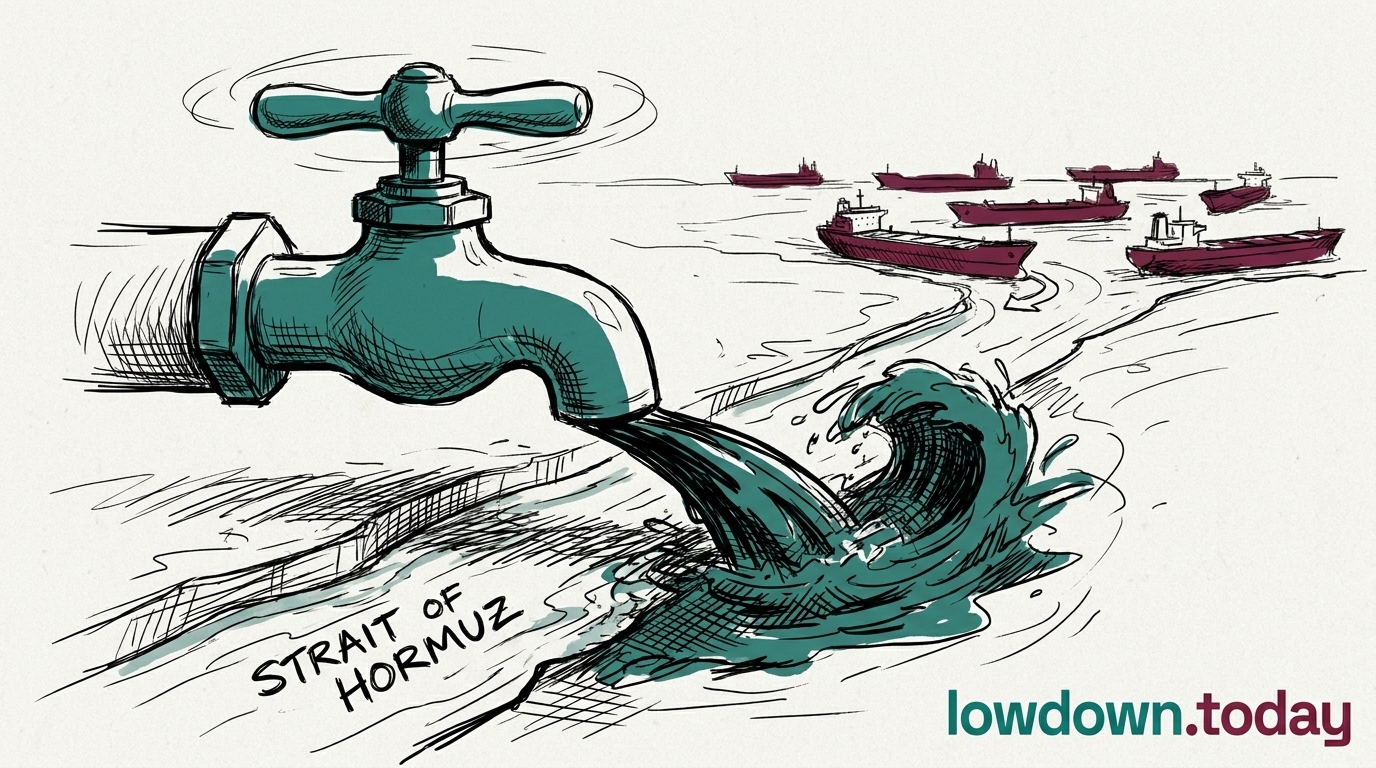
Two cabinet members gave opposite assessments of the Navy's readiness to reopen the Strait of Hormuz — the chokepoint for 20% of global oil — within a single day.

ConflictDeveloping
Key takeaway

Two cabinet secretaries gave opposite answers on Hormuz in 24 hours, revealing an unresolved strategic objective at the core of the war.

Defence Secretary Pete Hegseth told reporters on Friday: 'Don't need to worry about' the strait of Hormuz. Twenty-four hours earlier, Energy Secretary Chris Wright told CNBC the Navy is 'simply not ready' to escort tankers through the strait, with all military assets focused on destroying Iran's offensive capabilities. Treasury Secretary Scott Bessent offered a third position on Thursday, telling Sky News that escorts would happen 'as soon as militarily possible' and that Washington was forming an 'international coalition' for the mission .

Both Hegseth's assurance and Wright's admission cannot be true. Either the strait is secure enough not to worry about — in which case Wright's assessment is wrong — or the Navy lacks escort capacity, in which case Hegseth's claim is empty. This is the second time in a week that The Administration's Hormuz messaging has moved markets on false premises. Wright's now-deleted 10 March claim that the Navy had already escorted a tanker through the strait briefly drove oil prices down approximately 12% intraday before being retracted .

The IRGC declared on Wednesday that 'not a litre of oil' would pass through the strait — the most absolute blockade language of the conflict. The International Maritime Organisation's tally shows tanker traffic through Hormuz down 90% from pre-war levels, with 20,000 seafarers stranded in the Persian Gulf . Meanwhile, 11.7 million barrels of Iranian crude have transited freely to China since 28 February, carried by shadow fleet vessels that systematically broadcast Chinese ownership credentials . The blockade has a beneficiary, and it is not the United States.

The Hormuz question is not abstract. the strait carried roughly one-fifth of global seaborne oil before the war. Three cabinet officials have now offered three incompatible assessments of when and whether the US can reopen it. For energy markets already pricing Brent above $99 and on track for an 8% weekly gain, the signal is that Washington itself does not have a unified answer — and until it does, the closed-strait premium holds.

Deep Analysis

In plain English

The Strait of Hormuz is a narrow waterway between Iran and Oman through which roughly one-fifth of the world's oil normally passes. It is currently closed to commercial shipping because of the war. On Thursday, the Energy Secretary said the US Navy is simply not ready to safely escort tankers through the strait. On Friday, the Defence Secretary said do not worry about it — implying the Navy has the situation in hand. Both men work for the same president and were speaking to the same critical question in 24 hours. They gave directly opposite answers. This matters beyond embarrassment. Oil markets, Gulf state governments, and allied navies are all making decisions based on US assurances. When the two most relevant cabinet officials contradict each other on a question of this magnitude, it signals the administration has not internally resolved whether reopening Hormuz is a war objective, a post-war problem, or a responsibility being deflected.

Deep Analysis
Synthesis

The Hegseth/Wright contradiction is more than a messaging failure. It reveals the administration has not internally resolved whether the war's objective is to permanently eliminate Iran's ability to threaten Hormuz — requiring direct military action inside the strait — or to conduct a degradation campaign that leaves the strait question to post-war diplomacy. These are fundamentally different strategic postures requiring different force deployments, different Gulf ally assurances, and different oil-market communications. Without resolving that question, every public statement on Hormuz will be systematically incoherent.

Root Causes

The US Navy has not conducted contested strait escort operations since Earnest Will ended in 1988. Intervening decades of fleet design optimised for blue-water power projection rather than close-range mine and anti-ship missile environments. Minesweeping capacity, close-in weapon system coverage across convoy hulls, and littoral combat vessel numbers were all reduced in successive post-Cold War budget cycles. Wright's comment reflects structural capability gaps accumulated over 35 years, not a temporary readiness lapse.

Escalation

The contradiction signals to Iran that the US has not committed to forcing Hormuz open under fire — reducing the deterrence cost of continued strait closure. Prolonged closure is Iran's lowest-cost remaining strategic leverage. The Hegseth/Wright split inadvertently confirms to Tehran that this leverage remains viable without requiring any additional Iranian military action.

What could happen next?
  • Risk

    Iran interprets the Hegseth/Wright contradiction as confirmation that the US has not committed to forcing Hormuz open under fire, reducing the deterrence cost of continued strait closure.

    Immediate · Assessed
  • Consequence

    Gulf states dependent on US security guarantees absorbed contradictory signals from two cabinet secretaries in 24 hours, directly complicating their own contingency planning and internal political calculations.

    Immediate · Assessed
  • Risk

    Sustained strait closure at the current 8% weekly Brent gain trajectory compounds into a structural supply shock with inflationary consequences across import-dependent economies within weeks.

    Short term · Assessed
  • Meaning

    The contradiction reflects an unresolved internal debate about whether Hormuz reopening is a war objective or a post-war diplomatic problem — a foundational strategic ambiguity that will constrain every subsequent operational decision.

    Medium term · Suggested
First Reported In

Update #34 · Tehran march bombed; first deaths in Oman

UPI· 13 Mar 2026
Read original
Causes and effects
This Event
Three officials, three lines on Hormuz
Three cabinet officials have given three incompatible assessments of US capacity to reopen the Strait of Hormuz in a single week, signalling that the administration has no unified plan for restoring the roughly 20% of global seaborne oil supply that transits the strait.
Different Perspectives
Hengaw and Iranian protest detainees
Hengaw documented three secret executions of protest-linked detainees at Isfahan and Karaj on 15 and 16 July, including Mohammad Amini Dehaghani, hanged over a January arson charge with no public trial record. Tehran is carrying out capital punishment against 2026 protesters while global attention stays fixed on the war with the US.
Russia
Russia
OFAC named Moscow aviation firm Avratek OOO and its principals Mariya Selina and Vadim Druzhbin directly for the first time in this war's Iran arms track, under an Executive Order 13382 designation issued 15 July. The designation converts years of rhetorical claims about Russian arms supply to Iran into named, sanctionable individuals and a documented company.
Bahrain
Bahrain
Bahrain sounded air-raid sirens during Iran's 14 July Gulf-wide barrage and was struck again in the 16 July Artesh claim against Sheikh Isa air base, home to the US Fifth Fleet. Manama's air-defence stocks were already reported near-exhausted before this second strike claim against the same base in a week.
Kuwait
Kuwait
Kuwait's armed forces intercepted the drones Iran's Army claimed against Ali Al Salem air base on 16 July and separately reported intercepting missiles and drones in Iran's Gulf-wide barrage on 14 July. Kuwait now absorbs strikes from two rival Iranian commands while hosting Camp Arifjan, the US logistics base Iran also claims to have destroyed.
Iran (Artesh and IRGC)
Iran's regular Army claimed the 16 July drone strikes on Kuwait's Ali Al Salem and Bahrain's Sheikh Isa air bases under its own banner, Operation Saeqeh phase ten, while the IRGC separately claimed a mine strike closing Hormuz on 18 July. Two Iranian institutions are now claiming parallel operations, with neither claim confirmed by Kuwait, Bahrain or CENTCOM.
United States
United States
CENTCOM bombed the interior cities of Ahvaz and Yazd for the first time overnight into 17 July, Marines began boarding vessels including the tanker Wen Yao, and Treasury let General License X1 lapse at 12:01am the same day. Washington closed every remaining channel for de-escalation without a new executive action, a posture of attrition rather than a wind-down.