Skip to content
Briefings are running a touch slower this week while we rebuild the foundations.See roadmap
Iran Conflict 2026
11APR

CENTCOM: 9,000 targets, 140 ships in 25d

3 min read
11:03UTC

The US military adds a thousand targets a week to its war tally and calls Iran's missile fire 'desperation' — but Tehran's forces reached Diego Garcia, penetrated Israeli air defences, and launched their 70th attack wave the day before.

ConflictDeveloping
Key takeaway

Missile launch rate collapse signals operational suppression, not necessarily capability destruction.

Adm. Brad Cooper, CENTCOM Commander, reported that US forces have struck 9,000 targets across Iran in 25 days, destroyed 140 vessels, and flown more than 9,000 combat sorties. The target count rose from 8,000 just days earlier , itself up from 7,000 the week before — a sustained pace of roughly 1,000 additional targets per week. Cooper said Iran NOW fires missiles "one or two at a time" compared with salvos of dozens at the war's outset, which he characterised as "desperation."

Ten days before Cooper's assessment, Iran fired two intermediate-range ballistic missiles at Diego Garcia4,000 km from Iranian territory, double the range ceiling Tehran had publicly acknowledged . In the same period, ballistic missiles struck Arad and Dimona in southern Israel, wounding 124 people; Israeli firefighters confirmed interceptors launched but failed to hit at least two incoming warheads. The IRGC announced its 70th attack wave on Saturday. Reduced launch volume may reflect stockpile conservation or a shift toward selective targeting — it does not self-evidently equal the operational collapse Cooper's language implies.

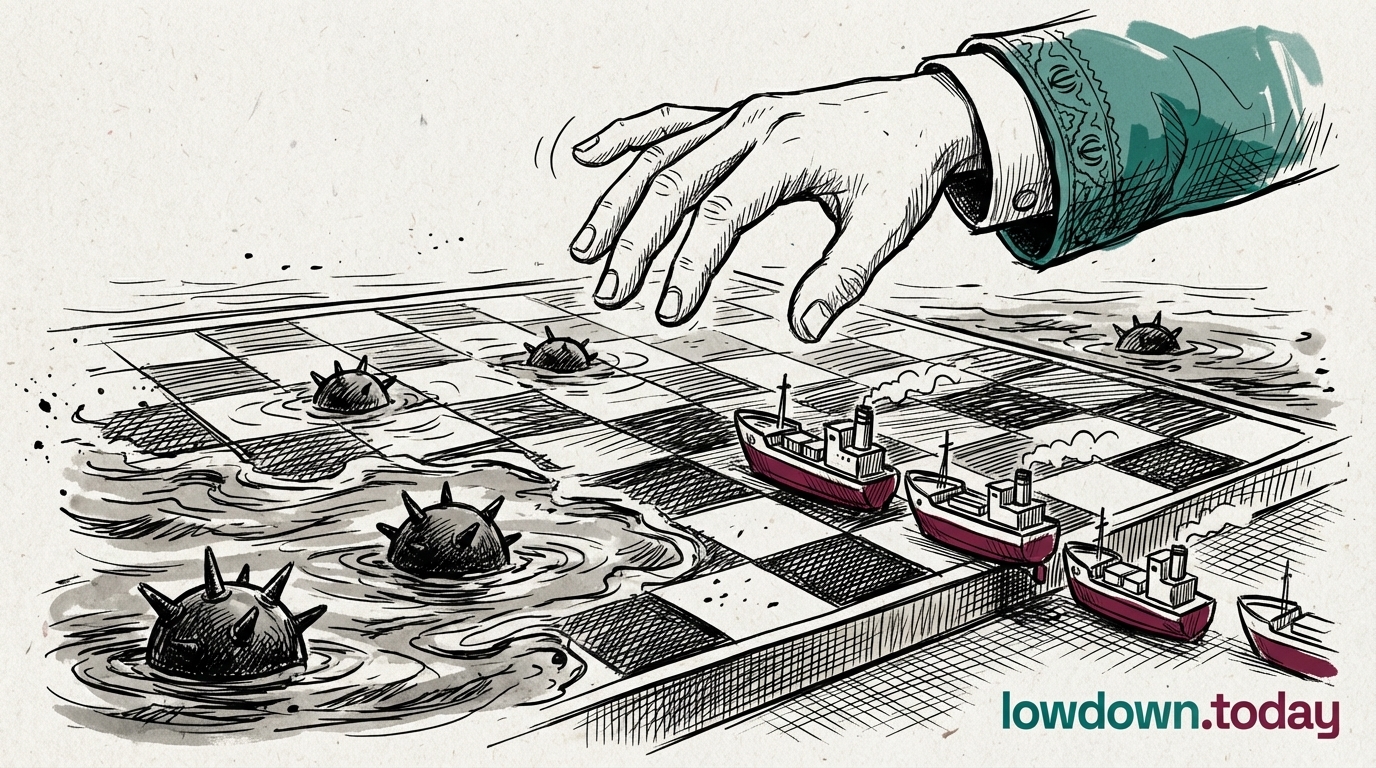
The 140 vessels destroyed — ten more than the previous week's count — have eliminated Iran's conventional navy as a fighting force. The strategic consequence, however, is narrower than the number suggests. Iran's maritime leverage over the strait of Hormuz rests on shore-based infrastructure, fast-attack craft, and territorial geography, not blue-water surface combatants. Foreign Minister Araghchi has stated the strait is "closed only to ships belonging to our enemies" , and the IRGC's toll system continues to operate from the five-mile channel between Larak and Qeshm islands, charging up to $2 million per vessel 1. The US has air superiority over the southern Iranian littoral — evidenced by A-10 Warthogs and Apache helicopters flying low-altitude anti-shipping patrols. But air superiority over open water has not translated into control of a chokepoint where the adversary's leverage is territorial, not naval.

Deep Analysis

In plain English

The US military is reporting enormous strike numbers, but the most consequential detail is Iran shifting from firing dozens of missiles at once to just one or two. The Pentagon calls this 'desperation' — but in 1991, Iraq showed an identical pattern under launcher-hunting pressure while retaining substantial reserves. The distinction matters enormously: an exhausted force poses little further threat, while a conserved force could still deliver a concentrated strike at a moment of Iran's choosing.

Deep Analysis
Synthesis

Cooper's characterisation is analytically convenient — it justifies continued strikes as a nearly-won campaign. But the identical launch data is consistent with IRGC strategic dispersal and concealment doctrine. The choice of framing reveals CENTCOM's institutional incentive to narrate success; intelligence consumers should weight that framing accordingly.

Root Causes

The reduction in Iranian missile fire reflects three concurrent pressures: launcher attrition from CENTCOM targeting, hardened facility destruction reducing reload capacity, and possible deliberate conservation for counter-value strikes if negotiations collapse. Cooper's public statement presents only the single 'desperation' framing, which serves an institutional interest in narrating campaign success.

Escalation

The constant strike rate of roughly 360 targets per day — unchanged from the previous week despite Trump's diplomatic announcement — indicates the military campaign is proceeding independently of the diplomatic track. This parallel dynamic creates acute risk of inadvertent escalation during the 5-day pause window.

What could happen next?
  • Meaning

    Iran's reduced missile salvo size limits immediate mass-casualty strike risk against US carrier groups or Israeli population centres.

    Immediate · Assessed
  • Risk

    If Iran is conserving rather than exhausted, a concentrated terminal salvo remains possible at a strategic moment during or after the 5-day diplomatic pause.

    Short term · Assessed
  • Consequence

    US precision-guided munitions stocks are being consumed at a rate that materially constrains readiness for simultaneous contingencies in the Pacific or Eastern Europe.

    Medium term · Assessed
  • Precedent

    A 25-day campaign achieving 9,000 targets will serve as the operational benchmark for future air campaigns, likely accelerating global proliferation of hardened underground military facilities.

    Long term · Suggested
First Reported In

Update #46 · Trump delays strikes; oil crashes to $99

CBS News· 24 Mar 2026
Read original
Causes and effects
This Event
CENTCOM: 9,000 targets, 140 ships in 25d
The operational pace — averaging 360 targets per day — has destroyed Iran's conventional navy and degraded its missile launch rate. But the IRGC's asymmetric maritime control of Hormuz continues despite the loss of 140 vessels, exposing a gap between the attrition campaign's statistics and its strategic objective of reopening the strait.
Different Perspectives
Iran human rights monitors (Amnesty International, Iran HRM, Hengaw)
Monitors documented 30 women held on capital moharebeh charges in a basement prison ward, Benyamin Naqdi's death sentence with a forced-confession broadcast, and 39 political executions since February. Iran's security courts have processed protest cases at uninterrupted wartime tempo regardless of the diplomatic track.
Lloyd's of London (war-risk underwriters)
Lloyd's held its Hormuz war-risk designation at $10-14 million per voyage while Brent fell 19%, maintaining a structural divergence from futures pricing. Underwriters require a UN Security Council resolution or government certification letter, not diplomatic optimism, before de-listing the strait.
Oman (Sultan Haitham's government)
Muscat issued a mine alert in its own territorial waters while denying any Hormuz toll plan after US Treasury threatened sanctions. A suspected mine in Omani waters on the same weekend as US financial pressure forces Muscat to demonstrate sovereignty without appearing to choose sides.
China (PRC)
China (PRC)
Beijing sent scholars rather than its defence minister to Shangri-La for the second year running and addressed Taiwan and multilateralism without mentioning Iran. China maintains its bilateral energy corridor protection with Tehran while refusing the diplomatic exposure of a public position at multilateral forums.
Iran Supreme National Security Council
The SNSC framed the unsigned MOU as a 10-point Iranian victory with enrichment already recognised, and the foreign ministry rejected Trump's nuclear conditions within hours. Tehran treats each unsigned day as validation that Iran has retained its stockpile without surrendering it.
Trump administration (CENTCOM/White House)
Trump posted three non-negotiable public conditions while CENTCOM disabled a commercial ship and Hegseth threatened resumed strikes from Singapore. The administration treats the unsigned MOU as leverage to extract maximum Iranian concessions before any ceasefire instrument is committed to paper.