Skip to content
You can now search across every topic, entity and event.What's new
Iran Conflict 2026
23AUG

OFAC quietly extends Russia crude waiver

4 min read
19:02UTC

OFAC issued General License 134B on 17 April, one day after Bessent killed GL 134A, keeping pre-loaded Russia-origin crude legal through 16 May at roughly $150 million a day.

ConflictDeveloping
Key takeaway

Treasury's 16 April announcement looked like a kill; the 17 April licence kept Russian cargoes flowing for another month.

The Office of Foreign Assets Control (OFAC) issued General License 134B on 17 April 2026, one day after Treasury Secretary Scott Bessent announced the non-renewal of GL 134A and the redesignation of Rosneft and Lukoil as Specially Designated Nationals . GL 134B authorises continued transactions in Russia-origin crude oil and petroleum products loaded onto vessels by 12:01 a.m. EDT on 17 April, with the authorisation valid through 12:01 a.m. EDT on 16 May 2026. Ancillary services covered include docking, bunkering, emergency repairs and maritime insurance. The licence carves out any cargo touching Iran, North Korea, Cuba, Crimea, Donetsk or Luhansk-linked entities, which remain under their separate sanctions architecture.

GL 134A had run since November 2025 and was scheduled to expire on 11 April . Bessent's 16 April statement was read by wires including Reuters and Semafor as a hard kill of the at-sea cargo channel. The licence Treasury's own sanctions desk signed the next day kept that channel running for any cargo already on the water. The real cliff is 16 May, not 11 April.

At Urals $106.81/bbl in early May, every day of legal at-sea liquidation translates to roughly $150 million in cargoes Moscow's shadow fleet can sell with insurance and port access. The four-week extension therefore covers cargoes worth roughly $4.5bn that the 16 April press release had implied were stranded.

The instrument resembles the 2022 price-cap architecture more than the 2014 Crimea designations: a cliff-extension licence designed to prevent disorderly liquidation rather than to reduce Russian revenue immediately. At $121/bbl, an at-sea waiver would subsidise Moscow at 2.6 times the price-cap design rate ; at $106 the multiple is lower but the legal-cargo flow is unbroken. The press-release moment moved one direction. The licence moved the other.

Deep Analysis

In plain English

OFAC, the US Treasury's sanctions office, quietly issued a new licence on 17 April 2026, one day after Treasury Secretary Bessent announced that an earlier licence allowing Russia to sell oil had not been renewed. The new licence, called General License 134B, allows Russian oil that was already loaded onto ships before 17 April to continue being sold until 16 May. In plain terms: Bessent's announcement sounded like a hard stop. The licence issued the next day kept Russian oil revenues flowing for another month. The difference between the two is worth roughly $4.5 billion to Moscow over the four-week window.

Deep Analysis
Root Causes

The structural cause of the GL 134A-to-134B gap is the shadow fleet architecture that Russia built between 2022 and 2025. Approximately 300 to 400 tankers operating outside Western insurance frameworks loaded Russian crude in the weeks before GL 134A's 11 April expiry, knowing a non-renewal announcement was possible.

Those tankers were at sea when the Bessent statement dropped. OFAC's operational constraint was straightforward: it could not simultaneously enforce a hard cut-off and avoid stranding hundreds of laden tankers in international waters without clear port destinations, which would have created a humanitarian and environmental liability larger than the revenue denial.

The second structural cause is the $106/bbl Urals price environment. GL 134A was defensible at $73/bbl as a market-stabilisation measure issued during the Iran war's early supply shock. At $106/bbl the waiver is worth approximately $150 million per day to Moscow, and the political cost of each extension day has risen proportionally.

OFAC's 16 May hard cliff reflects an internal Treasury assessment that the at-sea cargo can realistically clear port by that date at current shipping speeds, making a GL 134C issuance operationally unnecessary.

What could happen next?
  • Consequence

    GL 134B establishes a precedent that OFAC will issue a same-day extension whenever a publicly announced sanctions cliff would strand at-sea cargo at scale, creating a structural market expectation of rolling extensions.

    Immediate · 0.82
  • Risk

    If OFAC issues GL 134C before 16 May at above-$100/bbl Urals, the credibility of all future Treasury sanctions announcements on Russian crude is materially reduced, affecting allied governments' willingness to coordinate.

    Short term · 0.75
  • Consequence

    Russia's RNRC capitalisation gap means Moscow has a structural interest in another OFAC extension after 16 May; without it, the shadow fleet faces underinsured voyages or Chinese P&I cover at higher cost.

    Medium term · 0.72
First Reported In

Update #15 · Hardware-free parade; crude waiver lives on

Baker McKenzie Sanctions News· 3 May 2026
Read original
Different Perspectives
Hizballah
Hizballah
Has not commented on the US Treasury's 20 August designation of ten people, including named couriers, over a cash network Treasury says moved money to it from the IRGC-Qods Force. ACLED recorded a sharp rise in attacks around it the same day.
Kuwait
Kuwait
Kuwait's Chief of the General Staff, Lieutenant General Khaled al-Shriaan, co-chaired the 16th US-Kuwait Joint Military Commission at the Pentagon on 21 August. Kuwait has not published what was agreed; only a summary of the meeting's existence and attendees is sourced.
Qatar
Qatar
Has not commented publicly on the $4.5bn KC-46A tanker Foreign Military Sale notification the State Department approved on 20 August. The notification opens a sale process; Doha has not confirmed whether it will proceed to a signed transfer.
Mohammad Bagher Ghalibaf
Told a Baghdad business meeting on 20 August that Iran will not endure a hungry population regardless of its military strength, against 87.9% point-to-point inflation and 128.1% food inflation for Tir. His fellow Majlis Economic Committee member Samsami separately warned a petrol price rise would ignite unrest.
US Navy
US Navy
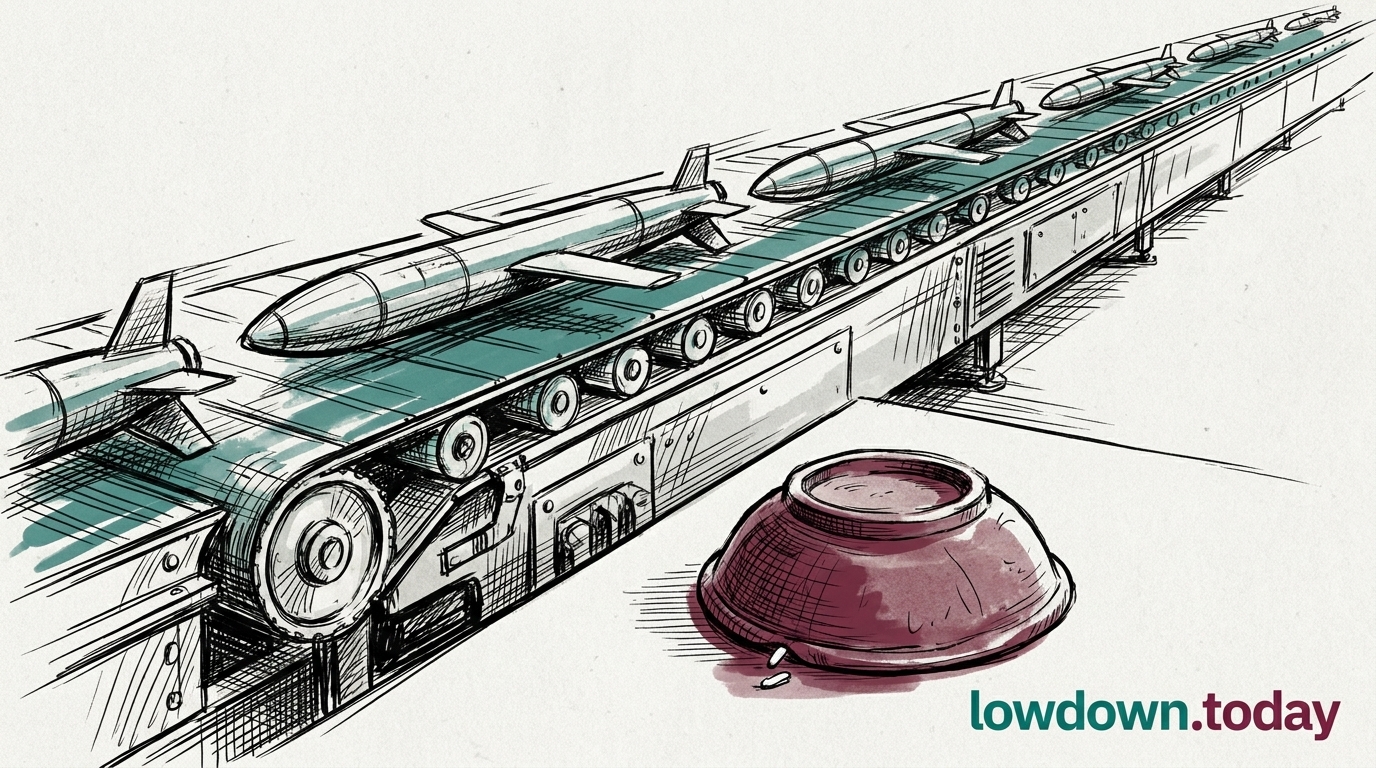
Signed a $22.9bn, seven-year contract with Raytheon on 17 August to raise Tomahawk output from about 60 a year to more than 1,000. The Acting Navy Secretary, quoted via an X post, framed it as the "Arsenal of Freedom" initiative; it replaces the 850 missiles fired by 1 April in about ten months at the new rate.
UK Maritime Trade Operations
UKMTO logged six armed men boarding a tanker 136 nautical miles east of Al Mukalla on 20 August and redirecting it toward Somalia. A vessel steered toward the Somali coast reads as an attempted seizure, a distinct hazard from the stand-off strikes the same lane has seen before.