Skip to content
You can now search across every topic, entity and event.What's new
Iran Conflict 2026
19AUG

Freight prices Hormuz risk as permanent

4 min read
18:42UTC

The TD3C MEG-China VLCC spot held at $412,888/day on 16 June while the Q4 forward sat at $181,163/day, and neither the 18 June US-Iran framework nor Iran's re-closure moved the contango.

ConflictDeveloping
Key takeaway

The Q4 freight forward refused to fall on the Hormuz deal, pricing the war-risk premium as structural.

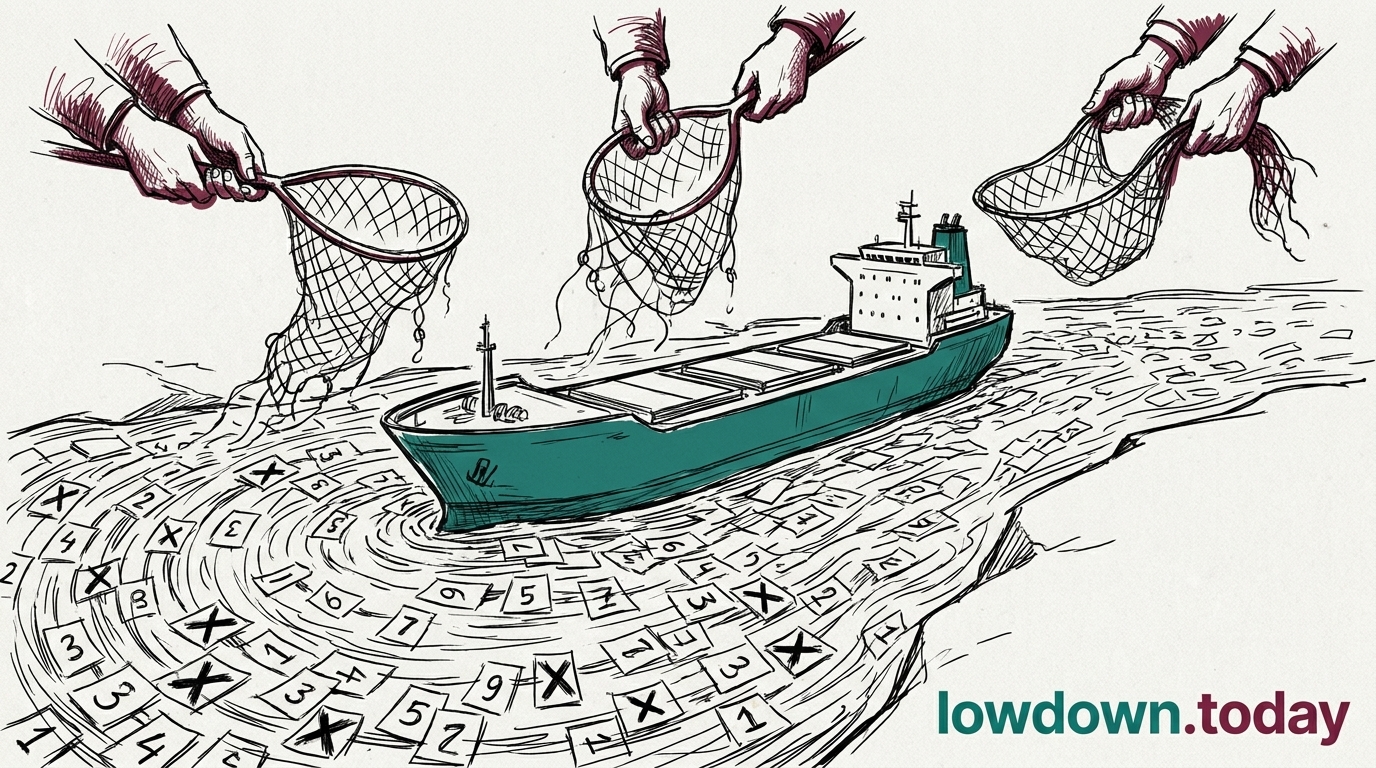
The TD3C MEG-China spot rate for a Very Large Crude Carrier held at $412,888/day on 16 June against a fourth-quarter forward freight agreement (FFA) of $181,163/day, a contango of roughly $231,000/day that the US-Iran memorandum of understanding signed on 18 June left untouched 1. TD3C is the Baltic Exchange benchmark for shipping crude from the Middle East Gulf to China; the FFA is the forward price desks pay to lock freight months ahead. The spot rate measures today's panic. The Q4 FFA measures what the market expects the clean rate to be once any reopening has normalised, and it did not fall when the strait reopened on paper.

Even that forward number carries fear. The 4Q26 FFA sits near $80,000/day above the Atlantic equivalent of roughly $100,000/day for West Africa and US Gulf cargoes to China 2. Lloyd's List frames the Lloyd's Joint War Committee (JWC) Hormuz war-risk designation as something that historically takes years to unwind, and Protection and Indemnity (P&I) cover for a Gulf crossing, the liability insurance no commercial tanker sails without, remains withdrawn 3. BIMCO, the shipping industry's main contract body, advised against starting transits and kept its CONWARTIME war-risk clause triggered 4.

That is the freight desk's read on the diplomatic calendar. Iran re-declared the strait shut on Saturday 20 June, and the Q4 FFA still did not move 5. The scramble for non-Hormuz medium-sour crude that drove the Med Aframax TD19 route to WS228 on 6 June has a forward analogue, and a single memorandum did not close it. For a desk fixing VLCCs into Q4, the $231,000/day gap is the dollar value of the market's disbelief, embedding roughly $0.40 to $0.50 a barrel of freight risk into MEG-China economics the curve expects to persist.

Deep Analysis

In plain English

Shipping companies use contracts called Forward Freight Agreements to lock in a price for moving oil in the future. Right now, a tanker sailing from the Persian Gulf to China earns over $412,000 a day because the Strait of Hormuz is considered too dangerous to cross under Western insurance cover. The futures contract for late 2026 has already settled at $181,000 a day: the shipping market is pricing in substantial risk even after a ceasefire holds, not zero. The gap between today's price and the future price ($231,000 a day) is the market's estimate of how much extra cost Hormuz will still carry even once a ceasefire holds. Insurance companies are the key reason: they lost cover from ships crossing Hormuz and have said they will not re-insure until floating mines are removed and safe voyages have been proven over months. No politician can override that decision.

Deep Analysis
Root Causes

The $231,000/day prompt-to-forward contango has three structural drivers that the 18 June MOU did not touch.

First, the Lloyd's JWC war-risk designation raises insurance premiums from 0.1% of hull value to 2.5% per seven-day period (per gCaptain, 16 June). This cost is priced into freight, not political calendars. No political instrument removes a JWC designation; only the JWC does, after reviewing actuarial evidence of reduced loss exposure over a sustained period.

Second, mine clearance at Hormuz requires 40-50 days at minimum for the navigable channels, with full clearance extending to six months (per entity context on the Strait of Hormuz). Commercial operators cannot rely on a declaration; they need surveys. No mine-clearance operation had begun as of 22 June.

Third, Kuwait Petroleum Corporation's marketing chief stated on 3 June that full output recovery would require 10-12 weeks even after any Hormuz reopening. The 4Q26 FFA at $181,163/day reflects those 10-12 weeks in the forward curve: Q4 is precisely the window within which production recovery is plausibly achievable, and the market is pricing the freight premium that survives into that window.

What could happen next?
  • Consequence

    The 4Q26 FFA at $181,163/day implies freight markets will stay elevated through at least Q3 2026 regardless of political developments, keeping European crude import costs above pre-crisis norms by roughly $1-2/bbl.

    Medium term · Assessed
  • Risk

    If the JWC designation unwinds faster than historical norms (as in the 2019 episode), the $80,000/day MEG-Atlantic premium embedded in Q4 forward freight could unwind rapidly, compressing shipping earnings and reversing the European crude cost premium without warning.

    Short term · Suggested
  • Precedent

    The freight market's refusal to price a clean Hormuz reopening on a political MOU sets a precedent for all future Hormuz diplomatic events: markets will discount political instruments until JWC designation is withdrawn and underwritten transits are demonstrated.

    Long term · Assessed
First Reported In

Update #10 · Hormuz opened on paper, freight said no

Lloyd's List· 22 Jun 2026
Read original
Different Perspectives
UK Maritime Trade Operations
UKMTO logged six armed men boarding a tanker 136 nautical miles east of Al Mukalla on 20 August and redirecting it toward Somalia. A vessel steered toward the Somali coast reads as an attempted seizure, a distinct hazard from the stand-off strikes the same lane has seen before.
Mohammad Bagher Ghalibaf
Iran's Majlis speaker received Iraq's Hormuz carve-out request in Baghdad on 19 August, a request that treats passage as Tehran's to grant. Ghalibaf's authority over that grant sits alongside the Revolutionary Guard's separate transit rules, which have moved independently of Iran's foreign ministry before.
Haibat al-Halbousi
Haibat al-Halbousi
Iraq's parliament speaker asked Iran for special consideration on Iraqi Hormuz oil exports during Ghalibaf's 19 August Baghdad visit. Iraq presses the request from a weak position: Iran's central bank is simultaneously demanding Baghdad release Iranian reserves parked in Iraqi accounts.
Federal Department of Economic Affairs, Education and Research
Switzerland's economics ministry updated the Article 21 forms governing lawful Iran money transfers on 19 August, with only the revised forms accepted from 26 August. Bern operates one of the few remaining legal Iran payment channels and has just set a hard cutover on its control point.
Motegi Toshimitsu
Motegi Toshimitsu
Japan's foreign minister said in Muscat on 20 August that Tokyo wants closer coordination with Oman on safe Hormuz and Bab el-Mandeb passage. Japan has no naval presence of its own in the strait, so it is routing the ask through the state negotiating with Iran instead.
Badr bin Hamad Al Busaidi
Oman's foreign minister joined Japan's in Muscat on 20 August to call for intensified coordination on Hormuz and Bab el-Mandeb navigation. Oman also runs the mediation track with Tehran, so the appeal travels through the same channel as the negotiation.