Skip to content
You can now search across every topic, entity and event.What's new
Iran Conflict 2026
31JUL

Trump tells Bloomberg extension 'highly unlikely'

3 min read
09:24UTC

Lowdown Bureau / Diplomatic. The president set a verbal deadline to Bloomberg while his own press secretary denied a written US extension request.

ConflictDeveloping
Key takeaway

The Bloomberg deadline is the most precise thing Trump has said about Iran this week and still carries no document.

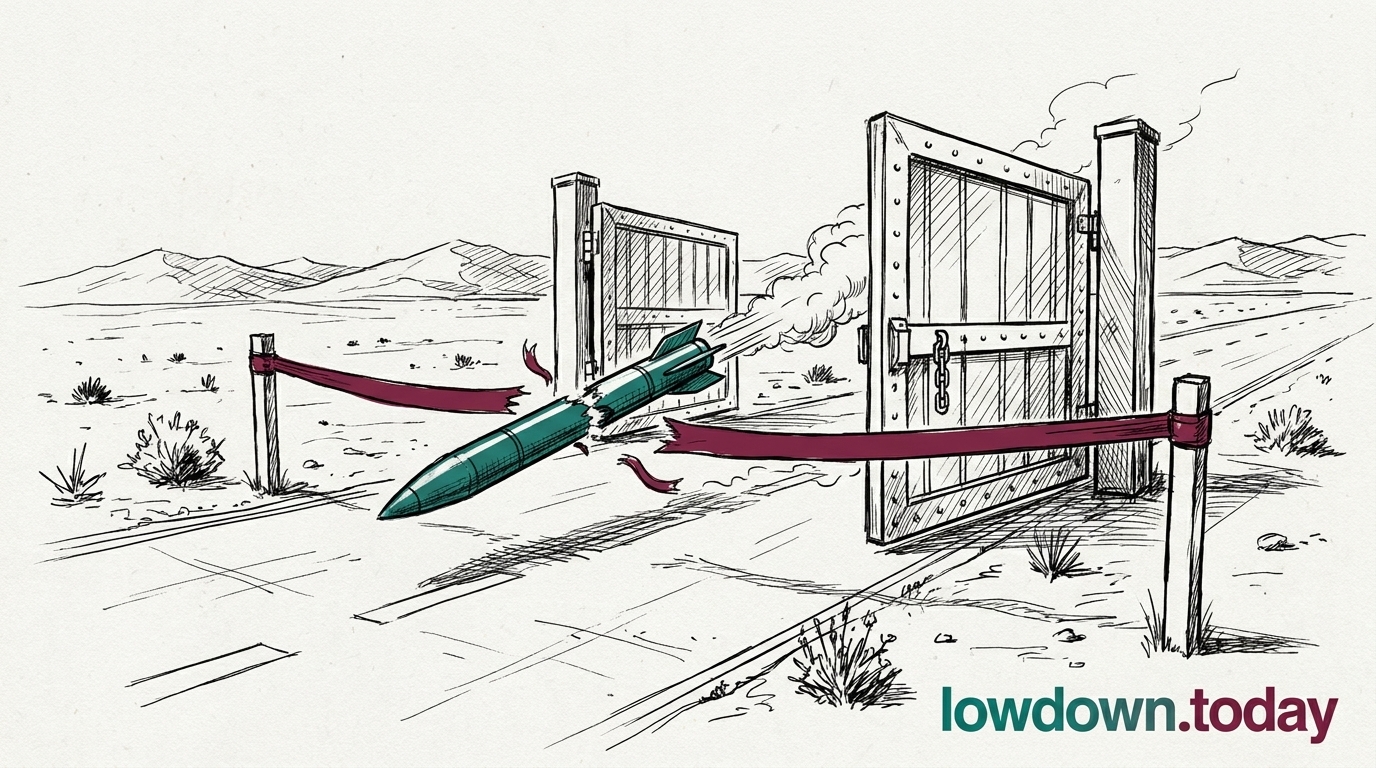
Donald Trump told Bloomberg that extending the Iran ceasefire was 'highly unlikely' without a deal, and that expiry fell 'Wednesday evening Washington time'. The remark is the clearest presidential commitment to the Wednesday deadline since the ceasefire was announced on a Truth Social post, and the first time The White House has assigned the deadline a precise hour.

Two kinetic events now sit behind the verbal deadline. The USS Spruance fired into the Touska's engine room overnight, US Marines boarded the vessel, and Iranian state media claimed drone attacks on American Navy ships the following morning. Trump's 'Wednesday evening' line trails both.

The signed White House record runs the other way. Press secretary Karoline Leavitt had already denied, before the Bloomberg interview, that the United States formally requested the 60-day extension regional officials briefed to Reuters and the Associated Press last week . No formal request went on paper; no formal refusal has either. Abbas Araghchi told Pakistani FM Ishaq Dar on Sunday that Iran is 'taking all aspects into consideration' before deciding on talks. Vice President JD Vance's scheduled Islamabad trip on Tuesday is the only diplomatic event between the verbal deadline and its passing.

Through fifty-two days of war, the pattern has held. Trump's public posture on Iran runs entirely through remarks, interviews and social posts. The Federal Register has carried zero Iran-tagged executive text since the war began. The Bloomberg line is the deadline the press will quote; Washington's signed ledger for the week consists of an OFAC designation that named Indian nationals and five domestic-energy instruments. By the architecture of the presidency's own publications, the deadline exists in remarks and nowhere else.


Deep Analysis

In plain English

The ceasefire between the US and Iran expires on Wednesday 22 April at Washington time. Trump told Bloomberg on 20 April that extension was 'highly unlikely' without a deal, and set the expiry time as 'Wednesday evening'. Meanwhile, his press secretary denied that the US had even formally asked for an extension; contradicting reports from unnamed regional officials who told international news agencies the two sides had agreed in principle to extend it. This matters because there is no signed document for this ceasefire. The entire arrangement exists on verbal assurances and media reports. With no legal instrument to extend, 'extension' in practice means both sides simply not resuming hostilities; which is exactly what both did for the previous 52 days without a signed agreement.

Deep Analysis
Root Causes

The contradiction between Trump's 'highly unlikely' statement and Leavitt's denial of a formal extension request reflects a structural feature of the Trump administration's Iran approach: all instruments are verbal and all commitments are deniable.

The White House has produced zero signed Iran executive instruments in 52 days. A press secretary denial of an extension request is only contradictory if a written request existed; with no document, Leavitt can accurately deny a formal request while unnamed regional officials accurately describe an informal understanding.

The ceasefire's informality creates a parallel structural problem for markets: the absence of a signed document means there is no legal mechanism by which an extension can be 'official'. Both sides extending by simply not resuming hostilities is indistinguishable from an informal extension; which is itself indistinguishable from the previous 52 days of undocumented ceasefire operation.

What could happen next?
  • Risk

    Trump's 'highly unlikely' formulation, combined with the Leavitt denial, removes the verbal scaffolding that has sustained the ceasefire since 30 March; without a new signal by Wednesday, markets will price a return to active hostilities.

  • Consequence

    The Leavitt denial creates a documented White House record that the US did not formally request extension; relevant to any subsequent War Powers Resolution dispute about who bears legal responsibility for the ceasefire lapse.

First Reported In

Update #75 · Ceasefire ends in the water, a day early

CNN· 21 Apr 2026
Read original
Different Perspectives
Shipping and insurance underwriters
Underwriters can price Houthi strikes because the group announces its targets, but an unclaimed drone at Damietta and a mandatory Iranian insurance scheme both deny them a pattern to price against. War-risk premiums are increasingly being set by the absence of a claimant, not the scale of the damage.
Jordan
Jordan
Azraq absorbed its fourth Iranian strike in seven weeks, again drawing no direct Jordanian retaliation, only an American one. Amman's exposure, hosting US basing without the Patriot density of Gulf allies, has not changed even as the war around it widens.
Houthi movement
Houthi movement
The Houthis' 20 July blockade of Saudi-linked shipping is the injury Riyadh's new 43-nation coalition directly answers, yet the group itself was never asked to join and remains outside every proposal on the table. Sanaa-aligned commentators call the coalition a paper reassurance for insurers rather than a deployable force.
Egypt's Cabinet
Egypt's Cabinet
Egypt confirmed the Damietta blaze was an attack, not an accident, on soil the war had never touched before. Cairo now faces an unclaimed threat to a facility supplying roughly 7% of its domestic gas, with no author to hold accountable and no pattern yet to defend against.
Oman
Oman
Muscat is running the only channel Iran will use, a voluntary Hormuz fee modelled on Malacca, but stayed out of Saudi Arabia's new naval coalition entirely. Oman's mediating leverage depends on treating Hormuz as shared and non-exclusive, the opposite of what Tehran is now demanding of it.
Iraq's Prime Minister
Al-Zaidi cancelled his first official Riyadh visit and convened the Coordination Framework, the coalition that keeps him in power and whose factions sit inside the PMF that Saudi jets just struck. He is caught between a five-year Saudi investment relationship and armed groups inside his own state he does not fully control.



