Skip to content
You can now search across every topic, entity and event.What's new
Iran Conflict 2026
23JUL

Pezeshkian offers peace; Khamenei won't

3 min read
19:27UTC

Iran's president outlined three ceasefire conditions that Washington and Tel Aviv have already ruled out. On the same day, the Supreme Leader called for new fronts — a government speaking with two voices on the central question of the war.

ConflictDeveloping
Key takeaway

Pezeshkian's conditions serve the diplomatic record; the IRGC, not he, controls the war's trajectory.

In calls with the leaders of Pakistan and Russia on Thursday, President Masoud Pezeshkian set out three conditions for ceasefire. First: recognition of Iran's "legitimate rights" — language encompassing both the nuclear programme and regional influence. Second: reparations for damage from US-Israeli strikes, with no figure named. Third: binding international guarantees against future military aggression.

Each condition is incompatible with the opposing side's stated position. Washington demanded unconditional surrender on Day 7 . Israel's stated war aim remains the replacement of Iran's government . Neither party will negotiate reparations to a government they intend to remove. The conditions read less as a diplomatic opening than as a documentary exercise — a public record Pezeshkian can cite later as proof he pursued peace while under sustained bombardment. They echo his earlier rejection of Trump's surrender demand as "a dream that they should take to their grave" , but repackage defiance in the language of international law.

The deeper problem is whether Pezeshkian can deliver a ceasefire even if one were agreed. This is the same president who ordered a halt to Gulf strikes on 6 March , watched the IRGC resume strikes within hours , then reversed course entirely the next day, vowing to step up attacks on US targets . In Iran's constitutional structure, The Supreme Leader — not the president — holds command authority over the armed forces and sets the strategic direction of foreign policy. On the same day Pezeshkian articulated ceasefire terms, Mojtaba Khamenei's statement called for "the opening of other fronts." The president talks of peace; the rahbar talks of escalation. Iran's government has issued four mutually contradictory positions on war and diplomacy in ten days — apology, halt order, escalation pledge, and now ceasefire conditions — from a civilian president who does not control the forces doing the fighting.

Deep Analysis

In plain English

Iran's elected president has publicly outlined three conditions for a ceasefire — but all parties know the US and Israel will not accept them. This is less about ending the war and more about Pezeshkian being able to cite a peace effort if asked later. Meanwhile, Iran's real military decision-makers — the Revolutionary Guards and the Supreme Leader — are talking about opening new fronts. Pezeshkian's peace conditions and Khamenei's escalation signals arrived on the same day. The president and the military leadership are publicly pulling in opposite directions, and under Iran's constitution the military leadership wins.

Deep Analysis
Synthesis

Islamabad and Moscow were chosen, not Beijing, Ankara, or the UN Secretary-General. Pakistan carries leverage with both Iran and the Gulf states; Russia holds a Security Council veto and active military channels to Tehran. The routing suggests Iran is assembling a parallel diplomatic track designed to outlast the military phase rather than resolve it — building a coalition that can eventually offer face-saving terms Washington cannot veto.

Root Causes

Pezeshkian's choice of Pakistan and Russia — not UN channels or European intermediaries — as interlocutors reflects Iran's post-2022 SCO alignment strategy. Tehran is routing diplomacy through a non-Western architecture consistent with its 2023 full SCO membership and bilateral security treaty with Russia. This is structural positioning, not improvisation under pressure.

Escalation

Pezeshkian's public maximalism locks him into positions that make any future Iranian concession appear as capitulation, reducing his political utility as a future interlocutor. This self-binding effect modestly raises the structural barrier to negotiated settlement even after current leadership positions change.

What could happen next?
  • Meaning

    Pezeshkian's conditions establish a separate civilian diplomatic track distinct from IRGC military command — relevant to any post-war governance and accountability framework.

    Short term · Assessed
  • Consequence

    Incompatible opening conditions eliminate near-term mediation prospects, sustaining the Hormuz blockade and its downstream economic disruptions for at least the immediate period.

    Immediate · Assessed
  • Risk

    Public maximalist conditions reduce Pezeshkian's future utility as a peace interlocutor by making any Iranian concession appear as capitulation to domestic audiences.

    Medium term · Suggested
  • Precedent

    Routing diplomacy through Pakistan and Russia rather than UN channels signals a preference for non-Western diplomatic architecture that could shape the structure of any eventual settlement framework.

    Long term · Suggested
First Reported In

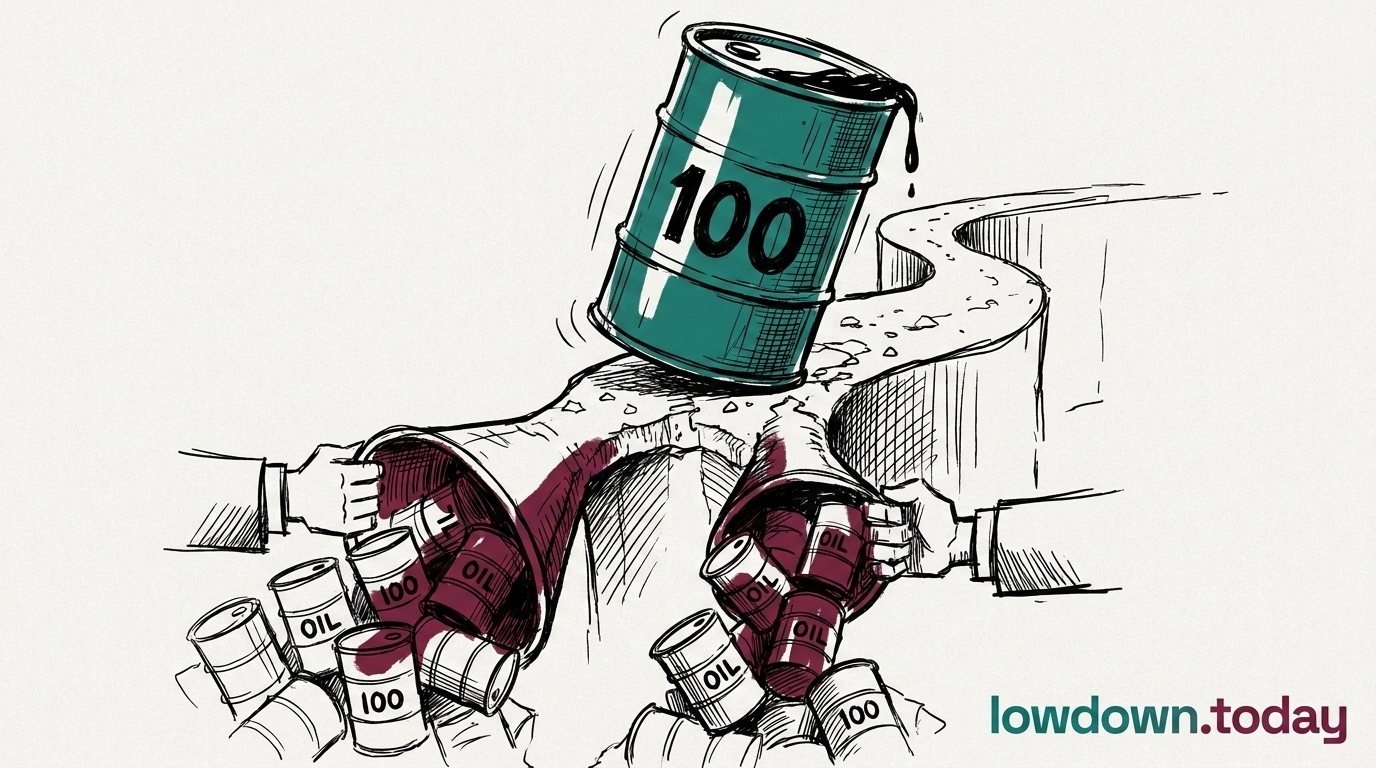
Update #33 · Oil breaks $100; war reaches Iraqi waters

Al Jazeera· 13 Mar 2026
Read original
Causes and effects
This Event
Pezeshkian offers peace; Khamenei won't
Pezeshkian's conditions are structured to be rejected. They establish a diplomatic record — evidence that Iran's civilian leadership pursued peace under bombardment — rather than a diplomatic opening. The simultaneous divergence between the president's ceasefire terms and the Supreme Leader's call for escalation exposes the constitutional fracture at the centre of Iran's war policy: the president lacks command authority over the armed forces, and the Supreme Leader who holds that authority is calling for expansion.
Different Perspectives
India
India
India buys more Saudi crude than any other country and has 2.5 million nationals working in the kingdom, so a $100 Brent and a live strike on Saudi tankers reach New Delhi through both fuel bills and remittance risk. Neither channel has an alternative route the way Saudi Arabia's own pipeline does.
Qatar
Qatar
Qatar co-authored the four-mediator ten-day ceasefire proposal alongside Egypt, Pakistan and Oman, centred on resuming Hormuz navigation, while separately pursuing its dated compensation claim against Iran at the UN Security Council filed on 21 July. Doha is mediating and litigating in the same week.
Israel
Israel
Israeli intelligence, reported by the Wall Street Journal, assesses Iran moved thousands of centrifuges and part of its roughly 440kg enriched-uranium stock into Pickaxe Mountain after the June 2025 strikes on its three main nuclear sites. Some of the US refuelling aircraft now deploying to the region are bound for Israeli bases and Ramon Airport.
Houthis
Houthis
Yahya Saree announced the missile and drone strikes on the Encelia and Layla on 22 July as enforcement of the embargo his forces had declared by radio warning alone two days earlier. Six vessels already turned back on the broadcast; the strike shows Houthi forces will use weapons once warnings stop working.
Saudi Arabia
Saudi Arabia
Saudi Arabia's state news agency confirmed only a fire on the Encelia's bow, with the crew safe; the Layla strike remains unconfirmed by Riyadh. The kingdom built its Petroline pipeline specifically to bypass Hormuz through the Red Sea, so the tanker fire lands on the route Riyadh had already spent billions escaping.
United States
United States
Washington is weighing both ten-day proposals but wants a longer truce than either offers, and moved F-16 and F-35 jets plus refuelling aircraft into the region while it decides. That deployment, not Trump's Pickaxe Mountain remarks, is the measurable US action, buying options for the day talks fail rather than betting on them.