Skip to content
You can now search across every topic, entity and event.What's new
Iran Conflict 2026
23JUL

CENTCOM: 9,000 targets, 140 ships in 25d

3 min read
19:27UTC

The US military adds a thousand targets a week to its war tally and calls Iran's missile fire 'desperation' — but Tehran's forces reached Diego Garcia, penetrated Israeli air defences, and launched their 70th attack wave the day before.

ConflictDeveloping
Key takeaway

Missile launch rate collapse signals operational suppression, not necessarily capability destruction.

Adm. Brad Cooper, CENTCOM Commander, reported that US forces have struck 9,000 targets across Iran in 25 days, destroyed 140 vessels, and flown more than 9,000 combat sorties. The target count rose from 8,000 just days earlier , itself up from 7,000 the week before — a sustained pace of roughly 1,000 additional targets per week. Cooper said Iran NOW fires missiles "one or two at a time" compared with salvos of dozens at the war's outset, which he characterised as "desperation."

Ten days before Cooper's assessment, Iran fired two intermediate-range ballistic missiles at Diego Garcia4,000 km from Iranian territory, double the range ceiling Tehran had publicly acknowledged . In the same period, ballistic missiles struck Arad and Dimona in southern Israel, wounding 124 people; Israeli firefighters confirmed interceptors launched but failed to hit at least two incoming warheads. The IRGC announced its 70th attack wave on Saturday. Reduced launch volume may reflect stockpile conservation or a shift toward selective targeting — it does not self-evidently equal the operational collapse Cooper's language implies.

The 140 vessels destroyed — ten more than the previous week's count — have eliminated Iran's conventional navy as a fighting force. The strategic consequence, however, is narrower than the number suggests. Iran's maritime leverage over the strait of Hormuz rests on shore-based infrastructure, fast-attack craft, and territorial geography, not blue-water surface combatants. Foreign Minister Araghchi has stated the strait is "closed only to ships belonging to our enemies" , and the IRGC's toll system continues to operate from the five-mile channel between Larak and Qeshm islands, charging up to $2 million per vessel 1. The US has air superiority over the southern Iranian littoral — evidenced by A-10 Warthogs and Apache helicopters flying low-altitude anti-shipping patrols. But air superiority over open water has not translated into control of a chokepoint where the adversary's leverage is territorial, not naval.

Deep Analysis

In plain English

The US military is reporting enormous strike numbers, but the most consequential detail is Iran shifting from firing dozens of missiles at once to just one or two. The Pentagon calls this 'desperation' — but in 1991, Iraq showed an identical pattern under launcher-hunting pressure while retaining substantial reserves. The distinction matters enormously: an exhausted force poses little further threat, while a conserved force could still deliver a concentrated strike at a moment of Iran's choosing.

Deep Analysis
Synthesis

Cooper's characterisation is analytically convenient — it justifies continued strikes as a nearly-won campaign. But the identical launch data is consistent with IRGC strategic dispersal and concealment doctrine. The choice of framing reveals CENTCOM's institutional incentive to narrate success; intelligence consumers should weight that framing accordingly.

Root Causes

The reduction in Iranian missile fire reflects three concurrent pressures: launcher attrition from CENTCOM targeting, hardened facility destruction reducing reload capacity, and possible deliberate conservation for counter-value strikes if negotiations collapse. Cooper's public statement presents only the single 'desperation' framing, which serves an institutional interest in narrating campaign success.

Escalation

The constant strike rate of roughly 360 targets per day — unchanged from the previous week despite Trump's diplomatic announcement — indicates the military campaign is proceeding independently of the diplomatic track. This parallel dynamic creates acute risk of inadvertent escalation during the 5-day pause window.

What could happen next?
  • Meaning

    Iran's reduced missile salvo size limits immediate mass-casualty strike risk against US carrier groups or Israeli population centres.

    Immediate · Assessed
  • Risk

    If Iran is conserving rather than exhausted, a concentrated terminal salvo remains possible at a strategic moment during or after the 5-day diplomatic pause.

    Short term · Assessed
  • Consequence

    US precision-guided munitions stocks are being consumed at a rate that materially constrains readiness for simultaneous contingencies in the Pacific or Eastern Europe.

    Medium term · Assessed
  • Precedent

    A 25-day campaign achieving 9,000 targets will serve as the operational benchmark for future air campaigns, likely accelerating global proliferation of hardened underground military facilities.

    Long term · Suggested
First Reported In

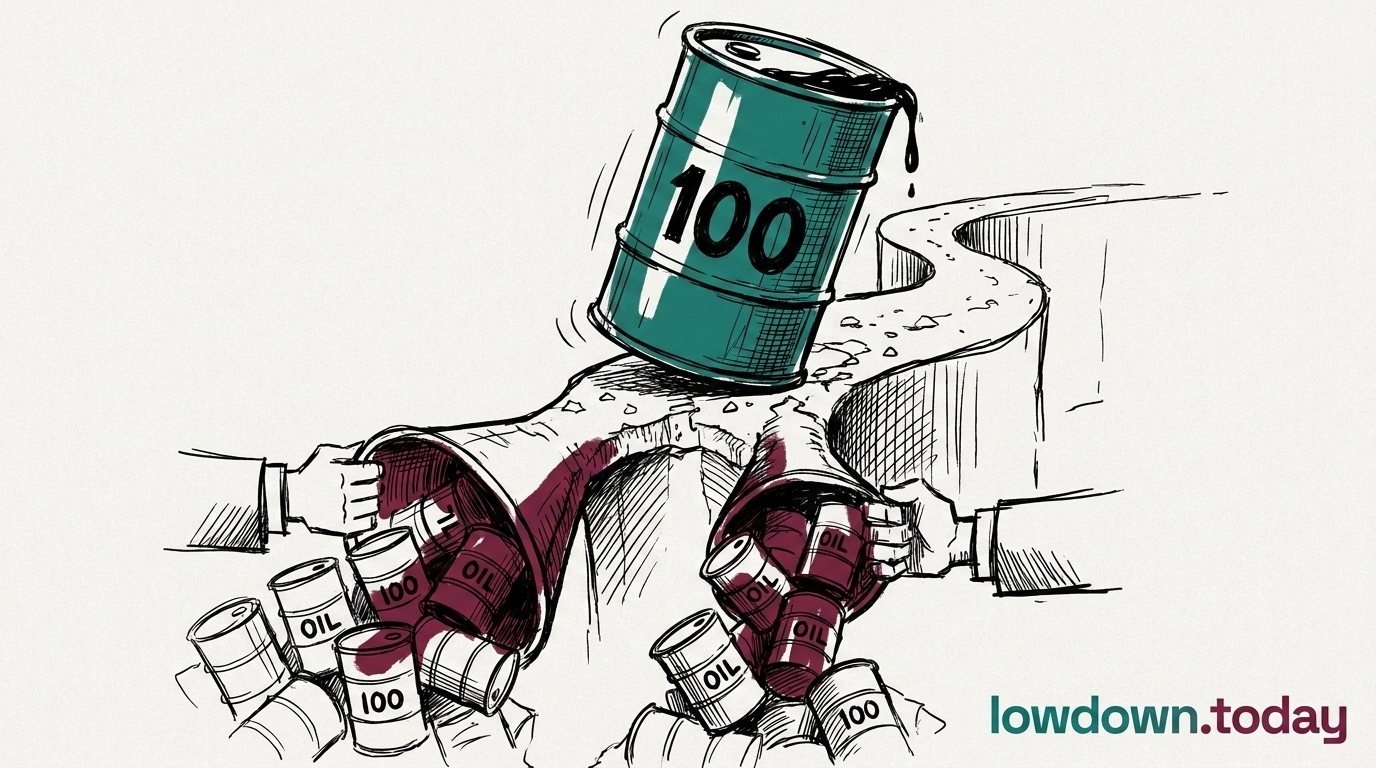
Update #46 · Trump delays strikes; oil crashes to $99

CBS News· 24 Mar 2026
Read original
Causes and effects
This Event
CENTCOM: 9,000 targets, 140 ships in 25d
The operational pace — averaging 360 targets per day — has destroyed Iran's conventional navy and degraded its missile launch rate. But the IRGC's asymmetric maritime control of Hormuz continues despite the loss of 140 vessels, exposing a gap between the attrition campaign's statistics and its strategic objective of reopening the strait.
Different Perspectives
India
India
India buys more Saudi crude than any other country and has 2.5 million nationals working in the kingdom, so a $100 Brent and a live strike on Saudi tankers reach New Delhi through both fuel bills and remittance risk. Neither channel has an alternative route the way Saudi Arabia's own pipeline does.
Qatar
Qatar
Qatar co-authored the four-mediator ten-day ceasefire proposal alongside Egypt, Pakistan and Oman, centred on resuming Hormuz navigation, while separately pursuing its dated compensation claim against Iran at the UN Security Council filed on 21 July. Doha is mediating and litigating in the same week.
Israel
Israel
Israeli intelligence, reported by the Wall Street Journal, assesses Iran moved thousands of centrifuges and part of its roughly 440kg enriched-uranium stock into Pickaxe Mountain after the June 2025 strikes on its three main nuclear sites. Some of the US refuelling aircraft now deploying to the region are bound for Israeli bases and Ramon Airport.
Houthis
Houthis
Yahya Saree announced the missile and drone strikes on the Encelia and Layla on 22 July as enforcement of the embargo his forces had declared by radio warning alone two days earlier. Six vessels already turned back on the broadcast; the strike shows Houthi forces will use weapons once warnings stop working.
Saudi Arabia
Saudi Arabia
Saudi Arabia's state news agency confirmed only a fire on the Encelia's bow, with the crew safe; the Layla strike remains unconfirmed by Riyadh. The kingdom built its Petroline pipeline specifically to bypass Hormuz through the Red Sea, so the tanker fire lands on the route Riyadh had already spent billions escaping.
United States
United States
Washington is weighing both ten-day proposals but wants a longer truce than either offers, and moved F-16 and F-35 jets plus refuelling aircraft into the region while it decides. That deployment, not Trump's Pickaxe Mountain remarks, is the measurable US action, buying options for the day talks fail rather than betting on them.