Skip to content
You can now search across every topic, entity and event.What's new
Iran Conflict 2026
19JUL

Medvedev likens Hormuz to nuclear arms

3 min read
14:05UTC

Dmitry Medvedev, Putin's envoy to the Tehran funeral, wrote that Iran's grip on the Strait of Hormuz is equivalent to possessing a nuclear weapon.

ConflictDeveloping
Key takeaway

Russia's Medvedev called Iran's Hormuz leverage a nuclear-equivalent deterrent, the strongest outside endorsement of that threat yet.

Dmitry Medvedev, deputy chairman of Russia's Security Council, attended the Tehran funeral as Vladimir Putin's personal envoy and wrote on Telegram that Iran's ability to disrupt the Strait of Hormuz "is equivalent to possession of a nuclear weapon" 1. the strait is the shipping channel through which roughly a fifth of the world's oil passes, and Iran sits on its northern shore. Medvedev added that Iran will "prevail" over the United States, and of the paused Doha negotiating track said: "negotiations are good, but they must be concluded with a result" 2.

TASS (Russia's state news agency) reported that Medvedev also reaffirmed the Russia-Iran comprehensive strategic partnership treaty, the 2025 pact formalising cooperation between the two states 3. His delegation carried Orthodox, Sunni and Shia clergy, a religious-diplomacy gesture more than a government-to-government one.

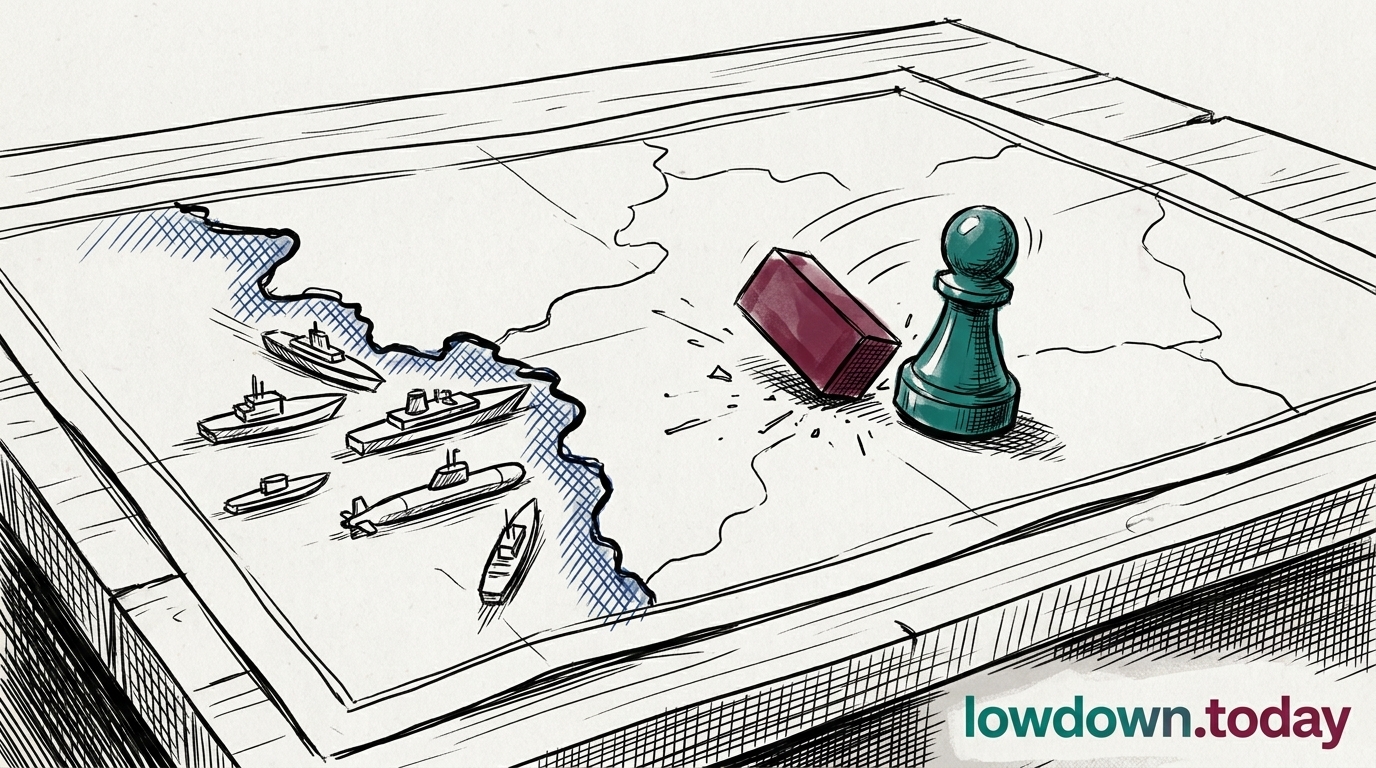
The framing matters more than the theatre. Since the war's opening weeks, Iran's grip on the strait has been treated as a commercial-disruption risk, a threat to oil prices and shipping schedules. Medvedev, speaking for a nuclear-armed partner, recast it as a strategic deterrent in its own right, the most explicit external endorsement yet of the chokepoint as a weapon Iran already holds. That gives Tehran outside cover to treat any future interdiction as deterrence rather than economic warfare.

Yet Putin stayed home and sent a deputy, matching China, which also sent its own deputy while Pakistan's prime minister came in person and Europe was left off the guest list entirely . The nuclear-weapon analogy is cheap to voice and costly to disown, which is why it arrived on Medvedev's Telegram feed rather than in a Kremlin statement. Russia is signalling alignment while withholding the personal Putin commitment that would raise the stakes.

Deep Analysis

In plain English

Dmitry Medvedev is a senior Russian official, formerly Russia's president, who now serves as deputy chair of its Security Council. Russia's actual president, Vladimir Putin, did not attend Iran's state funeral for its late supreme leader; he sent Medvedev instead. At the funeral, Medvedev made a striking comparison: he said Iran's ability to block the Strait of Hormuz, a narrow shipping channel through which a large share of the world's oil passes, is as powerful a deterrent as owning a nuclear weapon. He also reaffirmed a treaty between Russia and Iran that formalises their cooperation, though the treaty does not commit Russia to defend Iran militarily. The comparison matters because it puts a Russian stamp of approval on Iran's argument that it doesn't need nuclear weapons to have serious leverage over the rest of the world, it just needs control of a narrow strip of water.

Deep Analysis
Root Causes

Russia's own leverage over Iran is limited by the comprehensive strategic partnership treaty's terms, which commit both states to consultation but not mutual defence, so Moscow has no treaty obligation to intervene materially at Hormuz and instead trades rhetorical alignment for continued Iranian cooperation on other fronts.

Iran's Hormuz-as-deterrent framing depends on the strait remaining under-transited relative to its pre-war baseline: the moment vessel counts return fully to normal, as they have begun to on some days , the chokepoint's deterrent value as a live threat, rather than a historical one, erodes.

Escalation

Direction: rhetorical escalation without a material commitment. Medvedev's statement raises the stakes of Hormuz rhetorically but is not accompanied by any announced Russian naval deployment or arms transfer, so the practical escalation risk remains tied to Iran's own IRGC Navy posture rather than Russian involvement.

What could happen next?
  • Meaning

    Russia's highest-level funeral representation endorsing Iran's chokepoint doctrine gives Tehran a rhetorical ally for its Hormuz leverage without any accompanying material Russian commitment.

  • Precedent

    Framing a conventional chokepoint capability as nuclear-equivalent gives other states with geographic leverage, such as Egypt over Suez, rhetorical cover to make similar claims in future disputes.

First Reported In

Update #147 · Japan opens Iran oil talks under US waiver

Al Jazeera· 6 Jul 2026
Read original
Different Perspectives
International Group of P&I Clubs
The Group has kept its Hormuz war-risk exclusion in force through the entire shipping recovery, even as London hull war-risk premiums fell to about 2% of vessel value. A burning LNG carrier off Limah is now the fresh case for holding that line, with mutual pooling meaning one hit reprices the strait for every owner at once.
Jordan
Jordan
Jordan's government said no threats existed at Aqaba hours before Iranian missiles landed there, and has not addressed the IRGC's claim that Jordanian civilians and soldiers supplied targeting intelligence for the strike. Amman hosts forces it does not command and is saying as little as it can.
United States (CENTCOM)
The Pentagon named two of the seventeen American dead, 1st Lieutenant Tyler Feehan and Private Isabella Gonzales, both killed at Jordan's Muwaffaq Salti Air Base, days after its Amman embassy had warned citizens away from Aqaba's airport and seaport. Washington is naming its own cost while flagging threats it declines to attribute publicly.
Iran
Iran
Iran said on Monday it disabled two oil tankers crossing the Strait of Hormuz without its permission, asserting a right to license passage through the strait it borders. Tehran named neither vessel, and CENTCOM had already denied a comparable Iranian claim on 18 July.
Qatar
Qatar
Qatar moved from summoning Iran's deputy ambassador on 8 July to a dated written claim at the UN Security Council thirteen days later, citing Resolution 2817 and reserving its Article 51 right of self-defence. Doha is building a permanent record while still hosting CENTCOM's forward headquarters and mediating with Tehran.
CENTCOM
CENTCOM
CENTCOM confirmed a third American service member died in northern Iraq on 19 July clearing unexploded ordnance from a downed Iranian drone, and recovered unidentified remains at Muwaffaq Salti Air Base in Jordan. The Pentagon has framed its Khuzestan strikes as degrading IRGC capacity, a rationale that stretches to explain a reactor foundation with no nuclear material in it.