Skip to content
Welcome, thoughtbot's Giant Robots listeners!Start here
Iran Conflict 2026
25JUN

Tankers run a southern route under US guidance

2 min read
14:30UTC

The Associated Press reported that operators keep moving oil on a southern route near the Omani coast under American guidance, as Lloyd's List Intelligence logged 102 Hormuz transits in a week.

ConflictDeveloping
Key takeaway

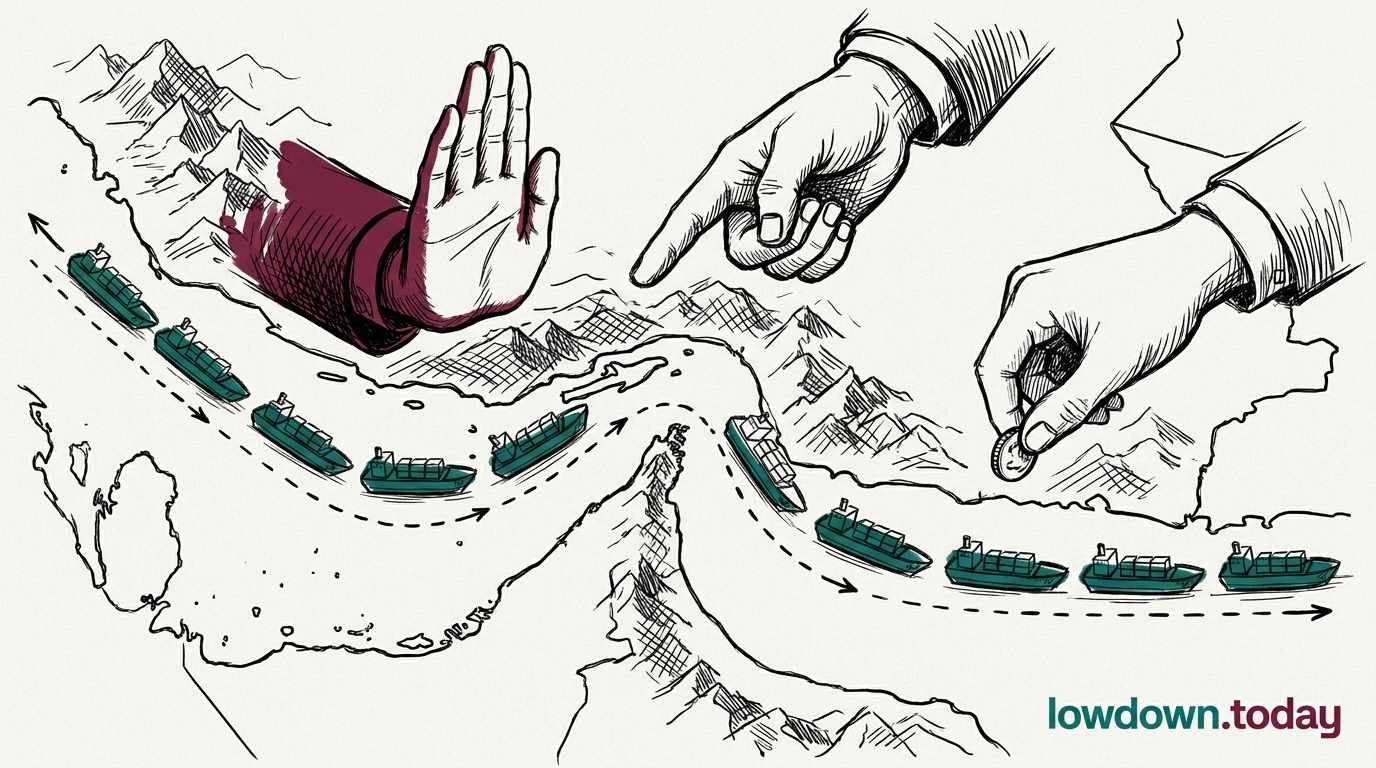
Oil keeps moving through Hormuz on a route one navy directs and the other calls illegal.

Associated Press reported on 3 September that tanker operators are still moving oil through the strait by taking a southern route near the coast of Oman under the guidance of US forces, while Lloyd's List Intelligence logged 102 Hormuz transits in the preceding week⁠1. The week's calendar boundaries were not published, so the count cannot be lined up precisely against any other week's.

That traffic level says something on its own. Shipping had fallen to a single transit on one day in mid-August, recorded by S&P Global. Cargo is moving again, and it is moving because somebody is telling masters where to sail.

Each navy now tells masters where they may sail. The IRGC's own statement called the route its targets were taking "unauthorized", which asserts a right to license traffic through an international waterway. Iran signed the UN Convention on the Law of the Sea, which guarantees transit passage through straits used for international navigation, but never ratified it, and that gap sits underneath every Iranian closure claim of this war. Washington runs the mirror image: American forces route the southern shuttle, and the IRGC calls that route unauthorised.

The physical argument runs alongside the legal one. Iran's Khatam al-Anbiya headquarters said it had laid new mines south of the strait by 2 September, in lanes the US Navy had cleared days before. A master on the southern shuttle is steering between a mine risk on one side and a legal claim on the other, with a war-risk premium attached to both.

Deep Analysis

In plain English

the strait of Hormuz is the narrow channel every tanker leaving The Gulf must pass through. The Associated Press reported that operators are still moving oil, but many now take a longer southern route hugging the Omani coast, guided by US forces, rather than the shortest path through the strait. Lloyd's List Intelligence, a shipping-data firm, counted 102 transits of the strait in the week AP reported on. That is not a closed strait; it is oil still moving, just under a different set of instructions than before, and at whatever extra time and cost the longer route adds.

What could happen next?
  • Meaning

    Traffic continuing at 102 transits in the reported week shows the strait is not closed, but a fleet routing around the shortest path under naval guidance is not operating normally either; the true state sits between those two extremes.

First Reported In

Update #176 · Three tankers for two warships

AP News· 7 Sept 2026
Read original →
Different Perspectives
Office for Budget Responsibility
The OBR's 28 October forecast assumed $82 oil for 2026 and 2027, from market prices for the ten working days to 19 August, and blamed dearer wholesale energy on the war without naming Iran. It expects CPI inflation close to 4% in early 2027 even at that price.
Hengaw, Kurdish rights group
Hengaw reported the 3 November hangings of Amirhossein Maleki and Amirhossein Ebrahimi in Isfahan, saying Ebrahimi was tortured into confessing and that nine of 12 people sentenced to death in the case have now been hanged. Iran's judiciary holds that the defendants killed members of the security forces.
FINTRAC, Canada's financial intelligence unit
FINTRAC worked with the US Treasury on the 6 November designation of eight money services businesses in British Columbia, Ontario and Quebec. Treasury says the businesses still operate, some under new names, so closing them falls to Ottawa.
Abdul Qadir al-Dakhil, Governor of Nineveh
Al-Dakhil cancelled three Mosul International Airport contracts on 7 November over alleged links to armed groups, after meeting Prime Minister Ali al-Zaidi in Baghdad. He named no group or company, and said the contracts will go to international companies.
Kuwait
Kuwait
Kuwait condemned the Houthi missile fired towards the Madinah region on 5 November and restated its support for Saudi Arabia, the Qatar News Agency reported. Its state tanker company, Kuwait Oil Tankers Company, is among the Gulf state fleets on Iran's expanded Hormuz list.
Scott Bessent, US Treasury Secretary
Treasury designated an alleged Chandigarh false-flag network on 4 November and eight Canadian exchangers on 6 November, while State sanctioned alleged MANPADS intermediaries. None of the actions touches an oil buyer; they target the paper, cash and procurement around Iran's trade.

Written with AI from Lowdown's published reporting. Not individually reviewed by an editor. Editorial standards.
