Skip to content
You can now search across every topic, entity and event.What's new
Iran Conflict 2026
22JUN

Deal bans the Hormuz toll, licenses its replacement

3 min read
09:56UTC

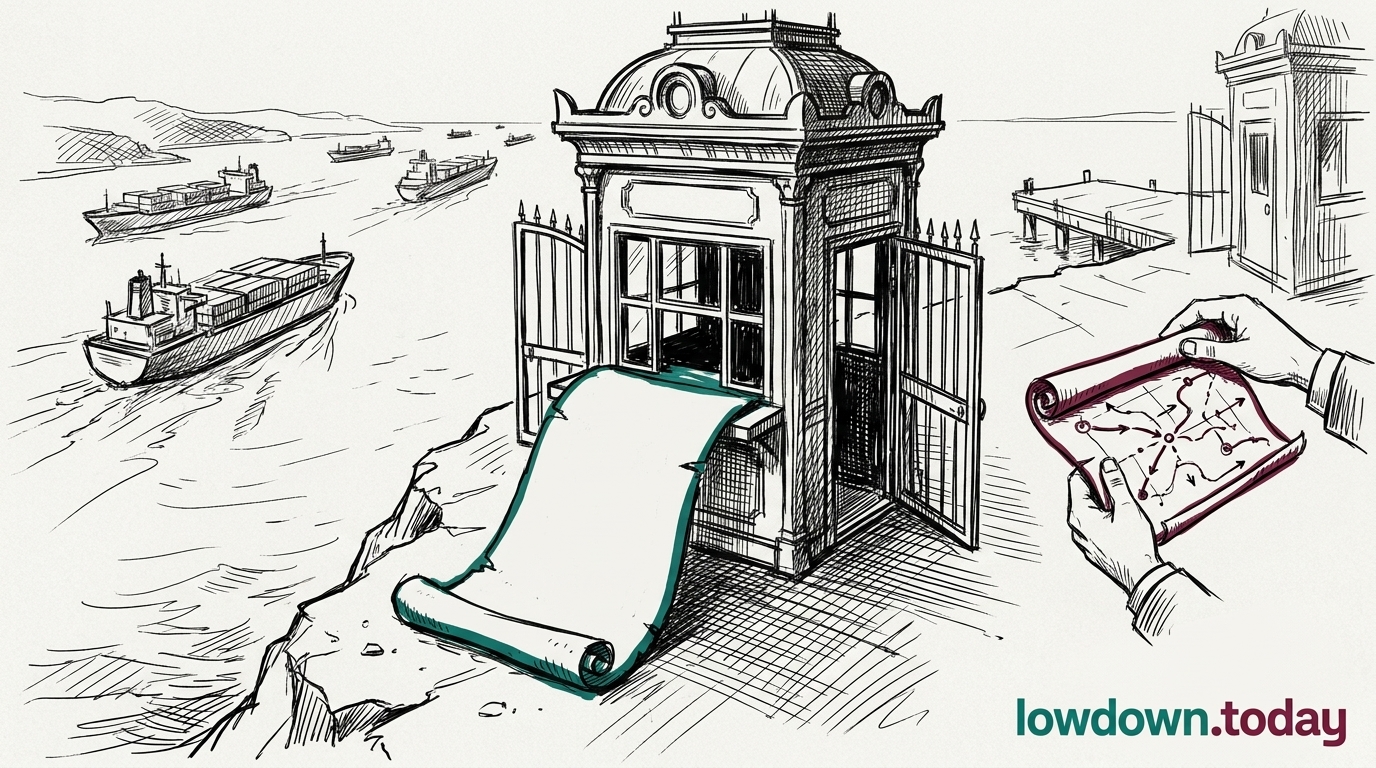
The published memorandum bans tolls on Hormuz passage, then invokes UNCLOS Article 26(2) to recast the IRGC's toll body as an Iran-Oman provider of maritime services, with a charge-free window of only 60 days.

ConflictDeveloping
Key takeaway

Iran agreed to drop the toll for 60 days and kept the legal machinery to switch it back on.

The Islamabad Memorandum of Understanding (MoU) text, published 17 June, bans "tolls" on Strait of Hormuz passage, then invokes the UN Convention on the Law of the Sea (UNCLOS), Article 26(2), to recast the charges as "maritime navigation services" 1. That article forbids fees on innocent passage but permits charges for specific services rendered to a ship, so a renamed toll becomes lawful revenue. Management is handed jointly to Iran and Oman, and the charge-free window runs 60 days only.

The body collecting the money does not go away. The Persian Gulf Strait Authority (PGSA), the body Iran's Revolutionary Guard (IRGC) created on 5 May that levied up to $2 million per tanker , is not dissolved under the deal. It survives under a quieter label, the 60-day clock counting down to the charge's return. Iran asserted Hormuz sovereignty and collected paid passage as early as 15 June, foreshadowing the framing the text now formalises .

Iran's foreign minister Abbas Araghchi put it plainly: "Charges for services provided will be collected," naming navigation, environmental protection and insurance. Counting from a signing date of roughly 15-16 June, the fees could resume as early as mid-August. The party with the largest exposure to those fees, Saudi Arabia, holds no seat in the Iran-Oman mechanism that will set them.


Deep Analysis

In plain English

The ceasefire deal said Iran would stop charging ships to pass through the Strait of Hormuz. But it only said so for 60 days. After that, Iran can restart the charges under a different name. Instead of calling them 'tolls' , a word the deal bans , Iran will call them 'maritime navigation services fees', citing a section of international maritime law. Think of it as a motorway toll renamed a 'road maintenance contribution.' The underlying charge is the same; the label has changed. The legal argument is questionable, but Iran has 60 days before it matters. By then, the deal will either be extended or collapsed on other grounds.

What could happen next?
  • Precedent

    The UNCLOS Article 26(2) rebranding, if unchallenged, sets a template for any state controlling a maritime chokepoint to levy transit charges under a services-fee framing that avoids the political label of 'toll.'

    Medium term · Reported
  • Risk

    Saudi Arabia's four idle supergiant fields face annual fee liability of up to $2 billion once the 60-day window closes, with no voice in the fee-setting mechanism. Riyadh's 26-day public silence on the MOU may break as the mid-August charge-resumption date approaches.

    Medium term · Reported
  • Opportunity

    The 60-day grace period gives shipping companies, P&I clubs, and international maritime lawyers a window to file UNCLOS arbitration claims testing the services-fee framing before charges resume.

    Medium term · Suggested
First Reported In

Update #131 · Iran deal's first death tests the text

Al Jazeera· 18 Jun 2026
Read original
Different Perspectives
Turkiye
Turkiye
Erdogan followed the Pakistani delegation to Jeddah for an instrument that has not been signed. Ankara's entry widens Saudi Arabia's defence architecture beyond the existing Pakistan pact, adding a second non-Gulf military partner mid-conflict.
Oman
Oman
Muscat is the corridor's broker but has published nothing about the arrangement Fars describes on its behalf. The account leaves Oman administering outbound traffic only, a narrower role than the shared route its mediation has rested on since 1979.
Pakistan
Pakistan
Islamabad sent Sharif, Munir and Dar to Jeddah to widen a defence commitment it has honoured in cheaper registers since March, when Dar invoked the Saudi mutual defence pact. Jeddah tests whether that hedge becomes a binding trilateral instrument with Turkiye.
United States
United States
Washington rejected the Majlis Hormuz bill outright while CENTCOM's own tally kept climbing to 49 vessels redirected since 14 July. Both instruments tightened in the same week Trump promised the strait would reopen soon.
Iran
Iran
Iran's foreign ministry is selling a phased Hormuz corridor through Oman and denying any percentage cargo tariff, while its own Majlis is legislating fines to 20% and a bar on Israeli-linked cargo. The two accounts, from the same government, do not agree with each other.
Saudi Arabia
Saudi Arabia
Riyadh published a target forecast, not an attribution, for the campaign it says the Najran strike previewed. That keeps an Article 51 case available while it formalises a trilateral defence architecture with Pakistan and Turkiye.



