Skip to content
You can now search across every topic, entity and event.What's new
Iran Conflict 2026
21JUN

Three ships a day in an 'open' strait

2 min read
17:51UTC

Kpler counted exactly three transits on each of 22, 23 and 24 July. CENTCOM's formal position is that the Strait of Hormuz remains open for transit.

ConflictDeveloping
Key takeaway

Three independent trackers put Hormuz traffic at a fraction of pre-war levels while CENTCOM calls it open.

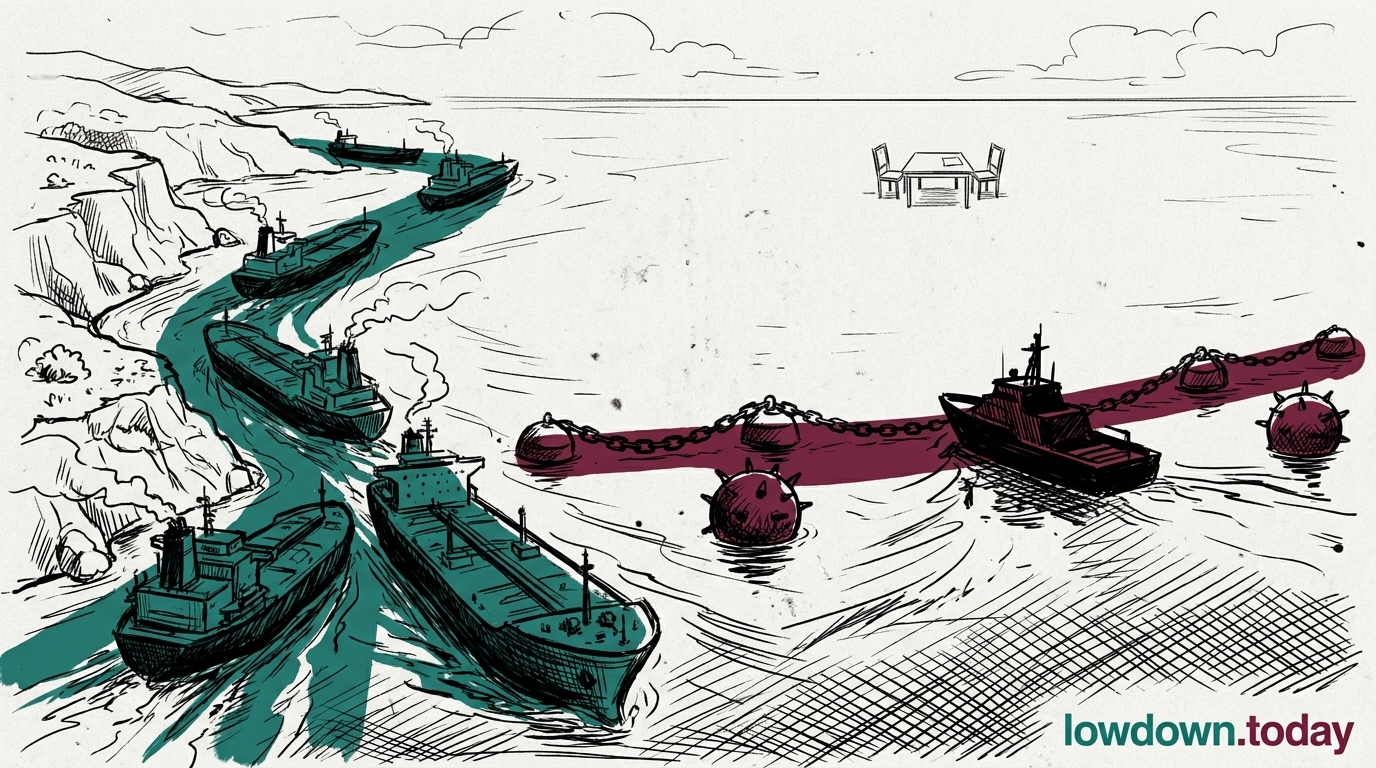
Kpler, the maritime data provider, recorded exactly three vessel transits through the Strait of Hormuz on each of 22, 23 and 24 July, down from more than 20 a day before 15 July 1. CENTCOM's formal position is that the strait remains "open for transit".

Both statements can be true at once, and the gap between them is the thing worth understanding. Hormuz is 33km wide at its narrowest and carries about a fifth of the world's seaborne oil; transit passage through it is a right in international law that no naval force has formally revoked. Whether a master exercises that right depends on his charterer, his crew and his underwriters, none of whom are bound by CENTCOM's characterisation. Kpler's count includes vessel-level detail, among them the very large crude carrier New Giant carrying about two million barrels of Basrah crude for China 2.

Two other providers reach the same place by different routes. S&P Global counted 40 vessels across 17 to 19 July, about 13 a day, roughly half the previous week's rate. Lloyd's List put tanker and gas-carrier movements specifically at 30 in the week to 20 July against 90 in the week to 13 July, part of the 66% weekly fall we reported on 21 July . Saul Kavonic of MST Marquee, on the record, puts flows at about 15% of pre-war levels 3. Three commercial datasets built for paying clients rather than for public argument agree on direction and on magnitude.

The insurance market reached this conclusion first and has not revisited it. War-risk rates on Hormuz transits were repriced in mid-July, when the broker Marcus Baker of Marsh quoted them against a count of eight vessels a day , and they have held at that level while physical traffic fell to three. Underwriters priced a closure the traffic has since caught up with. The exposure now sits in what has not been priced: a single mine strike or boarding in the Larak-Qeshm corridor, the route vessels use to stay outside CENTCOM's written blockade order, could push mainstream insurers to withdraw cover rather than reprice it, which would close the strait commercially without any government declaring it closed.


Deep Analysis

In plain English

The US military says the Strait of Hormuz, the narrow waterway through which much of the world's oil passes, is "open for transit". But three separate companies that track ship movements say otherwise. Kpler recorded just three ships a day passing through between 22 and 24 July, down from more than 20 a day before 15 July. S&P Global counted about 13 ships a day in a similar recent stretch, roughly half the week before. In practice, almost nobody is sailing through, whatever the official language says, because the insurance cost of doing so has become too high for most shipping companies to accept.

Deep Analysis
Root Causes

"Open for transit" and "commercially viable to transit" are two different claims, and the gap between them is what three trackers are actually measuring. CENTCOM's statement addresses the first, whether the US Navy will contest passage; the P&I clubs, the insurers that underwrite almost all commercial shipping, address the second, and they set premiums based on assessed risk of loss, not on any government's characterisation of the strait's status.

Once those premiums cross a threshold where insurance cost exceeds freight margin, as the current range does for many operators, rational shipowners divert regardless of what CENTCOM says, because the decision is made in a London or Scandinavian underwriting office, not in Washington or Tehran.

What could happen next?
  • Meaning

    A near-90% collapse in daily transits despite an "open" designation shows insurance markets, not naval statements, are setting the real terms of access to Hormuz.

  • Consequence

    Sustained traffic collapse compounds the Cape of Good Hope diversions already under way, adding weeks to voyage times for cargo bound for Europe and Asia.

First Reported In

Update #162 · Munitions, not Iran, halted US bombing

Baird Maritime (citing Kpler)· 26 Jul 2026
Read original
Different Perspectives
Hengaw
Hengaw
The Norway-based monitoring group reported the Urmia executions of Omid Behzad and Pouria Safvat, the only source to do so, consistent with its documented pattern of recording far more executions than the Iranian state acknowledges. Iran's government has not confirmed either execution.
Shipping and insurance underwriters
War-risk premiums price the Houthi campaign because the group announces its targets in advance, but a reopening Trump has promised without a published text gives underwriters no benchmark to reprice Hormuz cover against. Insurers want a text before they move rates, not a promise.
Houthi movement
Houthi movement
Spokesman Yahya Saree claimed strikes on two tankers in the Red Sea and Gulf of Aden on 5 August, only one of which UKMTO could confirm. The group's campaign against shipping continues on its own schedule, independent of any Hormuz arrangement further north.
Oman
Oman
Muscat has brokered the coordinates both Tehran and Washington's wire sources now describe differently, but has published no account of its own. Oman's position depends on treating Hormuz as a shared route, which is not what Iran is currently describing.
United States Central Command
CENTCOM raised its interdiction tally from 35 to 44 redirected vessels and disclosed its first boardings on 3 August, the day before Trump promised a reopening. The command's own enforcement record does not yet reflect the release the President has described.
Iran's Foreign Ministry
Spokesman Esmaeil Baghaei described the agreed Hormuz coordinates as a wholly new corridor under Iranian management, not a split of the existing route, days after his own deputy rejected Oman's lane proposal. Tehran wants the arrangement read as a change of ownership, not a compromise on access.



