Skip to content
Welcome, thoughtbot's Giant Robots listeners!Start here
Iran Conflict 2026
21JUN

IRGC: not a litre through Hormuz

3 min read
17:51UTC

The IRGC promised total closure of the world's most important oil chokepoint — but 11.7 million barrels of Iranian crude have already passed through to China.

ConflictDeveloping
Key takeaway

Iran declared total closure while exempting its own exports — selective coercion, not genuine blockade.

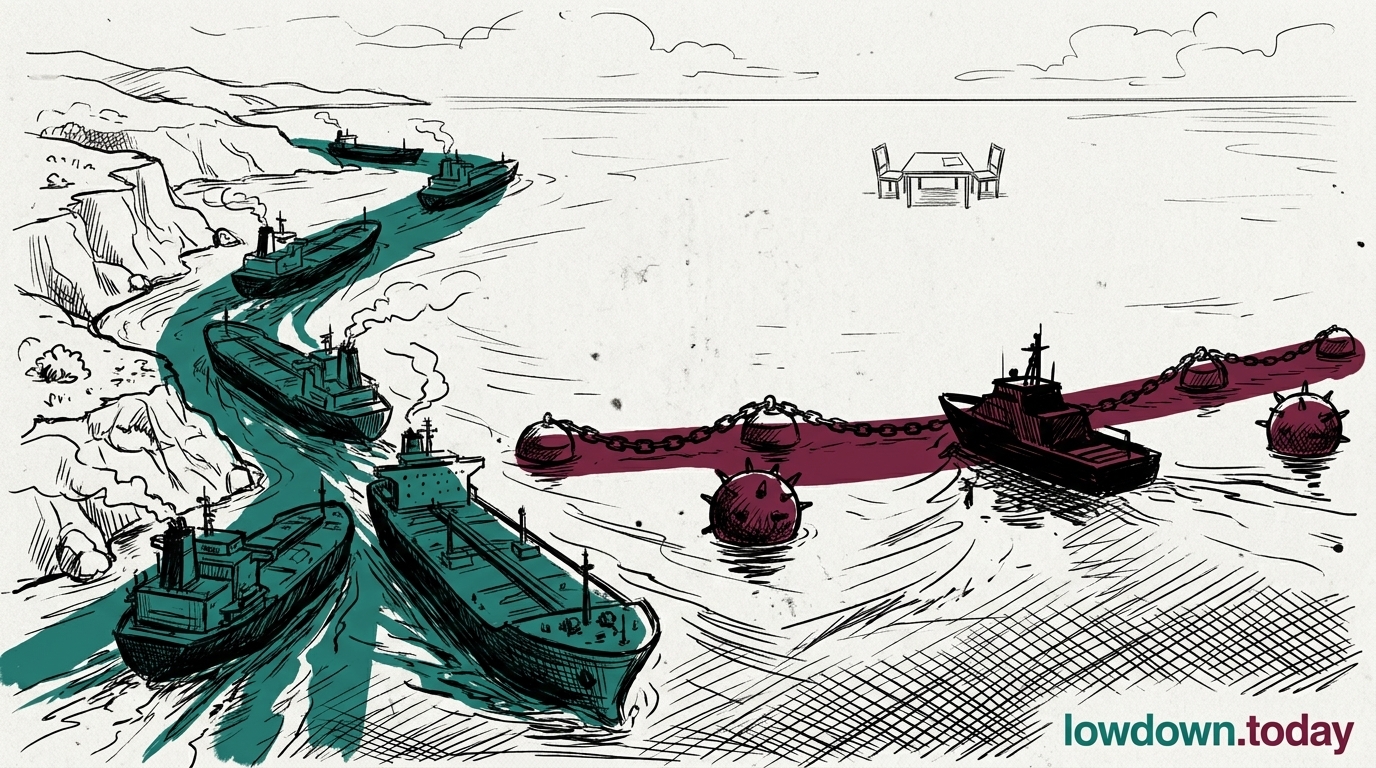
The IRGC declared on Wednesday that "not a litre of oil" would pass through the strait of Hormuz. This is the most absolute blockade language of the conflict, completing an escalation from IRGC operational warnings in the first days, through the Foreign Ministry's statement that tankers "must be very careful" — the first diplomatic-level Hormuz threat of the war — to a declaration of total closure.

The IRGC has backed the rhetoric with force. It struck the Marshall Islands-flagged tanker Louise P with a kamikaze drone, publicly naming the vessel and claiming it belonged to the US. It hit the Prima after the vessel ignored warnings about the transit ban. Both attacks were publicly claimed — the IRGC identified each ship, stated its rationale, and took responsibility. Under UNCLOS, attacking civilian merchant vessels is prohibited unless they directly assist military operations. No such claim was made for either vessel.

The declaration has a conspicuous exception: Iran's own crude continues to flow. Since 28 February, 11.7 million barrels of Iranian oil have transited the same strait, all bound for China. A blockade under international law requires impartial enforcement against all vessels. What the IRGC has constructed is not a blockade but a selective interdiction regime — one that punishes states aligned with the US-Israeli campaign while rewarding those providing diplomatic cover. The last time Iran systematically attacked commercial shipping in The Gulf was the 1980–88 Tanker War, which prompted the US to launch Operation Earnest Will, escorting reflagged Kuwaiti tankers under the American flag. No equivalent convoy operation has been announced.

The practical effect is already measurable. Tanker traffic through Hormuz has fallen 90% from pre-war levels. Every major protection and indemnity club cancelled War risk coverage effective 5 March. Kuwait declared force majeure on all oil exports. The declaration formalises what shipping companies had already priced in: the strait is open only to those Tehran permits through.

Deep Analysis

In plain English

the strait of Hormuz is a narrow waterway — roughly 34 kilometres at its narrowest — through which approximately a third of the world's seaborne oil normally passes. Iran and Oman share its coastline. Iran has now announced that no oil will transit at all. But Iranian tankers have continued sailing through the same strait, carrying crude to China. This means the 'total blockade' is selective: Iran is weaponising control of the strait to punish adversaries while protecting its own revenue stream and rewarding its main diplomatic ally. It is economic warfare using a geographic chokepoint as the instrument — and the chokepoint stays open for the one party whose support Iran cannot afford to lose.

Deep Analysis
Synthesis

The selective blockade establishes a novel strategic template: a state actor weaponises a critical maritime chokepoint against adversaries while maintaining a protected revenue channel to a single patron, using that patron's diplomatic weight as political cover. No existing international legal or military framework contains a response mechanism designed for this specific configuration of selective transit denial.

Root Causes

Iran's sanctions-constrained economy is structurally dependent on Chinese oil purchases for nearly all export revenue. A genuine total closure would sever its primary income source. The 'not a litre' rhetoric is calibrated to maximise coercive pressure on adversaries while remaining structurally impossible to apply to China — the declaration's absolutism is affordable precisely because the exception is guaranteed.

Escalation

The absolute declaration creates a legal and political test the US has not yet acted on. Tolerating Iranian oil transits while enforcing closure against other nations concedes the two-tier order. Acting against Iranian-flagged vessels risks direct naval confrontation in waters Iran claims as territorial sea. The US has chosen inaction, which becomes harder to reverse as the pattern solidifies into a de facto norm.

What could happen next?
  • Risk

    US inaction on Iranian-flagged transits concedes the two-tier order; acting against them risks the first direct US-Iran naval exchange in the Persian Gulf since 1988.

    Immediate · Assessed
  • Meaning

    The gap between the 'not a litre' declaration and 11.7 million barrels flowing to China reveals Iranian escalatory constraints that adversaries can calibrate their responses against.

    Short term · Assessed
  • Precedent

    Iran's selective blockade doctrine may be studied as a replicable model for other actors controlling strategic chokepoints in future confrontations.

    Long term · Suggested
First Reported In

Update #32 · UN condemns Iran 13-0; ceasefire blocked

CNBC· 12 Mar 2026
Read original →
Causes and effects
This Event
IRGC: not a litre through Hormuz
Iran escalated from diplomatic warnings to a declaration of total Hormuz closure — the strongest blockade language since the 1988 Tanker War. The declaration is selectively enforced: Iran's own crude transits freely to China while non-Chinese shipping faces interdiction, converting Hormuz from a waterway into a tool of economic coercion against US-aligned economies.
Different Perspectives
Office for Budget Responsibility
The OBR's 28 October forecast assumed $82 oil for 2026 and 2027, from market prices for the ten working days to 19 August, and blamed dearer wholesale energy on the war without naming Iran. It expects CPI inflation close to 4% in early 2027 even at that price.
Hengaw, Kurdish rights group
Hengaw reported the 3 November hangings of Amirhossein Maleki and Amirhossein Ebrahimi in Isfahan, saying Ebrahimi was tortured into confessing and that nine of 12 people sentenced to death in the case have now been hanged. Iran's judiciary holds that the defendants killed members of the security forces.
FINTRAC, Canada's financial intelligence unit
FINTRAC worked with the US Treasury on the 6 November designation of eight money services businesses in British Columbia, Ontario and Quebec. Treasury says the businesses still operate, some under new names, so closing them falls to Ottawa.
Abdul Qadir al-Dakhil, Governor of Nineveh
Al-Dakhil cancelled three Mosul International Airport contracts on 7 November over alleged links to armed groups, after meeting Prime Minister Ali al-Zaidi in Baghdad. He named no group or company, and said the contracts will go to international companies.
Kuwait
Kuwait
Kuwait condemned the Houthi missile fired towards the Madinah region on 5 November and restated its support for Saudi Arabia, the Qatar News Agency reported. Its state tanker company, Kuwait Oil Tankers Company, is among the Gulf state fleets on Iran's expanded Hormuz list.
Scott Bessent, US Treasury Secretary
Treasury designated an alleged Chandigarh false-flag network on 4 November and eight Canadian exchangers on 6 November, while State sanctioned alleged MANPADS intermediaries. None of the actions touches an oil buyer; they target the paper, cash and procurement around Iran's trade.

Written with AI from Lowdown's published reporting. Not individually reviewed by an editor. Editorial standards.
