Skip to content
You can now search across every topic, entity and event.What's new
Iran Conflict 2026
17JUN

JKM-TTF arb collapses as tankers return

4 min read
09:37UTC

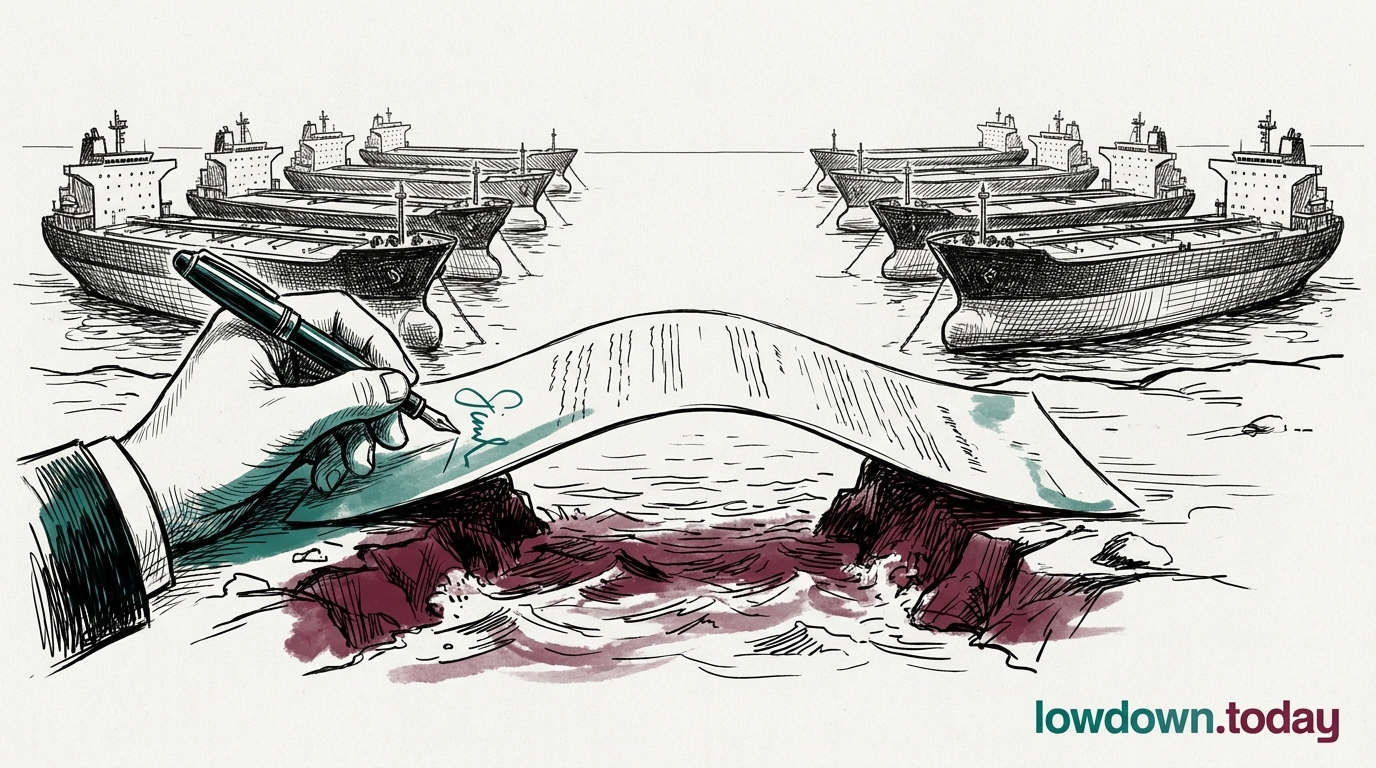
Seven Qatar-linked tankers cleared Hormuz and Qatar's PM set a weeks-to-normal LNG timeline, collapsing the JKM-TTF arb from USD 5.26 to about USD 2. Europe may pull Atlantic cargoes back on price before Qatar restarts a single train.

ConflictDeveloping
Key takeaway

The cargo-routing question may resolve on price weeks before Qatar produces a molecule.

The JKM-TTF arbitrage, the spread between Asian and European spot gas that decides where a flexible LNG cargo sails, collapsed from USD 5.26/MMBtu on 12 June to about USD 2 by 22-23 June, after holding USD 4.35 as late as 18 June . Two forces pulled from opposite ends. JKM, the north-east Asian spot benchmark, fell 18% week-on-week to around USD 15.3 as Strait of Hormuz risk deflated 1, while the European heatwave held TTF up from the demand side.

Seven Qatar-linked LNG tankers transited the Strait of Hormuz between 11 and 22 June, six of them inbound to reload at Ras Laffan, Qatar's main export complex 2; the one outbound vessel, Al Ghashamiya, carried a cargo loaded on 1 March, pre-conflict stock rather than fresh output. Qatar's prime minister, Sheikh Mohammed bin Abdulrahman Al Thani, said on 24 June that output would return to normal within a few weeks, reaching half its capacity a month after safe passage and four-fifths within two 3. Two destroyed trains still cap recovery near 83% for three to five years .

The routing question may resolve before Qatar lands a fresh molecule. Six inbound tankers reloading at Ras Laffan are positioning, not producing, and the outbound cargo was March inventory. If the arb holds near USD 2, the Atlantic LNG that spent the spring sailing east loses its Asian premium, and the cheapest home for a flexible cargo becomes a European regas berth. Goldman Sachs dates LNG normalisation to end-July ; the spread says Europe could pull cargoes weeks earlier, on relative price alone.


Deep Analysis

In plain English

LNG (liquefied natural gas) is gas cooled to minus 162 degrees and loaded onto special tankers that can sail anywhere in the world. The price difference between European and Asian markets determines which direction tankers sail: when Asia pays more, tankers go east; when Europe pays more, they come west. The price gap between Asia and Europe collapsed from about USD 5.26 to USD 2 between 12 and 22 June. This happened because Qatar, the world's largest LNG exporter, resumed loading tankers through the Strait of Hormuz after the conflict there eased. Asian buyers stopped paying high spot prices because they expected normal supply to return soon. A narrower price gap means tankers are now more likely to sail toward European ports rather than Asian ones, which could help fill Europe's gas storage over the next two months.

Deep Analysis
Root Causes

The JKM-TTF arb collapse from USD 5.26 to USD 2 between 12 and 22 June reflects two independent mechanisms working simultaneously. First, Hormuz reopening deflated the geopolitical risk premium in Asian spot prices: buyers who paid a conflict-risk premium of roughly USD 2-3/MMBtu in early June reduced forward purchasing as tanker transits resumed, dropping JKM approximately 18% to USD 15.3/MMBtu.

Second, TTF recovered from EUR 41.12 on ban-binding day to EUR 41-43/MWh as heatwave gas-for-power demand competed with mandate injection for prompt molecules, narrowing the arb calculation from the TTF denominator side.

The structural floor under any Qatari supply-return thesis is the destroyed train constraint at Ras Laffan. Two LNG trains lost in the conflict represent 12.6 Mtpa of Qatar's 77 Mtpa nameplate.

Rebuilding LNG trains takes three to five years from FID; the PM's weeks-to-normal timeline targets 50% capacity after one month and 80% after two months at the surviving trains, with a hard ceiling near 83% of pre-conflict nameplate that will not be recovered within the injection season or the 2027 winter regardless of diplomatic outcomes.

What could happen next?
  • Opportunity

    JKM-TTF arb at USD 2 is below the USD 3-4 Atlantic routing breakeven, meaning flexible non-destination cargoes from the US Gulf, Trinidad, and Norway's Hammerfest LNG are now economically indifferent between European and Asian delivery; procurement desks can compete for these cargoes without bidding above current TTF plus regasification costs.

    Immediate · Assessed
  • Risk

    Qatar's two destroyed Ras Laffan trains cap recovery near 83% of pre-conflict nameplate for three to five years; any market assumption of full Qatari LNG return within one injection season overstates the structural supply ceiling and misrepresents the PM's weeks-to-normal timeline, which targets surviving train capacity only.

    Medium term · Assessed
  • Consequence

    The USD 2 arb is a shift in the cargo-routing regime from the Asian-pull condition that held since April; if Asian buyers return to forward purchasing after the PM's statement, the arb reopens above the USD 3-4 routing breakeven and Atlantic cargoes swing back east, removing the current European supply bridging increment before Qatari volume restarts.

    Short term · Reported
First Reported In

Update #21 · Heat cracks the French-nuclear floor

GV Wire· 26 Jun 2026
Read original
Causes and effects
This Event
JKM-TTF arb collapses as tankers return
A sub-USD 2 arb could redirect Atlantic LNG cargoes to European berths weeks before Qatar physically restarts production.
Different Perspectives
Lloyd's Market Association
War-risk underwriters price the Houthis' Red Sea attacks because the group announces its targets in advance, but the unclaimed Damietta drone gives insurers a hit with no author to price against. An attack nobody claims costs shipping more than one that is claimed, since premiums are set against a known pattern, not raw damage.
US Central Command
US Central Command
CENTCOM has announced no strike on Iran since resuming bombing on 30 July within hours of an IRGC salvo on Jordan, and centcom.mil did not respond to requests to confirm any pause. The command has gone quiet before while a larger operation was being weighed, so silence alone proves nothing about what it has or has not done.
Hengaw
Hengaw
Hengaw recorded at least 67 executions in Iran during July, of which the state acknowledged only eight, and reported the 1 August execution of protest detainee Arvin Kheirkhahan at Shahrud with no advance notice to his family. A family's first notice of a death sentence is now usually the instruction to collect a body.
Egypt
Egypt
Egypt's government asked media on 2 August to report the Damietta attack accurately, named no author, and said no findings will be published before its own investigation concludes. Cairo holds the debris and jurisdiction over an attack on its own soil, and naming a culprit now would pull it into a dispute it has avoided for five months.
Iran's Foreign Ministry
Araghchi called the Hormuz talks with Oman final-stage on 2 August, four days after his own deputy rejected Oman's lane proposal, and denied the Damietta drone strike as an Israeli false flag while two Iranian officials privately claimed it for Tehran. Iran's public position now contradicts itself on both files at once.
Bahrain and Kuwait
Bahrain and Kuwait
Bahraini and Kuwaiti aircraft flew their own strikes on Iranian depots in July with Emirati air cover behind them, and Ynetnews reports some Gulf capitals wanted the 2 August strike to proceed rather than stop. States that have already taken fire see a closing window on Iranian weakness, not a reason to pause.



