Skip to content
You can now search across every topic, entity and event.What's new
Iran Conflict 2026
17JUN

Qatar restart leaves a fifth out

3 min read
09:37UTC

QatarEnergy told buyers it can reach 50% of capacity within a month of safe Hormuz passage and 80% within two, but two production trains destroyed in March cap full recovery for years.

ConflictDeveloping
Key takeaway

QatarEnergy can restart to 80% in two months, but two destroyed trains cap a fifth of global LNG for years.

QatarEnergy told buyers it can reach 50% of capacity within one month of safe Hormuz passage and 80% within two months, but full recovery of its Ras Laffan complex runs to years because two production trains were destroyed in March 1. QatarEnergy is the world's largest LNG exporter; Ras Laffan is its industrial city on the Gulf coast, the single largest LNG export complex on the planet. It shipped close to a fifth of global LNG last year, which makes the two-train loss a permanent structural cap of roughly 20% on what can return whenever the strait clears.

QatarEnergy starts that restart clock only once a Hormuz safe-passage date lands, which the US-Iran memorandum has not yet set. Even then, the 50% and 80% milestones describe a partial plant: the destroyed trains are not a maintenance outage that clears with a schedule, but capacity that has to be rebuilt. Pre-conflict European import volumes are therefore off the table at any reopening date, not merely delayed.

That gap matters because the curve is not pricing it. The same forward strip that prices a fuller refill than the physical balance supports also prices a fuller Qatari recovery than the destroyed plant can deliver, the wedge OIES quantified this week and covered in event 4. Goldman Sachs reinforced the read on 17 June, pushing its end-of-July restart estimate later as anchored vessels queued (covered in event 6), against a benchmark that had already begun selling into the diplomacy . The restart math says the supply side recovers slower and shallower than the prompt collapse implies.


Deep Analysis

In plain English

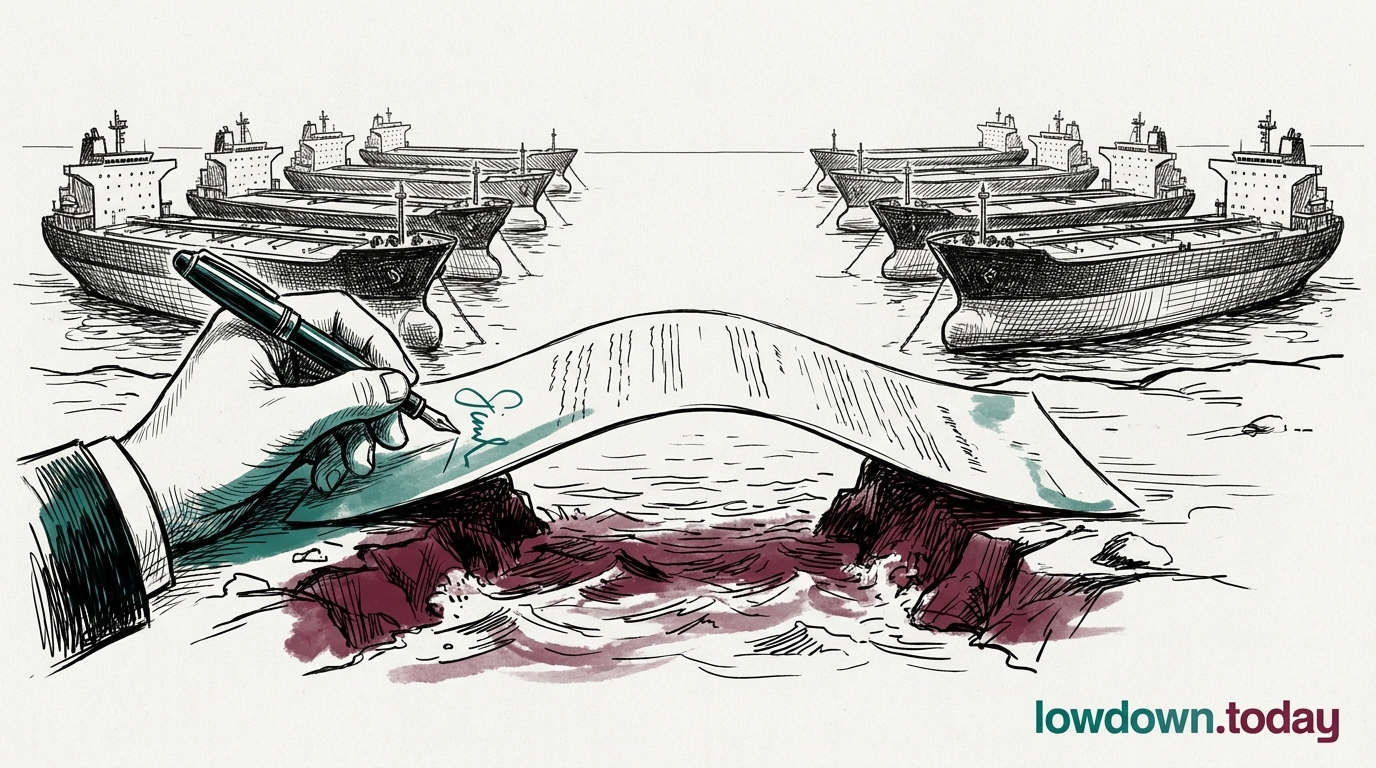
Qatar owns the world's largest liquefied natural gas export terminal at Ras Laffan, which ships gas chilled to liquid form onto specialised tankers that carry it to Europe and Asia. During the conflict in spring 2026, two of the factory-like production units at the terminal were destroyed. Qatar says it can restart to half-capacity within a month of the shipping route reopening, and to 80% within two months. But the two destroyed units represent about a fifth of the terminal's total output, and rebuilding them from scratch takes years. Meanwhile, roughly 500 cargo ships are still waiting outside the Strait of Hormuz, the narrow sea passage that all Qatar's tankers must use. Shipping companies are cautious: the strait may have been mined during the conflict, and insurers want proof it is safe before allowing normal operations. Goldman Sachs estimates full shipping normalisation will not happen until the end of July at the earliest.

Deep Analysis
Root Causes

The two-train loss at Ras Laffan is a structural supply constraint arising from infrastructure destruction rather than market dynamics. Ras Laffan's production trains are large cryogenic process units, each typically 4-8 mtpa of LNG capacity, whose destruction during the March 2026 conflict requires replacement of heat exchangers, compressor trains, and in some cases structural foundations that cannot be patched in situ.

The 500 vessels still anchored outside Hormuz after the memorandum reflect a second structural delay: shipowners and war-risk insurers require physical evidence of mine-clearance completion and insurance market re-opening before resuming commercial transit through a recent conflict zone.

The Lloyd's of London and Scandinavian P&I clubs, which cover the majority of global LNG tanker liability, typically require a mine-free certificate from a recognised naval authority before removing enhanced war-risk premiums, a process that takes weeks to months, explaining Goldman's end-July normalisation estimate.

What could happen next?
  • Consequence

    A permanent 20% cap on Qatari LNG output, equivalent to roughly 4 bcm/month below pre-conflict levels, requires Europe to source replacement LNG from Atlantic Basin suppliers at freight premiums that may widen TTF-JKM competition over winter.

  • Risk

    Goldman's end-July LNG normalisation date, if it slips further due to insurer hesitancy or mine-clearance delays, would directly shrink the July injection window, the highest-volume injection month in the EU calendar, and push storage further below the 80% floor.

First Reported In

Update #19 · German spark spread flips +EUR 15 in 48hrs

InvestingLive· 18 Jun 2026
Read original
Different Perspectives
Lloyd's Market Association
War-risk underwriters price the Houthis' Red Sea attacks because the group announces its targets in advance, but the unclaimed Damietta drone gives insurers a hit with no author to price against. An attack nobody claims costs shipping more than one that is claimed, since premiums are set against a known pattern, not raw damage.
US Central Command
US Central Command
CENTCOM has announced no strike on Iran since resuming bombing on 30 July within hours of an IRGC salvo on Jordan, and centcom.mil did not respond to requests to confirm any pause. The command has gone quiet before while a larger operation was being weighed, so silence alone proves nothing about what it has or has not done.
Hengaw
Hengaw
Hengaw recorded at least 67 executions in Iran during July, of which the state acknowledged only eight, and reported the 1 August execution of protest detainee Arvin Kheirkhahan at Shahrud with no advance notice to his family. A family's first notice of a death sentence is now usually the instruction to collect a body.
Egypt
Egypt
Egypt's government asked media on 2 August to report the Damietta attack accurately, named no author, and said no findings will be published before its own investigation concludes. Cairo holds the debris and jurisdiction over an attack on its own soil, and naming a culprit now would pull it into a dispute it has avoided for five months.
Iran's Foreign Ministry
Araghchi called the Hormuz talks with Oman final-stage on 2 August, four days after his own deputy rejected Oman's lane proposal, and denied the Damietta drone strike as an Israeli false flag while two Iranian officials privately claimed it for Tehran. Iran's public position now contradicts itself on both files at once.
Bahrain and Kuwait
Bahrain and Kuwait
Bahraini and Kuwaiti aircraft flew their own strikes on Iranian depots in July with Emirati air cover behind them, and Ynetnews reports some Gulf capitals wanted the 2 August strike to proceed rather than stop. States that have already taken fire see a closing window on Iranian weakness, not a reason to pause.



