Skip to content
Foundations rebuilt, and the first new thing is here: search across every topic, entity, and event.Try search
Iran Conflict 2026
11JUN

Trump: blockade stays till deal signed

3 min read
09:17UTC

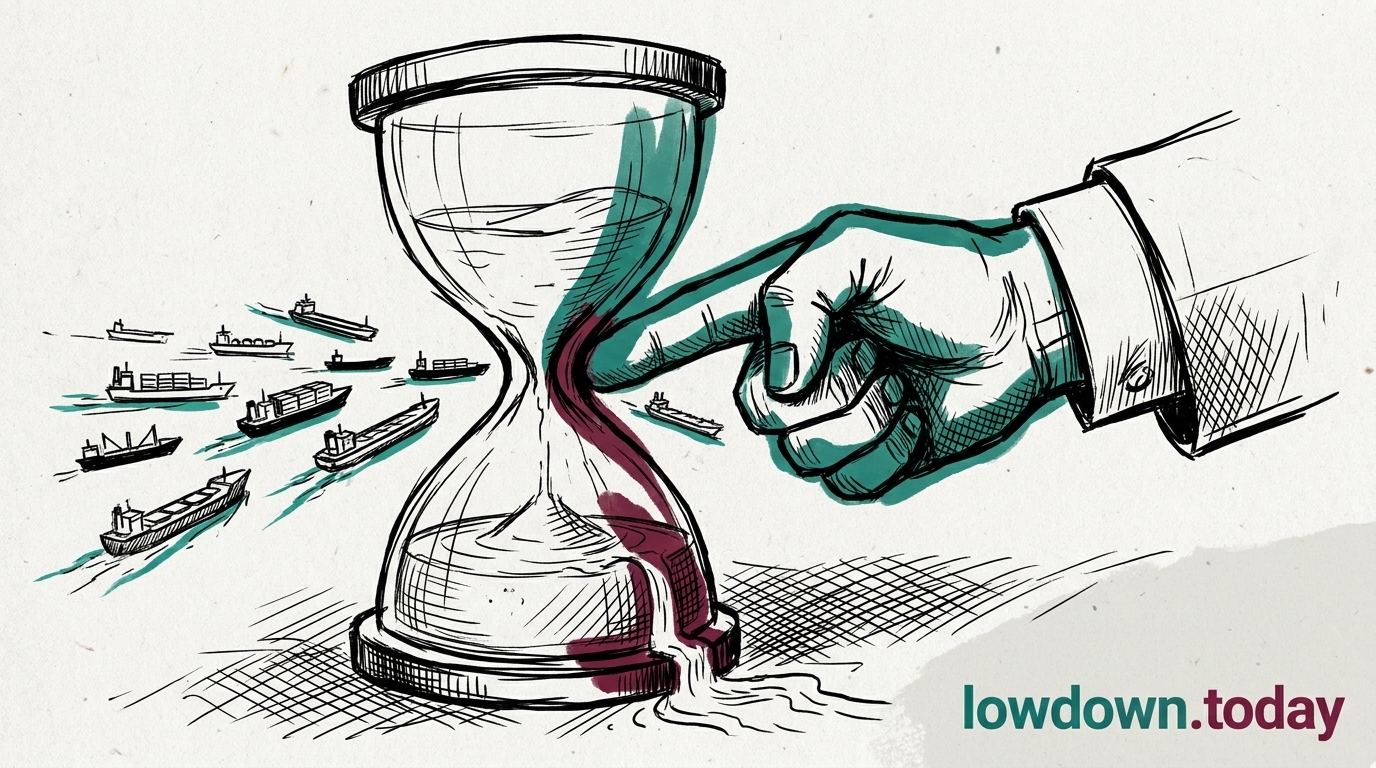
Trump set his most specific reopening condition yet on Sunday: the naval blockade stays "until an agreement is reached, certified, and signed." No instrument accompanied the post. The blockade holds regardless of the deal talk.

ConflictDeveloping
Key takeaway

Trump's signed-deal condition keeps the blockade in force and rules out a verbal memorandum.

Donald Trump posted on Truth Social on Sunday 24 May that the US naval blockade of the Strait of Hormuz will stay "in full force and effect until an agreement is reached, certified, and signed" 1. He added that talks were "proceeding in an orderly and constructive manner" and told his negotiators "not to rush into a deal" because "time is on our side." No executive order or presidential instrument accompanied the post.

Trump had earlier presented the negotiation as nearly settled ; the 24 May post adds an operational condition rather than fresh optimism, and its value lies in what it commits the United States to do rather than say. "Certified, and signed" sets a documentary bar the talks have not met: it rules out the partial or verbal memorandum structure the negotiations had been moving toward.

For the reader arriving cold: the blockade is the US Navy enforcing closure of the strait, the world's busiest oil chokepoint, through which roughly a fifth of seaborne crude moves. Trump's condition means the ships stay regardless of how warm the diplomatic language gets, until a signed text exists. That is why a deal can be reported as close while the strait stays shut.

The condition also bears directly on the sequencing fight. Iran wants its frozen assets freed before it concedes anything operational, while Trump now wants a signed agreement before he lifts the blockade. The two preconditions point in opposite directions, and a verbal understanding satisfies neither. On the day, the only concrete US act was the wording of a social-media post, and the blockade it described needed no signature to stay in force.

Deep Analysis

In plain English

President Trump posted on 24 May that the US naval blockade of the Persian Gulf will stay in place until a deal with Iran is reached and actually signed, agreed by both sides, and formally certified. He also told his negotiators to take their time. This rules out a looser kind of deal where both sides announce they have agreed without writing it down. Iran and the US had been trying to reach exactly that kind of informal arrangement. Trump's post says a signed document is required before the blockade ends, which raises the bar significantly for the ongoing talks.

Deep Analysis
Root Causes

The absence of signed instruments across 87 days of conflict traces to a constitutional and legal-reversibility calculation. The United States War Powers Resolution (1973) requires the president to submit a written report to Congress within 48 hours of committing armed forces.

Trump submitted no such report; the administration has argued the operation falls under existing Authorizations for Use of Military Force. A 'certified and signed' MOU, if it constitutes a ceasefire terminating existing hostilities, would create a legislative record the White House has so far avoided.

Additionally, any signed MOU that includes US sanctions relief requires OFAC to publish a general licence, which becomes a permanent public record challengeable under the Administrative Procedure Act. Trump's preference for Truth Social over signed instruments reflects the legal-reversibility advantage of executive non-commitment: no signed text means no APA challenge, no Senate ratification hearing, and no precedent that constrains future executive action toward Iran.

What could happen next?
  • Consequence

    Any informal MOU structure, including the 60-day framework Ghalibaf and Vance had reportedly developed, requires revision into a formally signed instrument before the blockade can lift under Trump's posted condition.

    Immediate · Assessed
  • Risk

    Iran's Khamenei Council may interpret 'certified and signed' as a demand for a treaty-level instrument, which would require US Senate ratification that no Republican senator has indicated willingness to provide.

    Short term · Suggested
  • Precedent

    A signed MOU, once deposited, becomes the first Iran-specific signed US executive instrument of the entire 87-day conflict, filling the zero-instrument gap documented across every prior post.

    Medium term · Assessed
First Reported In

Update #107 · Two markets, two prices on one Iran deal

Al Jazeera· 25 May 2026
Read original
Different Perspectives
Oil markets / Lloyd's underwriters
Futures markets priced CENTCOM's strikes-complete statement as a de-escalation signal and pushed Brent down 1.7 per cent to $94.71, even as the IRGC declared Hormuz closed. Lloyd's war-risk premiums held elevated because institutional de-listing requires a UN Security Council resolution that Russia and China have just shown they will block.
Pakistan (mediator)
Pakistan (mediator)
Interior minister Mohsin Naqvi carried dual civilian and military letters to Mojtaba Khamenei in Tehran on 6-7 June with no public response. The IRGC's Hormuz closure on 11 June shows the corps is acting independently of the channel Pakistan is using, making the mediation structurally unable to produce a binding commitment without direct IRGC access.
Russia and China
Russia and China
Russia and China voted against GOV/2026/40 at the IAEA Board, following through on the blocking position coordinated with Grossi in Geneva on 5 June; both states continue to oppose Western institutional pressure on Iran at every multilateral venue.
E3 and IAEA (UK, France, Germany)
The E3 co-sponsored IAEA resolution GOV/2026/40, adopted 21-3-10 on 10 June, demanding Iran disclose 440.9 kg of unaccounted HEU and admit inspectors to four denied facilities. The 10 abstentions and Russia-China noes leave any Security Council referral without a viable enforcement path.
IRGC / Iran military command
The corps declared Hormuz closed to all traffic on 11 June and claimed two vessels struck, overriding the MoU its own civilian negotiators were pursuing through Pakistan. The closure order used the Persian Gulf Strait Authority apparatus to convert a toll mechanism into a military prohibition.
Trump administration / CENTCOM
CENTCOM completed a second day of strikes on Tehran, Sirik and Minab, rejected the IRGC Hormuz closure as inconsistent with observed transit, and said strikes were complete. Hegseth framed the bombing explicitly as the negotiation: the method is coercive deal-making with no stated pause threshold.