Skip to content
Foundations rebuilt, and the first new thing is here: search across every topic, entity, and event.Try search
Iran Conflict 2026
11JUN

Brent hits $109.30 as summit dip fades

4 min read
09:17UTC

Brent crude closed Saturday 16 May at $109.30, $3.30 above the post-summit settle of $106.00 and $36.30 above Day 1 of the war; meanwhile the physical premium on Iranian crude collapsed to near-parity as the dark fleet absorbed the blockade.

ConflictAssessed
Key takeaway

Brent at $109.30 reversed the summit dip while the physical premium on Iranian crude collapsed to near-parity.

Brent Crude reached $109.30 on Saturday 16 May, up $3.30 from the post-summit close of $106.00 on Thursday 14 May and above the $107.77 ceiling registered on Tuesday 12 May 1. The benchmark has reversed every Trump-Xi summit-optimism correction since the verbal outputs of last week. UK forecourts now translate the wholesale move into roughly £1.75 to £1.85 per litre at the pump.

The White House presidential-actions index recorded zero Iran instruments through Day 78 , and the War Powers Act timer Murkowski has cited stood at Day 78 of 60 in arrears . Aramco CEO Amin Nasser warned on Tuesday 12 May that global oil normalisation slips to 2027 if the blockade extends past mid-June . The IEA May report showed a 246-million-barrel inventory draw in eight weeks, the largest sustained drawdown since the 1979 oil crisis.

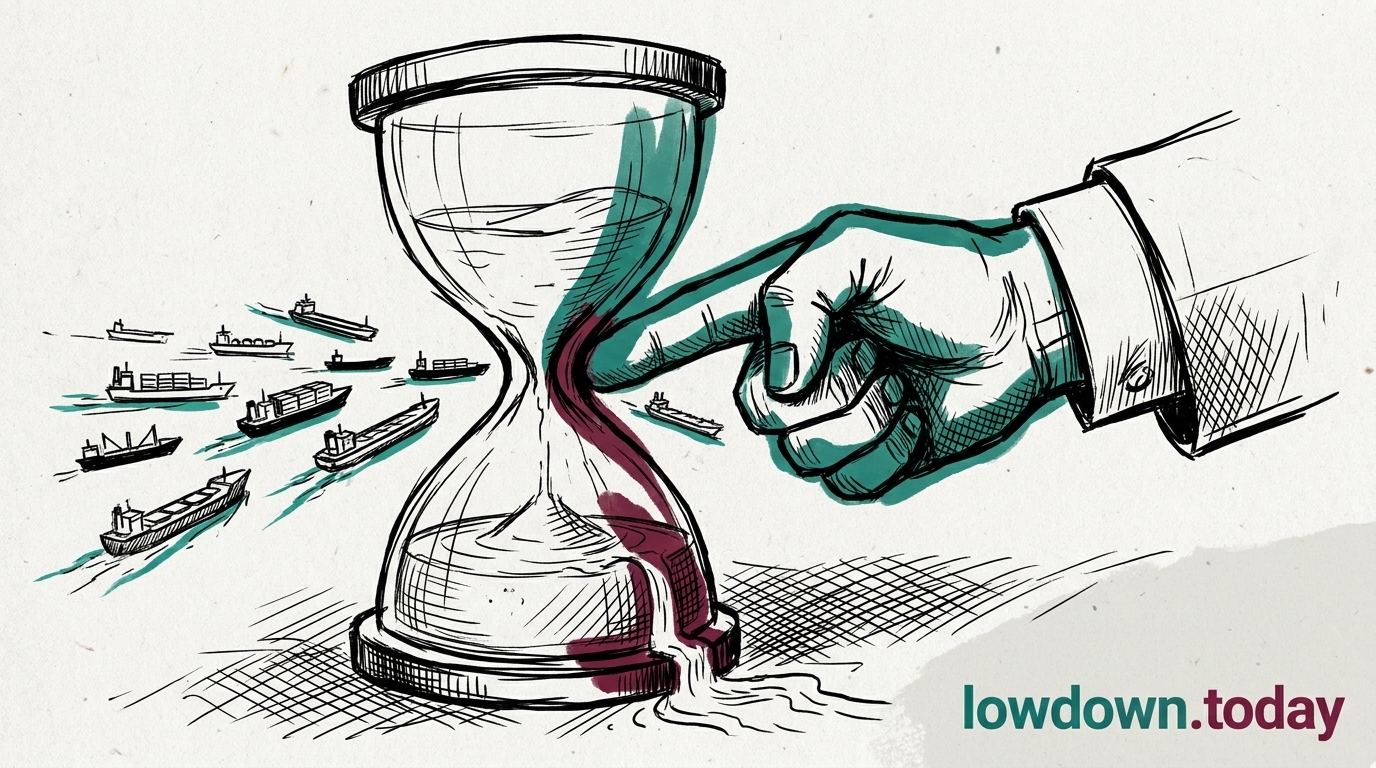
The physical Iranian crude premium collapsed from over $30 per barrel above Brent in early April to near-parity by mid-May 2, an effective $30 unwind in six weeks. Dark-fleet logistics absorbed Iranian supply faster than Western analysts modelled. Brent is now pricing residual escalation risk, not actual supply loss; the underlying barrels still reach refineries through the bilateral channel codified by Tehran.

Counter-perspective: a sustained Brent rally without a corresponding physical-market squeeze is the classic profile of a paper-market dislocation that mean-reverts when the next round of summit diplomacy delivers verbal de-escalation. The 1973 and 2008 precedents both show benchmark spreads above $20 sustained for under 90 days before retracing. The blockade itself reaches Day 78 on Saturday 16 May , making the next four weeks the empirical test of whether this episode breaks that pattern.

Deep Analysis

In plain English

Oil prices jumped back up to $109.30 on Saturday 16 May, undoing a brief dip that followed a US-China summit earlier in the week. The summit produced no concrete agreement on Iran, and markets concluded the war is no closer to ending. The odd part is that the price of actually buying Iranian oil has fallen dramatically. That is because a shadow fleet of tankers, mostly operating outside Western insurance and sanctions rules, has quietly been absorbing Iranian crude and getting it to buyers in Asia. Brent at $109.30 is pricing geopolitical risk. Iranian crude landing in Chinese and Indian refineries is pricing at near-parity to Brent because the dark fleet has normalised that supply chain. Each price reflects a different bet on how and when the conflict closes.

Deep Analysis
Root Causes

Brent at $109.30 reflects two disconnected pricing signals running in parallel. The benchmark prices the ongoing absence of any US executive instrument closing the war (the White House presidential-actions index records zero Iran instruments across 78 days) and the IEA's confirmed 246-million-barrel inventory draw. Neither of these resolves without a signed presidential instrument or a ceasefire architecture.

The physical premium collapse from $30 above Brent to near-parity reflects the dark fleet's absorption capacity. Iranian crude is reaching Chinese, Indian, and other Asian refiners via non-Western shipping and insurance, entirely outside the Lloyd's and Scandinavian P&I market. The consequence is that Iranian export revenues are closer to pre-war levels than the $109.30 benchmark implies, which reduces Tehran's economic incentive to accept ceasefire terms.

What could happen next?
  • Consequence

    Iran's near-parity physical crude premium reduces Tehran's economic pressure to accept ceasefire terms, since dark-fleet revenues are closer to pre-war levels than the Brent benchmark implies.

    Short term · 0.79
  • Risk

    Aramco's 2027 normalisation forecast means the Hormuz premium may persist in UK energy prices through at least 12-18 months of ceasefire and insurance-market recovery, even if fighting stops in June 2026.

    Medium term · 0.74
  • Meaning

    The benchmark-physical decoupling means standard Brent price signals are providing a misleading read of Iran's economic leverage and ceasefire incentive structure.

    Immediate · 0.83
First Reported In

Update #99 · Two Hormuz papers; Washington on neither

OilPrice.com· 16 May 2026
Read original
Different Perspectives
Oil markets / Lloyd's underwriters
Futures markets priced CENTCOM's strikes-complete statement as a de-escalation signal and pushed Brent down 1.7 per cent to $94.71, even as the IRGC declared Hormuz closed. Lloyd's war-risk premiums held elevated because institutional de-listing requires a UN Security Council resolution that Russia and China have just shown they will block.
Pakistan (mediator)
Pakistan (mediator)
Interior minister Mohsin Naqvi carried dual civilian and military letters to Mojtaba Khamenei in Tehran on 6-7 June with no public response. The IRGC's Hormuz closure on 11 June shows the corps is acting independently of the channel Pakistan is using, making the mediation structurally unable to produce a binding commitment without direct IRGC access.
Russia and China
Russia and China
Russia and China voted against GOV/2026/40 at the IAEA Board, following through on the blocking position coordinated with Grossi in Geneva on 5 June; both states continue to oppose Western institutional pressure on Iran at every multilateral venue.
E3 and IAEA (UK, France, Germany)
The E3 co-sponsored IAEA resolution GOV/2026/40, adopted 21-3-10 on 10 June, demanding Iran disclose 440.9 kg of unaccounted HEU and admit inspectors to four denied facilities. The 10 abstentions and Russia-China noes leave any Security Council referral without a viable enforcement path.
IRGC / Iran military command
The corps declared Hormuz closed to all traffic on 11 June and claimed two vessels struck, overriding the MoU its own civilian negotiators were pursuing through Pakistan. The closure order used the Persian Gulf Strait Authority apparatus to convert a toll mechanism into a military prohibition.
Trump administration / CENTCOM
CENTCOM completed a second day of strikes on Tehran, Sirik and Minab, rejected the IRGC Hormuz closure as inconsistent with observed transit, and said strikes were complete. Hegseth framed the bombing explicitly as the negotiation: the method is coercive deal-making with no stated pause threshold.