Skip to content
Briefings are running a touch slower this week while we rebuild the foundations.See roadmap
Iran Conflict 2026
9JUN

US strikes Iran's naval base mid-talks

3 min read
10:36UTC

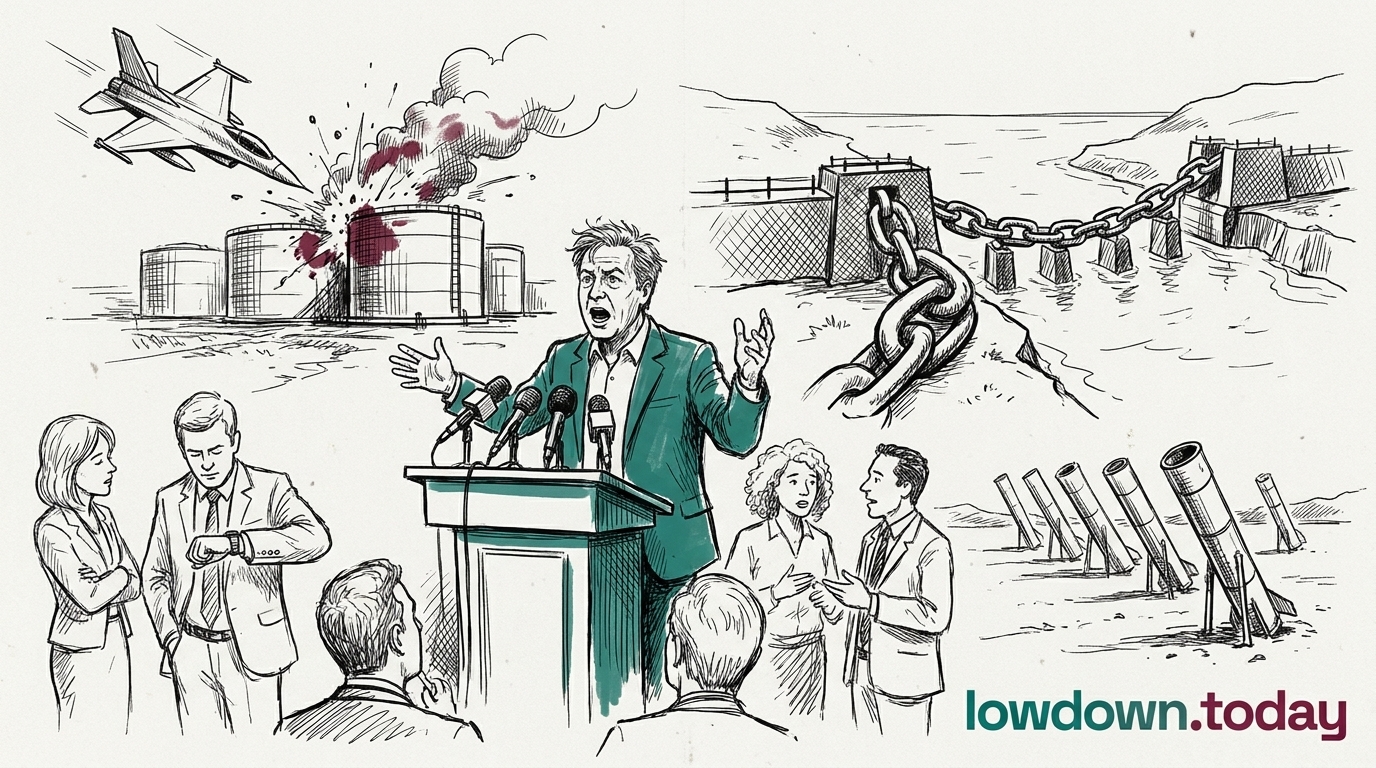
CENTCOM struck Iran's largest naval base on Monday 25 May, eliminating two IRGC mine-laying boats in the Strait of Hormuz hours after Iranian negotiators sat with Qatari mediators in Doha.

ConflictDeveloping
Key takeaway

Ordnance landed on Iran's naval base during live talks, showing neither capital commands a single institutional voice.

US Central Command (CENTCOM), the US military command for the Middle East, said its forces struck Iran's largest naval base at Bandar Abbas on Monday 25 May, eliminating two Islamic Revolutionary Guard Corps (IRGC) boats caught laying mines in the Strait of Hormuz and destroying a surface-to-air missile (SAM) site that had locked onto US warplanes 1. CENTCOM called the action self-defence, "defensive in nature, not offensive and not an effort to break the ceasefire", and a US official put the scope at "very small" 2.

Bandar Abbas sits at the narrowest navigable point of the strait and serves as the IRGC Navy's operational hub. The base is familiar ground in this war: an Israeli strike there in March killed IRGC Navy Commander Alireza Tangsiri. Mines in a shipping lane are a recognised casus belli, and striking the boats laying them falls under a commander's standing rules of engagement, not a presidential decision. That distinction matters, because it explains how ordnance can land on the IRGC's headquarters while Washington's diplomats wait on a counter-text.

Two days earlier Donald Trump had declared the accord "largely negotiated" , and the 18 May stand-down he posted at Gulf leaders' request had established the pattern of a diplomatic track and a military track answering to different authorities. The redirections that reached 70 vessels by 19 May escalated here to a direct kinetic strike. The IRGC's devolved mosaic defence pushes launch and emplacement authority down to provincial units, so Iran's civilian negotiators cannot credibly promise the boats will stop, even when they want the deal.

Iranian state outlet Fars News Agency dismissed Trump's "largely negotiated" line as "inconsistent with reality" the same day Tehran's own envoys kept the Doha channel open 3. Neither government can deliver at the table what its operators do in the field, the same dual-track method the West has long pinned on Washington, now running visibly on both sides.


Deep Analysis

In plain English

Iran's military wing, the Islamic Revolutionary Guard Corps (IRGC), was sending small boats to the Strait of Hormuz to lay underwater mines, devices that can blow a hole in a ship's hull. These boats operated from Bandar Abbas, Iran's largest naval port on the coast of the strait. US forces (CENTCOM, America's military command for the Middle East) spotted these boats in the act and bombed them, along with a surface-to-air missile system at the base that had targeted US aircraft. The US called it self-defence. A deal between the US and Iran was being negotiated at the same time, less than 24 hours away in Doha. Mine-laying during active diplomacy is significant because even one mine hitting a ship could spike oil prices, sink a deal, and restart the shooting. The IRGC's navy and Iran's diplomats answer to different bosses, which is why both things happened on the same morning.

Deep Analysis
Root Causes

The Bandar Abbas strike is made possible by a legal architecture no current actor has closed. The 1982 UN Convention on the Law of the Sea guarantees transit passage through international straits, but Iran never ratified UNCLOS.

Iran's 2024 maritime law updates claim jurisdiction over "hostile-linked vessels" inside its self-declared 12-nautical-mile territorial sea, which overlaps the navigable channel. CENTCOM operates under an Article 2 self-defence doctrine that requires no congressional authorisation and no signed instrument, allowing kinetic action to proceed entirely outside the civilian negotiating track.

The IRGC mine-laying boats were operating from Iran's largest naval base precisely because the base survived the early-campaign strikes that killed Admiral Tangsiri in March. Without a signed ceasefire instrument or written rules of engagement from any party, both sides retain unilateral authority to define what constitutes a threat, and both are exercising it simultaneously.

Escalation

The Bandar Abbas strikes move the conflict closer to direct naval exchange than at any point since the opening campaign. CENTCOM's framing as "very small" and "defensive" is designed to contain escalatory signalling, but the precedent of striking a major Iranian naval base while ceasefire talks run simultaneously is structurally significant.

The IRGC has historical precedent for absorbing targeted naval strikes without widening the war (1988 Praying Mantis), but it also has precedent for delayed asymmetric retaliation (2020 Ain al-Assad). The next 48-72 hours of IRGC communications will indicate which template Tehran is using.

What could happen next?
  • Risk

    If the IRGC retaliates against a US vessel or Gulf state target, ceasefire talks in Doha collapse and Brent reprices toward the $112.10 conflict high.

    Immediate · Suggested
  • Precedent

    CENTCOM's Article 2 self-defence strike on a major Iranian naval base while diplomacy runs in parallel sets a template that IRGC commanders can invoke symmetrically to justify their own "defensive" operations.

    Medium term · Assessed
  • Consequence

    Lloyd's of London Joint Hull Committee will treat the Bandar Abbas strike as evidence the war-risk designation at Hormuz was correctly held, blocking any early de-listing.

    Short term · Assessed
First Reported In

Update #108 · US strikes Bandar Abbas as deal talk stalls

KVIA (CENTCOM statement)· 26 May 2026
Read original
Causes and effects
This Event
US strikes Iran's naval base mid-talks
A force-protection strike during live negotiations shows the US military track running independent of the diplomatic one, with each side's soldiers contradicting its diplomats the same afternoon.
Led to
Brent bounces; ship insurers stay put
The Bandar Abbas strike on 25 May (event 0) drove Brent's 1.63% bounce to $98.83 on 26 May by repricing oil risk that deal optimism had stripped out.
Occurred 26 May 2026
Read story →
IRGC claims first US aircraft kill
CENTCOM destroyed IRGC mine-laying boats at Bandar Abbas on 25 May (ID:3611); the IRGC's 26 May MQ-9 claim and aircraft firings are the declared kinetic retaliation.
Occurred 26 May 2026
Read story →
Iran war cabinet home, no deal signed
CENTCOM struck Bandar Abbas on Arafah Day without notifying Saudi Arabia (ID:3611); the six-day Saudi silence and diplomatic slight are the direct consequence.
Occurred 26 May 2026
Read story →
Tanker struck at Hormuz mouth, no claim
The Olympic Life was struck on the same day as the CENTCOM Bandar Abbas strikes; attribution to IRGC retaliation is uninvestigated but the timing invites the link.
Occurred 26 May 2026
Read story →
Iran fires ballistic missile at Kuwait
Iran's 27 May ballistic missile at Kuwait and drone launches near Hormuz were framed by the IRGC as retaliation for CENTCOM's 25 May strikes on Bandar Abbas mine-laying boats and SAM site.
Occurred 28 May 2026
Read story →
Kuwait invokes Article 51 after strike
CENTCOM's 25 May Bandar Abbas strike set the operational pattern for the 28 May retaliatory drone-station strike following the Kuwait missile.
Occurred 28 May 2026
Read story →
CENTCOM hits Goruk and Qeshm Island
The mine-laying boat destruction at Bandar Abbas is part of the kinetic lineage that the Goruk/Qeshm strikes continue.
Occurred 31 May 2026
Read story →
Different Perspectives
Gulf shipping and insurance markets
With Hormuz and Bab el-Mandeb both hostile at once, war-risk underwriters face their first dual-chokepoint pricing problem; the rerouting hedge that absorbed one closure is gone for Israeli-linked hulls. Any deal that reopens Hormuz without a Houthi stand-down clause delivers only partial shipping relief.
Russia and China
Russia and China
Russia and China met IAEA chief Grossi jointly in Geneva on 5 June to coordinate an advance blocking position against Washington's censure resolution, the first documented instance of proactive pre-session obstruction rather than reactive post-vote dissent. Beijing's move came four days after OFAC designated Shanghai Qianye Energy under Iran energy sanctions.
Saudi Arabia
Saudi Arabia
Saudi Arabia was left out of the emergency $4.01 billion Patriot waiver Qatar received on 2 May as its own PAC-3 stocks ran near-empty from intercepting Iranian salvoes over Aramco facilities. Riyadh is on a standard 18-month FMS queue behind a production line booked through 2030, with no equivalent priority to Qatar's Al Udeid basing role.
Houthis (Ansar Allah)
The Houthis declared a complete ban on Israeli Red Sea navigation on 8 June and struck Jaffa, their first attack on Israeli territory since April, seven days after the Tasnim authorisation to activate other fronts including Bab el-Mandeb. The declaration put both chokepoints under hostile authority simultaneously.
Iran
Iran
Iran agreed the 9 June mutual halt after the Mahshahr exchange and coordinated with Russia and China to block Washington's IAEA censure resolution, using the Board as a second front while the bilateral pause held on the military one. Tehran's acceptance of the Lebanon carve-out contradicts the linkage position it stated on 1 June.
Benjamin Netanyahu and the IDF
Israel struck the Karun Petrochemical plant at Mahshahr on 8 June over Trump's explicit objection, then agreed a halt with Iran the following day scoped on Israeli terms with Lebanon carved out. Netanyahu's posture is that the IDF will not accept Iranian missile factories as off-limits regardless of US diplomatic timelines.



