Skip to content
You can now search across every topic, entity and event.What's new
Iran Conflict 2026
9JUN

Trump talks war, signs no orders

3 min read
10:36UTC

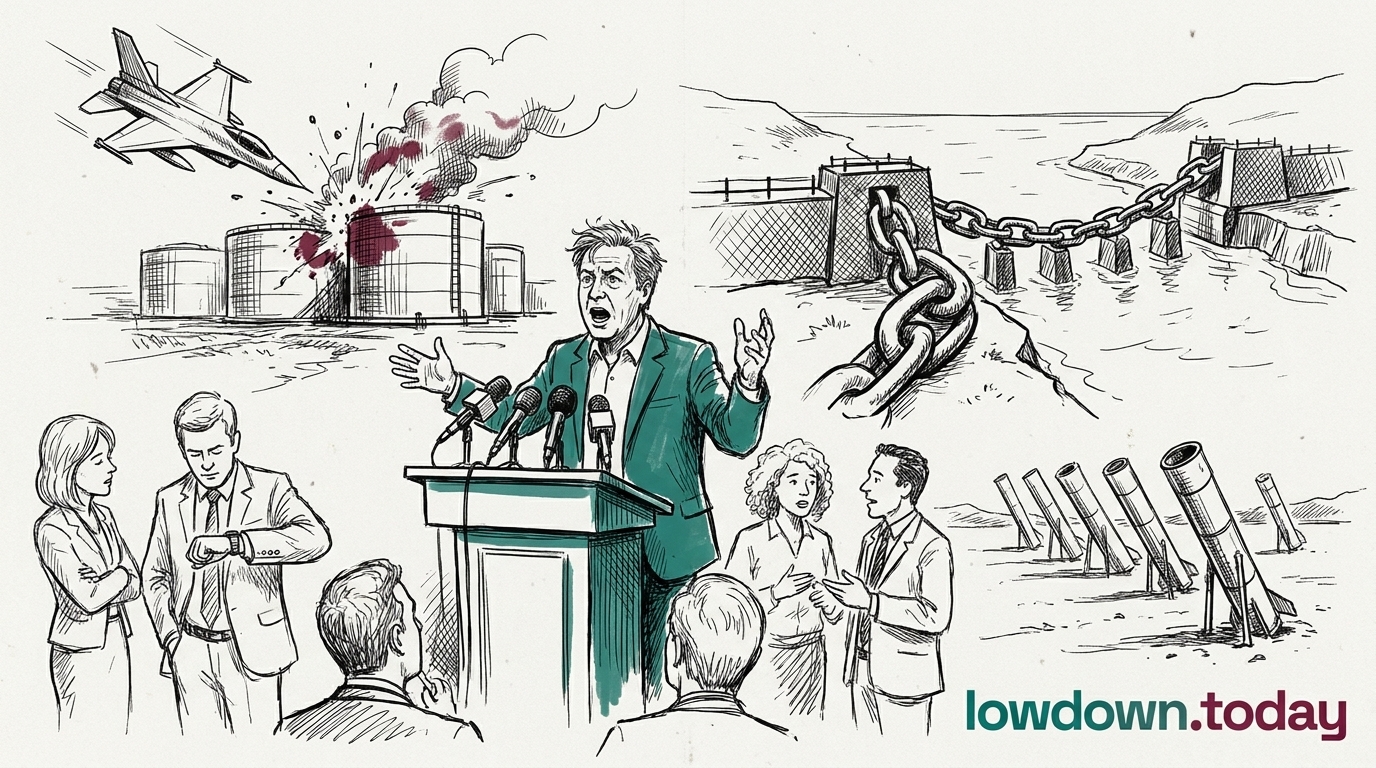
Trump posted mid-session on 21 June that the US would 'hit Iran very hard again, only harder' and told Fox it would 'take over the strait'; OFAC, the Federal Register and the Presidential Actions index carried zero Iran entries on either day.

ConflictDeveloping
Key takeaway

Trump escalated to strait-seizure and renewed strikes while his government signed no order, designation or licence.

Donald Trump posted on Truth Social on 21 June that Iran must "immediately stop their highly paid PROXIES in Lebanon" or the United States would "hit Iran very hard again, just like we did last week, only harder" 1. In a Fox News phone interview the next morning he said that if Iran closed the Strait of Hormuz the US would "blow the s--- out of them", and threatened to "take over the strait" and "collect tolls". The threats landed mid-session at the Switzerland round, the working talks implementing the 16 June Islamabad Memorandum of Understanding between Washington and Tehran.

US policy binds through three registers that do not respond to a social-media post: The White House Presidential Actions index, the Treasury sanctions authority known as OFAC, and the Federal Register, the government's record of official acts. Each carried zero Iran entries across 21 and 22 June. Trump signed the memorandum and ordered the naval blockade lifted on 16 June ; these threats added no order, designation or licence behind them.

Iran's delegation paused the talks and, by the Jerusalem Post's account, walked out on the Sunday night before returning 2. Ghalibaf refused to join the group photo and gave no joint press conference, and Iranian state media said the session stopped after an "insulting message" from the US President. US officials said the delegation stayed on-site throughout, so the two accounts of that evening differ. Either way the threats bought a diplomatic cost, not a concession.

Deep Analysis

In plain English

During the Switzerland talks, President Trump posted on his social media site threatening to bomb Iran again and even to seize the Strait of Hormuz. But when you check the US government's official registers (the documents that make policy real and legally binding), there was nothing there. No order to the military, no new sanctions, nothing signed. This matters because Iran has learned to tell the difference between Trump's words and actual US government action. His team in Switzerland kept negotiating rather than leaving for good, but Iran's delegation did pause and briefly walked out, probably to signal to hardliners back home that they are not simply accepting whatever Trump says.

Deep Analysis
Root Causes

Trump's threat-and-sign-nothing pattern across the full conflict (the pattern was established by Day 80, as noted in the US entity context) reflects an executive branch running two parallel foreign policies: the institutional track (OFAC, Federal Register, Pentagon) and the presidential-communications track (Truth Social, Fox News). OFAC, the Federal Register, and the Pentagon act on signed instruments; Truth Social posts bind nobody.

The IRGC's ability to read this gap is the structural root cause of the delegation pause rather than full walkout: Ghalibaf's faction knows the threat had no instrument behind it but cannot appear indifferent to it.

Escalation

De-escalatory in outcome: the Iranian delegation's return after the walkout, and the subsequent communique, shows the threat did not break the talks. But the pattern erodes US credibility for future coercion: each unexecuted threat makes the next one cheaper for Iran to absorb.

What could happen next?
  • Risk

    Repeated unexecuted threats reduce US coercive leverage in the 60-day final-agreement window; Iran's negotiating team now has a documented baseline (two IRGC closure declarations, multiple Truth Social threats, zero accompanying instruments) for calibrating future US pressure.

  • Consequence

    Ghalibaf's photo refusal gives IRGC hardliners a visible symbol that the pro-deal bloc did not capitulate, reducing the domestic political cost of continued engagement.

First Reported In

Update #135 · Trump's threats peak, his paper stays blank

Reuters· 22 Jun 2026
Read original
Causes and effects
This Event
Trump talks war, signs no orders
On the two days the President threatened the most, the registers that turn US policy into binding action recorded nothing.
Different Perspectives
India
India
India buys more Saudi crude than any other country and has 2.5 million nationals working in the kingdom, so a $100 Brent and a live strike on Saudi tankers reach New Delhi through both fuel bills and remittance risk. Neither channel has an alternative route the way Saudi Arabia's own pipeline does.
Qatar
Qatar
Qatar co-authored the four-mediator ten-day ceasefire proposal alongside Egypt, Pakistan and Oman, centred on resuming Hormuz navigation, while separately pursuing its dated compensation claim against Iran at the UN Security Council filed on 21 July. Doha is mediating and litigating in the same week.
Israel
Israel
Israeli intelligence, reported by the Wall Street Journal, assesses Iran moved thousands of centrifuges and part of its roughly 440kg enriched-uranium stock into Pickaxe Mountain after the June 2025 strikes on its three main nuclear sites. Some of the US refuelling aircraft now deploying to the region are bound for Israeli bases and Ramon Airport.
Houthis
Houthis
Yahya Saree announced the missile and drone strikes on the Encelia and Layla on 22 July as enforcement of the embargo his forces had declared by radio warning alone two days earlier. Six vessels already turned back on the broadcast; the strike shows Houthi forces will use weapons once warnings stop working.
Saudi Arabia
Saudi Arabia
Saudi Arabia's state news agency confirmed only a fire on the Encelia's bow, with the crew safe; the Layla strike remains unconfirmed by Riyadh. The kingdom built its Petroline pipeline specifically to bypass Hormuz through the Red Sea, so the tanker fire lands on the route Riyadh had already spent billions escaping.
United States
United States
Washington is weighing both ten-day proposals but wants a longer truce than either offers, and moved F-16 and F-35 jets plus refuelling aircraft into the region while it decides. That deployment, not Trump's Pickaxe Mountain remarks, is the measurable US action, buying options for the day talks fail rather than betting on them.