Skip to content
Briefings are running a touch slower this week while we rebuild the foundations.See roadmap
Iran Conflict 2026
4JUN

Iran fires on Al Udeid, Gulf air hub

4 min read
11:25UTC

The base coordinating every US and coalition sortie against Iran was targeted overnight. Qatar — which has not joined the operation and shares the world's largest gas field with Tehran — has said nothing.

ConflictDeveloping
Key takeaway

Iran has shifted from targeting US symbols and diplomatic presence to targeting the infrastructure actively running the war against it, imposing a command-and-control cost that is qualitatively different from previous strike objectives.

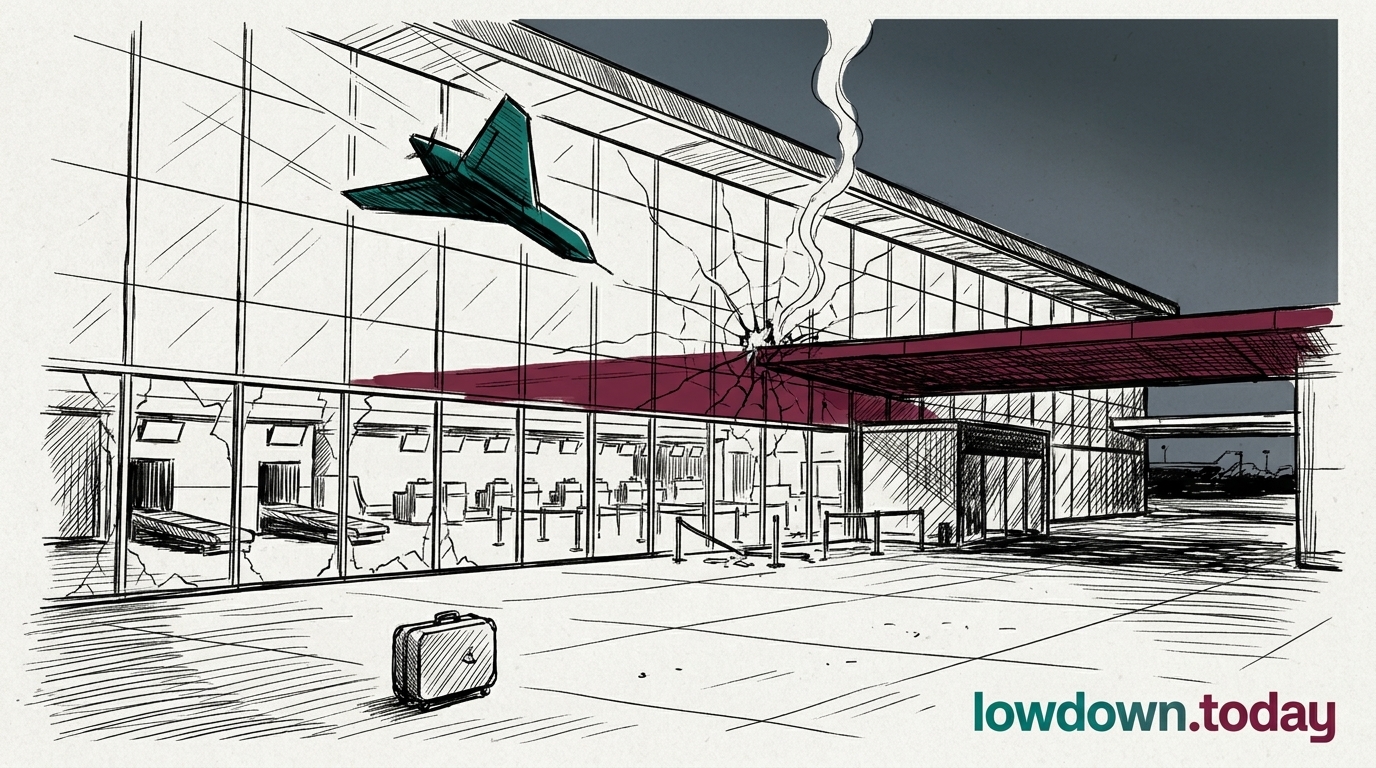
Iran targeted Al Udeid Air Base in Qatar overnight — America's largest military installation in the Middle East. Al Udeid hosts the Combined Air Operations Centre (CAOC), which assigns targets, routes aircraft, and deconflicts every US and Coalition sortie across the theatre. When Defence Secretary Hegseth spoke of achieving "complete control of Iranian skies" , the CAOC at Al Udeid is the facility that would deliver it. Neither the US nor Qatar has released a damage assessment.

Qatar's silence is distinct from Washington's. Qatar has not publicly joined the US-Israeli operation. It hosts Al Udeid under a bilateral defence cooperation agreement first signed in 1992, expanded significantly after 2002 when the CAOC relocated from Saudi Arabia's Prince Sultan Air Base after Riyadh asked the US to draw down. Doha has maintained closer relations with Tehran than its Gulf neighbours, driven in part by the South Pars/North Dome gas field — the world's largest natural gas reserve — which Iran and Qatar share across their maritime border. Iran already struck Qatar's Ras Laffan LNG complex on Monday , forcing QatarEnergy to halt all LNG production . China intervened directly, pressing Tehran to spare Qatari energy infrastructure . The Al Udeid strike suggests Iran has concluded that Qatar's role as the platform from which the air campaign is prosecuted overrides whatever restraint Beijing's intervention purchased.

The IRGC had previously claimed to have "dismantled a US radar installation in Qatar" — a claim neither Washington nor Doha addressed. Whether accurate or not, hitting Al Udeid goes further: from peripheral installations to the base coordinating the entire campaign. If Hegseth's claim of more than 2,000 targets struck is accurate, a substantial share of those missions were tasked from the CAOC now under fire.

For Qatar, the political position is acute. A public assessment confirming damage to Al Udeid could accelerate domestic pressure to revisit the basing agreement. Confirming the base was unharmed would undercut Iran's claims and risk further retaliation. Saying nothing — which is what Doha has chosen — avoids provoking either Washington or Tehran while the war's trajectory remains unclear. But silence has a shelf life. Qatar supplies roughly 20% of the world's LNG, hosts the command centre running the air war, and shares its most valuable natural resource with the country being bombed. That position cannot hold indefinitely.


Deep Analysis

In plain English

Al Udeid is not just a base where planes park — it is the room where every US and allied aircraft mission across the entire region gets planned, tracked, and coordinated in real time. Striking it is less like attacking a garage and more like attacking the air traffic control tower for the whole war. Qatar, which has carefully avoided publicly joining the US-Israeli operation, now finds itself absorbing strikes because it hosts the facility running that operation — a neutrality that Iran's targeting logic does not recognise.

Deep Analysis
Synthesis

Targeting the CAOC implicitly tests whether the US will retaliate symmetrically against Iranian command-and-control equivalents — IRGC headquarters, radar and communications nodes, MOIS facilities. The absence of a US damage assessment may reflect an effort to avoid being forced into a public response commitment that would either require escalation or signal tolerance for C2 strikes. Both options carry strategic costs the administration has not yet chosen between.

Root Causes

Iran's doctrine of graduated counter-pressure — targeting progressively more critical nodes in the adversary's operational architecture — explains the sequence from diplomatic to command-and-control targets. The IRGC's targeting logic follows a consistent asymmetric principle: make the operational tempo unsustainable by degrading the infrastructure coordinating it, rather than attriting aircraft or personnel at the margin.

Escalation

Qatar's public non-participation gives it no protective status under Iran's apparent 'host nation bears responsibility' targeting doctrine. This removes Qatar's ability to maintain genuine neutrality and may force it toward either requesting US forces to reduce their operational footprint — depriving the US of its primary regional air operations centre — or accepting de facto belligerent status with all the targeting exposure that entails.

What could happen next?
  • Consequence

    Qatar faces an immediate forced choice between distancing itself publicly from US operations — risking its primary security partnership — and accepting de facto belligerent status with the targeting exposure that entails.

    Immediate · Assessed
  • Risk

    CAOC disruption, even partial, could reduce coalition sortie coordination efficiency and create targeting deconfliction gaps during a period of maximum operational tempo.

    Immediate · Assessed
  • Precedent

    Successful strikes on US command-and-control infrastructure without triggering immediate US retaliation in kind would validate Iran's escalation-without-response theory and incentivise further targeting of C2 nodes across the theatre.

    Short term · Suggested
  • Risk

    If Qatar requests US forces to stand down or relocate to avoid further strikes, the US loses its primary regional air operations centre with no equivalent replacement at comparable readiness.

    Medium term · Suggested
First Reported In

Update #20 · Hormuz sealed; Senate war powers bill fails

Breaking Defense· 5 Mar 2026
Read original
Causes and effects
This Event
Iran fires on Al Udeid, Gulf air hub
Al Udeid hosts the Combined Air Operations Centre coordinating the entire air campaign against Iran. Targeting it is a direct attempt to disrupt US command-and-control. Qatar's silence — caught between its US basing agreement and its exposure to Iranian retaliation for a war it did not join — reflects the political impossibility of its position.
Different Perspectives
Israel
Israel
IDF Chief Eyal Zamir declared on 3 June there was no ceasefire for his forces, and strikes killed at least 10 civilians and one Israeli soldier on 4 June. The IDF killed Hezbollah's chief engineer and warned three south Lebanon villages to evacuate on 5 June, advancing into ground the unsigned Washington framework has not caught.
Hezbollah / Lebanon
Hezbollah / Lebanon
Naim Qassem rejected the Washington Lebanon framework on 4 June as "absurd, humiliating and insulting", blocking a ceasefire instrument that required Hezbollah to withdraw north of the Litani before any Israeli withdrawal. Over one million Lebanese remain displaced; the framework's collapse prolongs that toll.
Iran
Iran
Foreign Minister Araghchi publicly coupled the Lebanon ceasefire to the Iran-US nuclear track on 4 June, carrying IRGC authority rather than his own civilian mandate. The IRGC delegation has sent no HEU counter-proposal since Araghchi confirmed no progress that same day; Mojtaba Khamenei's 21 May order to keep the 440.9 kg stockpile inside Iran remains operative.
United States
United States
Rubio placed the Iran-US deal at 95 per cent complete on 4 June while the administration signed no Iran instrument and OFAC designated only Cuban targets. Trump separately disclosed and rejected an airlift plan to collect Iran's HEU stockpile, claiming the material is "entombed", a claim the IAEA cannot verify.
China
China
Beijing's MOFCOM Blocking Rules constrain OFAC enforcement on the mainland; China has not corroborated Trump's verbal account of any bilateral summit, and the rial's failure to hold its Rubio bounce, combined with the IRGC's stablecoin rail closure, increases Chinese yuan-denominated oil-payment exposure through Hormuz.
Bahrain
Bahrain
The IRGC struck Bahrain on 3 June as its sirens sounded and its PAC-3 magazine neared exhaustion; excluded from Rubio's 2 May emergency resupply, Bahrain received a 50-round Federal Register notice on 1 June on an 18-month delivery timeline, meaning it is defending the US Fifth Fleet headquarters on the last rounds it has.



