Skip to content
You can now search across every topic, entity and event.What's new
European Tech Sovereignty
27MAY

Mediators sign the deal, the parties don't

3 min read
15:19UTC

Qatar and Pakistan issued the only communique of the Switzerland round on 22 June, announcing a 60-day roadmap and an oversight committee; neither Washington nor Tehran put a name to it.

TechnologyDeveloping
Key takeaway

The Geneva round produced a 60-day roadmap and oversight committee, but only Qatar and Pakistan signed it.

Qatar and Pakistan, the two mediators, issued a joint communique on 22 June announcing a 60-day roadmap toward a final US-Iran deal, a High-Level Committee of senior officials to oversee the talks, and technical sub-groups set to run through the week on the nuclear file, sanctions and dispute resolution 1. The communique came on the second day of the Switzerland round at the Burgenstock Resort near Lucerne, where JD Vance, the US Vice-President, met Iran's Foreign Minister Abbas Araghchi and parliament speaker Mohammad Bagher Ghalibaf.

The Switzerland round is the working session implementing the Islamabad Memorandum of Understanding, the ceasefire and sanctions framework the United States and Iran signed on 16 June. Vance reached Burgenstock the previous day for the first direct session of the round . The High-Level Committee is a political steering body: senior officials who supervise the technical teams haggling over the detail.

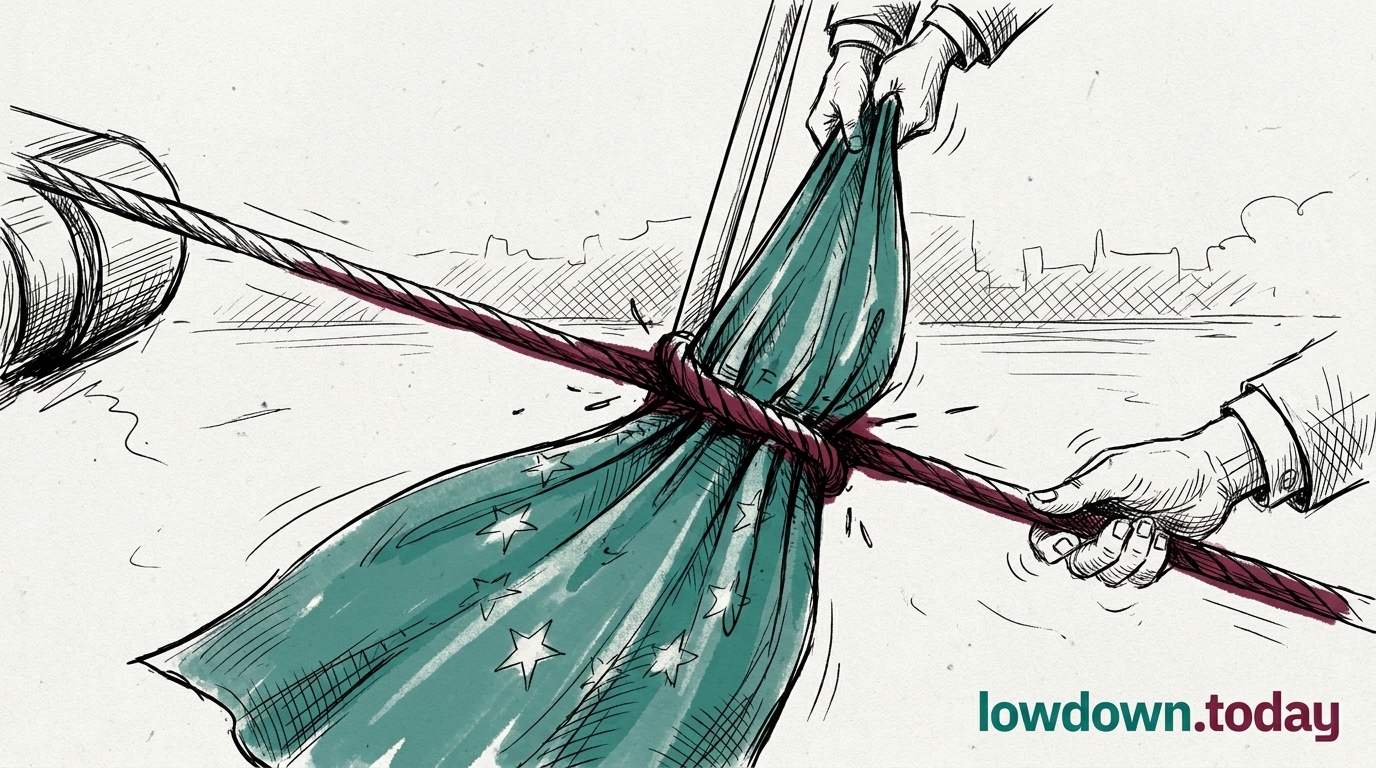
No US-Iran joint statement emerged. Pakistani Prime Minister Shehbaz Sharif called it "a great day that will lead to world peace", and the Qatari foreign ministry called it "just the beginning". The scaffolding of the negotiation is now built, yet Washington and Tehran signed none of it, leaving the only paper record of the round in the hands of the mediators rather than the principals.

Deep Analysis

In plain English

Iran and the United States are trying to reach a deal, but neither side wants to be seen publicly agreeing with the other. So instead, two other countries (Qatar and Pakistan) announced a plan on their behalf: a 60-day timetable and a committee of senior officials to oversee the negotiations. Qatar and Pakistan signed the communique; the United States and Iran did not. Iran's delegation even refused a group photo at the talks. A plan announced only by the middlemen carries no legal weight: if either the US or Iran decides to walk away, neither has formally agreed to anything that can bind them.

Deep Analysis
Root Causes

Iran's refusal to issue a joint statement with the United States reflects the IRGC's veto over civilian diplomacy. Ghalibaf's refusal of the group photo is institutional signal: the Majlis speaker cannot be photographed alongside Vance without providing hardliners grounds to accuse the pro-deal bloc of capitulation. The IRGC's Khatam al-Anbia closure declaration on 20 June had already framed the negotiations as proceeding under duress.

The US side's preference for a mediator-issued communique rather than a joint instrument reflects the Trump administration's pattern across the full conflict : announcing outcomes through verbal channels that create no binding precedent and require no Congressional notification. A joint US-Iran text at this stage would trigger the War Powers Resolution clock and the Murkowski AUMF debate.

Escalation

Lateral: the communique reduces the immediate risk of a further Iranian unilateral action (such as a third Hormuz closure declaration), but the mediator-only signature and Ghalibaf's photo refusal are early-warning signals that the Iranian side has not committed politically to the roadmap's endpoint.

What could happen next?
  • Risk

    The High-Level Committee has no enforcement mechanism; if either the US or Iran disputes an interpretation, the mediators (Qatar, Pakistan) have no binding instrument to invoke.

    Short term · Assessed
  • Consequence

    A mediator-signed framework that produces no joint text by the 60-day deadline will be harder to revive than the Islamabad MOU was, because both sides will have spent political capital on a process that visibly failed.

    Medium term · Reported
  • Precedent

    The Qatar-Pakistan co-mediation model, if it produces even a partial deal, becomes the template for future US-Iran contacts: both states can deny direct engagement while using third parties to announce outcomes.

    Long term · Reported
First Reported In

Update #135 · Trump's threats peak, his paper stays blank

NBC News· 22 Jun 2026
Read original
Causes and effects
This Event
Mediators sign the deal, the parties don't
The institutional architecture of the US-Iran talks now exists, but the two governments doing the negotiating authored none of it.
Different Perspectives
United States (Google/Alphabet)
Alphabet lost its final Android appeal on 2 July with no further court to hear it, a result its Computer and Communications Industry Association allies frame as precedent, not deterrence, since the €4.1bn fine changed nothing about Google's Play Store terms across eight years of litigation.
UK Department for Science, Innovation and Technology
DSIT opened its £96m second Sovereign AI wave on 3 July, switching from April's equity stakes to fixed-price contracts because Britain has no domestic hyperscaler or Bpifrance-style lender to fund capacity another way. It is betting on buying outcomes it controls alone rather than joining an EU-wide framework.
German federal government
Berlin backed both German deliverables this week, Infineon's fab and Aleph Alpha's merger, but is finding one far harder to close than the other. It wants enforceable protective rights inside Cohere's cap table before the merger closes, a legal instrument the Bundeskartellamt has no filing to review yet.
European Commission
European Commission
The Commission banked a clean CJEU win on the eight-year Android case on 2 July, removing Google's last comparator argument before President von der Leyen rules on the far larger DMA self-preferencing fine due 27 July. Brussels treats Infineon's early Dresden delivery as proof the Chips Act mechanism works, at the node Europe already led.
Bruegel (EU industry sceptics)
Bruegel economist Mario Mariniello argued the EU sovereignty package mimics US and Chinese strategy while EU cloud providers hold roughly 15% of their home market; using nationality as a proxy for security without fixing the underlying capital and energy gaps that drive the dependency creates €86bn of migration cost without the security benefit it is sold as delivering.
France
France
France published a joint sovereignty definition with Germany at VivaTech and mobilised €13bn under Tibi Phase 3, placing SAP's partnership with Mistral as the working proof that a German enterprise-software giant running a French sovereign model inside public administration is what digital sovereignty looks like in practice.
