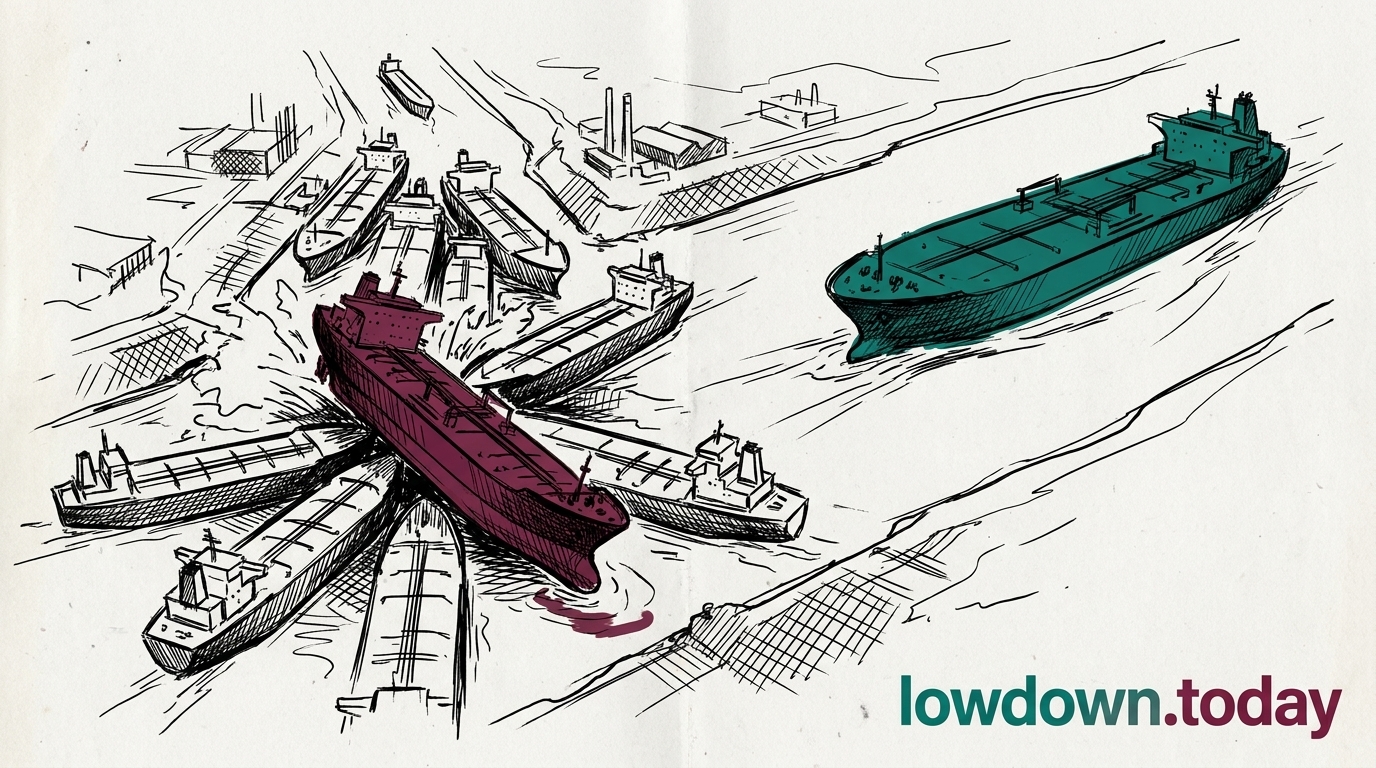
Saudi crude loadings through Bab el-Mandeb, the strait between Yemen and the Horn of Africa that funnels Suez-bound shipping, fell 36% in two weeks, from 9.5 million barrels a day at the 29 June peak to 6.1 million in the week of 13 July, before a shot was fired1. The Houthis, the Yemeni armed movement that controls the country's Red Sea coast, declared a naval blockade of Saudi-linked shipping through the strait on 20 July. On 23 July they struck two Saudi tankers, the Encelia and the Layla, with missiles and drones in the Red Sea; both caught fire, the Encelia broadcast 'not under command', and no crew casualties were reported2.
More than 2,000 ships have already rerouted around the Cape of Good Hope, adding up to three weeks to a Europe-bound voyage, and Saudi exporters have pushed over 70% of their barrels to the west-coast terminal at Yanbu to skip the strait entirely. The military dimension belongs to the Gulf war that took Brent past $90 on Iran's strike against Kuwait. Every barrel that rounds the Cape instead of transiting Suez ties up a ship for longer, and a fleet that turns slower charges more.
Analysts cited by Bloomberg warn that a full Bab el-Mandeb closure stacked on the Hormuz constraint could put roughly a quarter of world oil and gas at risk3. That figure describes a ceiling rather than a base case: the strait is being avoided, not sealed, and rerouting round the Cape keeps the barrels flowing at a higher freight cost rather than removing them from the market.




