Skip to content
You can now search across every topic, entity and event.What's new
European Oil Markets
16JUL

Medvedev likens Hormuz to nuclear arms

3 min read
09:39UTC

Dmitry Medvedev, Putin's envoy to the Tehran funeral, wrote that Iran's grip on the Strait of Hormuz is equivalent to possessing a nuclear weapon.

EconomicDeveloping
Key takeaway

Russia's Medvedev called Iran's Hormuz leverage a nuclear-equivalent deterrent, the strongest outside endorsement of that threat yet.

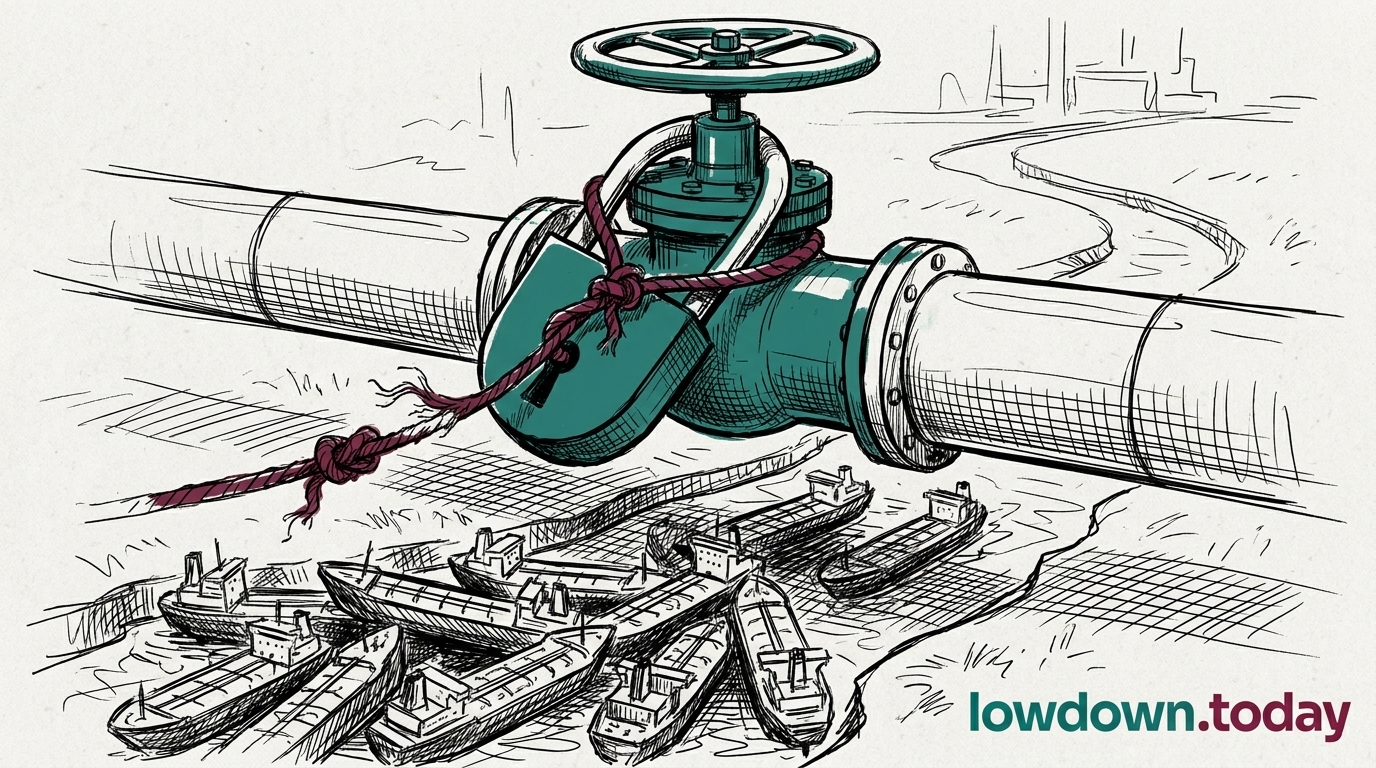
Dmitry Medvedev, deputy chairman of Russia's Security Council, attended the Tehran funeral as Vladimir Putin's personal envoy and wrote on Telegram that Iran's ability to disrupt the Strait of Hormuz "is equivalent to possession of a nuclear weapon" 1. the strait is the shipping channel through which roughly a fifth of the world's oil passes, and Iran sits on its northern shore. Medvedev added that Iran will "prevail" over the United States, and of the paused Doha negotiating track said: "negotiations are good, but they must be concluded with a result" 2.

TASS (Russia's state news agency) reported that Medvedev also reaffirmed the Russia-Iran comprehensive strategic partnership treaty, the 2025 pact formalising cooperation between the two states 3. His delegation carried Orthodox, Sunni and Shia clergy, a religious-diplomacy gesture more than a government-to-government one.

The framing matters more than the theatre. Since the war's opening weeks, Iran's grip on the strait has been treated as a commercial-disruption risk, a threat to oil prices and shipping schedules. Medvedev, speaking for a nuclear-armed partner, recast it as a strategic deterrent in its own right, the most explicit external endorsement yet of the chokepoint as a weapon Iran already holds. That gives Tehran outside cover to treat any future interdiction as deterrence rather than economic warfare.

Yet Putin stayed home and sent a deputy, matching China, which also sent its own deputy while Pakistan's prime minister came in person and Europe was left off the guest list entirely . The nuclear-weapon analogy is cheap to voice and costly to disown, which is why it arrived on Medvedev's Telegram feed rather than in a Kremlin statement. Russia is signalling alignment while withholding the personal Putin commitment that would raise the stakes.


Deep Analysis

In plain English

Dmitry Medvedev is a senior Russian official, formerly Russia's president, who now serves as deputy chair of its Security Council. Russia's actual president, Vladimir Putin, did not attend Iran's state funeral for its late supreme leader; he sent Medvedev instead. At the funeral, Medvedev made a striking comparison: he said Iran's ability to block the Strait of Hormuz, a narrow shipping channel through which a large share of the world's oil passes, is as powerful a deterrent as owning a nuclear weapon. He also reaffirmed a treaty between Russia and Iran that formalises their cooperation, though the treaty does not commit Russia to defend Iran militarily. The comparison matters because it puts a Russian stamp of approval on Iran's argument that it doesn't need nuclear weapons to have serious leverage over the rest of the world, it just needs control of a narrow strip of water.

Deep Analysis
Root Causes

Russia's own leverage over Iran is limited by the comprehensive strategic partnership treaty's terms, which commit both states to consultation but not mutual defence, so Moscow has no treaty obligation to intervene materially at Hormuz and instead trades rhetorical alignment for continued Iranian cooperation on other fronts.

Iran's Hormuz-as-deterrent framing depends on the strait remaining under-transited relative to its pre-war baseline: the moment vessel counts return fully to normal, as they have begun to on some days , the chokepoint's deterrent value as a live threat, rather than a historical one, erodes.

Escalation

Direction: rhetorical escalation without a material commitment. Medvedev's statement raises the stakes of Hormuz rhetorically but is not accompanied by any announced Russian naval deployment or arms transfer, so the practical escalation risk remains tied to Iran's own IRGC Navy posture rather than Russian involvement.

What could happen next?
  • Meaning

    Russia's highest-level funeral representation endorsing Iran's chokepoint doctrine gives Tehran a rhetorical ally for its Hormuz leverage without any accompanying material Russian commitment.

  • Precedent

    Framing a conventional chokepoint capability as nuclear-equivalent gives other states with geographic leverage, such as Egypt over Suez, rhetorical cover to make similar claims in future disputes.

First Reported In

Update #147 · Japan opens Iran oil talks under US waiver

Al Jazeera· 6 Jul 2026
Read original
Different Perspectives
Indian refiners
Indian refiners
Indian refiners kept lifting discounted Urals as the India/Baltic price split widened past $9-10 a barrel, a gap that only grows as GL X1's Iranian wind-down cuts an alternative discounted grade off the market by 17 July. Cheaper Russian feedstock is being locked in while it lasts.
Chinese refiners
Chinese refiners
Chinese refiners gain leverage as the Urals-Brent discount widens, since Beijing's state buyers already source discounted Russian barrels near the fiscal floor unaffected by Western insurance costs. A wider discount, if it holds past 23 July, lets them lock in cheaper term contracts regardless of the cap's outcome.
US money managers (CFTC-tracked)
Managed money trimmed WTI net length into the rally, positioning that reflects doubt the Hormuz premium survives without freight or war-risk confirmation. The Brent-WTI spread widening almost entirely on the Brent leg supports that scepticism about a broad-based repricing.
OPEC+ (Saudi-led subgroup)
Saudi Arabia is defending market share through a fourth straight 188kbd August hike even as OPEC's own July MOMR cut 2026 demand growth for the fourth consecutive month. At a $108-111 fiscal breakeven, every added barrel costs Riyadh revenue it cannot recoup, so the hike reads as a positioning signal, not a demand bet.
Greek shipping registries
Greece, backed by Cyprus and Malta, is pushing a three-month cap-freeze compromise against the Commission's freeze to January 2027 ahead of the 23 July vote. Athens' and Valletta's combined tanker registrations mean a shorter review gives their insurers more frequent chances to reprice risk on Russian cargoes.
Russia (Deputy PM Alexander Novak)
Novak extended the diesel export restriction to producers on 8 July, the first producer-binding curb of the war, protecting the domestic pump price ahead of any refinery repair timeline. Urals still trades below Russia's $59 budget floor even as Brent gained, so the ban trades export revenue for fiscal stability at home.