Skip to content
You can now search across every topic, entity and event.What's new
European Energy Markets
31JUL

Israel rejects a deal it never signed

3 min read
09:44UTC

Netanyahu said Israel had been saved from annihilation, then admitted he had not read the memorandum's text. Ben-Gvir called it non-binding; Smotrich demanded Beirut demolitions; Gantz called the whole thing a strategic failure.

EconomicDeveloping
Key takeaway

Israel's whole political spectrum rejected the memorandum, and none of the objectors carries a signature Geneva can bind.

Prime Minister Benjamin Netanyahu told a press conference Israel had "saved itself from annihilation", then admitted in the same appearance that he had not seen the memorandum's text. 1 He confirmed Israeli forces would stay in southern Lebanon regardless of the deal. Israel signed nothing in Islamabad and is not a party to the instrument, yet its government spent the signing weekend rejecting terms it says it has not read.

The coalition went further than the prime minister. National Security Minister Itamar Ben-Gvir posted that "Trump's agreement does not bind us in any way". Finance Minister Bezalel Smotrich called for ten buildings in Beirut destroyed for every drone Hezbollah fires, extending the threat to Tyre, Sidon and the Bekaa. The objections were not confined to the right: opposition leader Benny Gantz, a former defence minister, called the deal a "strategic failure". 2

Trump had publicly threatened Netanyahu only days earlier over Israel's strike on the Karun field , so an Israeli repudiation of his memorandum reads as defiance in Washington as much as in Jerusalem. A ceasefire announced over a government that depends on ministers who reject any Lebanon withdrawal rests on whoever can compel Israel, and the one actor with that leverage has not used it.


Deep Analysis

In plain English

Washington and Tehran signed the Islamabad MOU; Israel was excluded from the Islamabad negotiations and received no advance text before 15 June. But its terms affect Israel directly because Iran has armed and backed Hezbollah in Lebanon, and the MOU is supposed to bring all that fighting to an end. Netanyahu said on 15 June that Israel had 'saved itself from annihilation' but admitted he had not read the text. National Security Minister Ben-Gvir said the deal does not bind Israel. Finance Minister Smotrich called for ten Beirut buildings destroyed per Hezbollah drone. Opposition leader Gantz called it a strategic failure. Right and centre in Israel each rejected the same agreement, for different reasons.

Deep Analysis
Root Causes

Netanyahu's coalition structure drives the MOU rejection pattern. Ben-Gvir's Otzma Yehudit (Jewish Power party) and Smotrich's Religious Zionism party together hold enough Knesset seats to collapse the government if Netanyahu implements a deal that withdraws IDF forces from Lebanon or Gaza. These parties ran on a platform of permanent IDF presence in occupied territory; accepting an MOU that even implies eventual withdrawal would trigger a coalition crisis.

Gantz's opposition rejection from the centre adds a different dimension: he left the emergency war cabinet in June 2025 and bases his objection on the deferred nuclear terms rather than coalition politics. Leaving 440.9 kg of HEU inside Iran under no inspection for 60 days is Gantz's stated grounds, a position that overlaps with Israeli security establishment concerns rather than settler ideology.

What could happen next?
  • Risk

    Smotrich's demand for ten Beirut buildings destroyed per Hezbollah drone, if acted on, would trigger the Lebanon violation clause Araghchi has already invoked, giving Iran legal cover to exit the MOU.

    Immediate · Assessed
  • Consequence

    Netanyahu's admission that he had not read the MOU text confirms Israel received no advance consultation; Washington must now decide whether to pressure Israel publicly or accept a deal its closest ally openly repudiates.

    Short term · Assessed
  • Risk

    Ben-Gvir's and Smotrich's public repudiation creates a political record that Netanyahu can cite domestically to justify non-compliance without formally withdrawing from a deal he never signed.

    Medium term · Suggested
First Reported In

Update #129 · Iran deal signed, but no paper to show

The Hill· 16 Jun 2026
Read original
Different Perspectives
Spain's LNG terminal operators
Spain's 9,145 GWh terminal inventory is the largest single stock in the EU LNG network, an option value that can reroute cargoes wherever the winter strip pays best rather than a cavern gas obligation tied to a fixed date. That flexibility matters more as Germany's cavern shortfall pushes more of the winter security question onto import infrastructure.
European Commission
European Commission
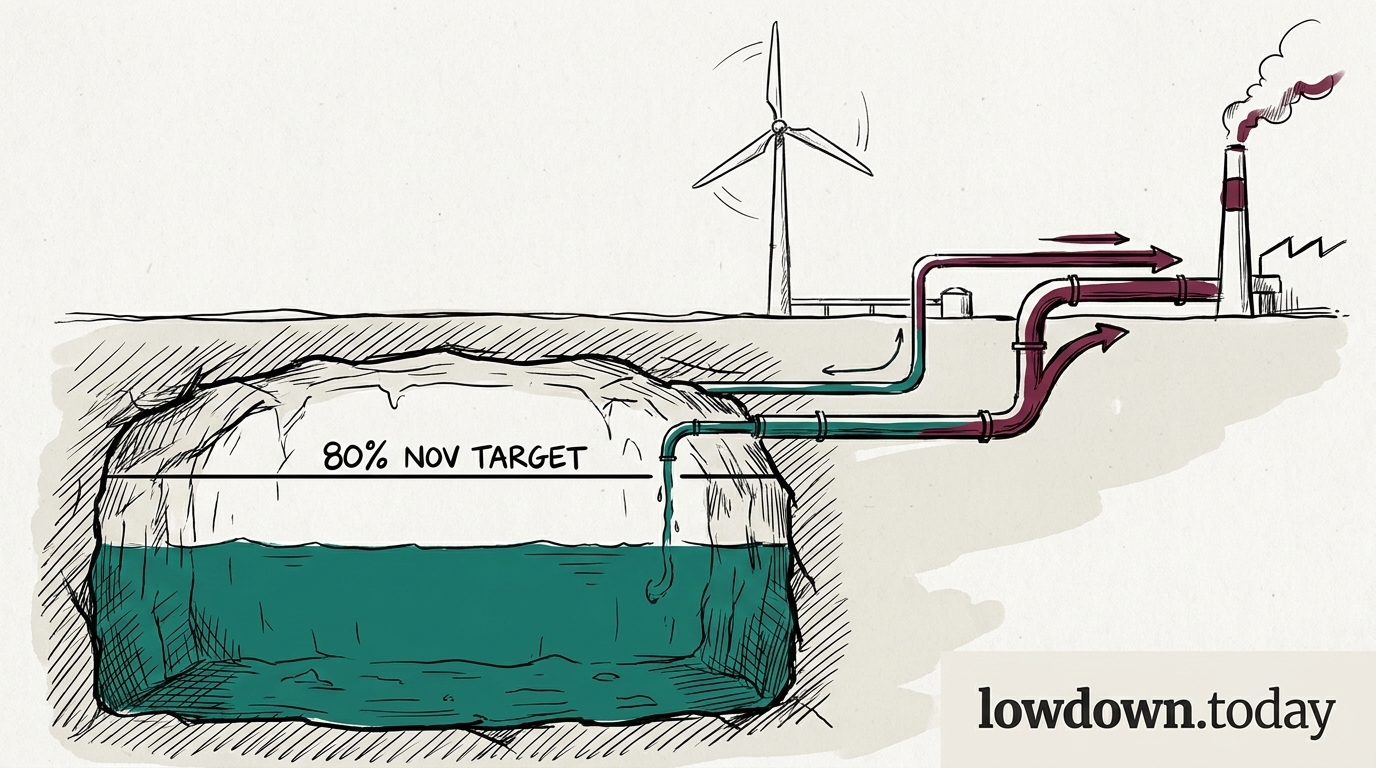
Brussels holds the bloc to 90% on a flexible window while Germany, holding roughly a quarter of EU storage capacity, tracks toward missing its own lower 80% figure by 21 points. A national shortfall this size in the anchor market matters more to bloc security than the flexible timetable alone can absorb.
French power exporters and CRE
French day-ahead rose in step with Germany but by less, reopening a EUR 7-17 premium that makes northward export flows commercially attractive again after the EUR 43.09 discount evaporated in days. CRE separately authorised RTE and Enedis to buy flexibility locally, betting the coming winter's binding constraint is grid congestion rather than a shortage of firm capacity.
TTF trading desk
TTF trading desk
A visible national shortfall like Germany's 21-point gap is a directional signal, not noise, for a desk holding the summer-winter spread. TTF's flat EUR 58-60 range through this week's German price swings says the market has not yet chosen to reprice refill risk into the front of the curve.
German cavern and CCGT operators
German caverns kept buying prompt gas at TTF near EUR 58-60 through the inversion; the wind collapse to 2.4 GW then flipped the spark spread to plus EUR 29 and put turbines back in the same queue. Every day turbines win that bid, injection at a third of the 877 GWh/day pace needed falls further behind.
Slovakia
Slovakia
Slovakia says it dropped its hold-out on the 21st sanctions package only after Ursula von der Leyen personally signed written gas-price and supply guarantees. The Council of the European Union's own 17,238-character release on the package names neither Slovakia nor any guarantee, leaving Bratislava's account unconfirmed by the institutional record.



