Skip to content
You can now search across every topic, entity and event.What's new
European Energy Markets
31JUL

Israel mobilises for Lebanon offensive

3 min read
09:44UTC

Israel mobilised reservists and launched an 'offensive campaign' in Lebanon after Netanyahu reportedly told his cabinet Trump had approved the operation — opening a third front the IDF has not managed since 1973.

EconomicDeveloping
Key takeaway

Trump's reported greenlight removes the one diplomatic brake — sustained US pressure — that historically constrained Israeli offensive timing in Lebanon, eliminating the ceasefire-negotiation window that ended the 2006 war on day 34.

Israel mobilised reservists and the IDF launched what it termed an "offensive campaign" in Lebanon. The Times of Israel reported that Prime Minister Benjamin Netanyahu told his cabinet President Trump had given approval for a new offensive against Hezbollah. Senior Israeli military officials have openly discussed a ground invasion — language the IDF avoided during the early phases of the 2006 Lebanon War, when ground operations were authorised incrementally and described as limited incursions.

The mobilisation follows a rapid escalation. Hezbollah struck an IDF base in Haifa, some 30 kilometres from the Lebanese border — well beyond the frontier zone that defined the 2006 conflict. Israel responded with strikes across Beirut's Dahieh district that killed 31 people and wounded 149 . The IDF killed Mohammad Raad, head of Hezbollah's parliamentary bloc , and declared "no immunity" for any Hezbollah official or supporter — targeting criteria that extend to political figures and civilian sympathisers, categories without clear legal boundaries under international humanitarian law.

Lebanon's Prime Minister Nawaf Salam called Hezbollah's Haifa attack "irresponsible and suspicious" and convened an emergency cabinet session with the army chief. Every Lebanese prime minister since the 1989 Taif Agreement had maintained careful ambiguity toward Hezbollah's military operations — a silence that allowed Lebanon's confessional power-sharing system to function while Hezbollah operated as an armed force outside state command. Salam broke that pattern. His word "suspicious" carries a specific implication: that Hezbollah may have struck Israel to provoke an invasion that serves Tehran's interest in drawing IDF forces north and away from the Iran campaign, rather than any Lebanese interest.

If the ground invasion materialises, Israel will fight in Iran, Gaza, and Lebanon simultaneously — a three-front commitment the IDF has not undertaken since the 1973 Yom Kippur War. In 1973, coordinated Egyptian and Syrian attacks nearly overwhelmed Israeli forces on the Sinai and Golan Heights before reserves could mobilise; Israel prevailed, but at a cost that reshaped its strategic doctrine for a generation. The IDF of 2026 has precision munitions, satellite intelligence, and Iron Dome. But the lesson of 1973 was about the limits of multi-front warfare regardless of qualitative advantage, and Hezbollah's pre-war arsenal — estimated by the Center for Strategic and International Studies at 130,000 to 150,000 rockets and missiles — exceeds the combined arsenals Israel faced across all fronts in 1973.


Deep Analysis

In plain English

Israel is preparing to send ground troops into Lebanon to fight Hezbollah — the same militia it fought in 2006 — while simultaneously striking Iran and continuing operations in Gaza. In 2006, that war lasted about five weeks and ended without Israel defeating Hezbollah. Hezbollah is now significantly better armed. Unlike 2006, the US president has reportedly told Israel it can proceed, meaning there is no superpower applying the diplomatic brakes that previously forced a ceasefire.

Deep Analysis
Synthesis

The concurrent Iran decapitation campaign and Lebanon offensive represent an attempt to resolve simultaneously two problems Israeli strategy has historically treated sequentially. The risk is interactive complexity: degrading Iran's command structure was intended to cut Hezbollah's resupply chain, but if that degradation is incomplete, a Lebanon ground offensive locks IDF assets against an adversary still receiving some Iranian direction — without the Iranian deterrent that previously constrained Israeli ground operations.

Root Causes

Hezbollah's integration into Lebanese governmental structures since 2006 — cabinet portfolios, parliamentary representation, social infrastructure provision — means a ground offensive cannot cleanly separate the organisation from the Lebanese state. This creates a post-conflict governance vacuum that the 2006 war did not fully produce, since Resolution 1701 preserved the fiction of Lebanese state sovereignty. A ground offensive that destroys Hezbollah's military wing risks hollowing out southern Lebanese governance with no replacement architecture.

Escalation

The Trump greenlight removes the primary historical constraint on Israeli Lebanon operations. In 2006, US pressure — eventually translated into UNSC Resolution 1701 — forced a ceasefire before IDF objectives were met. With that brake absent and Iran's command structure degraded, Hezbollah's external resupply and tasking chain is disrupted — giving Israel a time-limited window for ground operations before Hezbollah disperses further into civilian infrastructure.

What could happen next?
  • Risk

    Simultaneous IDF ground operations in Lebanon and Gaza, combined with the Iran air campaign, stress reserve call-up capacity and logistics to beyond any post-1973 precedent, with no US ground force backstop.

    Immediate · Assessed
  • Consequence

    A Lebanon ground offensive without a ceasefire architecture destroys the UNSC Resolution 1701 framework that has governed the Lebanon-Israel border since 2006, removing the primary international mechanism for managing future escalation on that front.

    Medium term · Assessed
  • Risk

    Hezbollah's precision missile inventory poses a qualitatively different threat to Israeli rear areas than in 2006 — IDF command centres, ports, and power infrastructure are within range of sub-50-metre CEP strikes.

    Immediate · Suggested
  • Precedent

    US presidential greenlight for concurrent operations against Iran and Lebanon marks the first time Washington has explicitly authorised a Middle Eastern ally to open a new front during an active campaign without a UNSC mandate or coalition framework.

    Long term · Suggested
First Reported In

Update #9 · IRGC HQ destroyed; Britain quits coalition

Times of Israel· 2 Mar 2026
Read original
Different Perspectives
Spain's LNG terminal operators
Spain's 9,145 GWh terminal inventory is the largest single stock in the EU LNG network, an option value that can reroute cargoes wherever the winter strip pays best rather than a cavern gas obligation tied to a fixed date. That flexibility matters more as Germany's cavern shortfall pushes more of the winter security question onto import infrastructure.
European Commission
European Commission
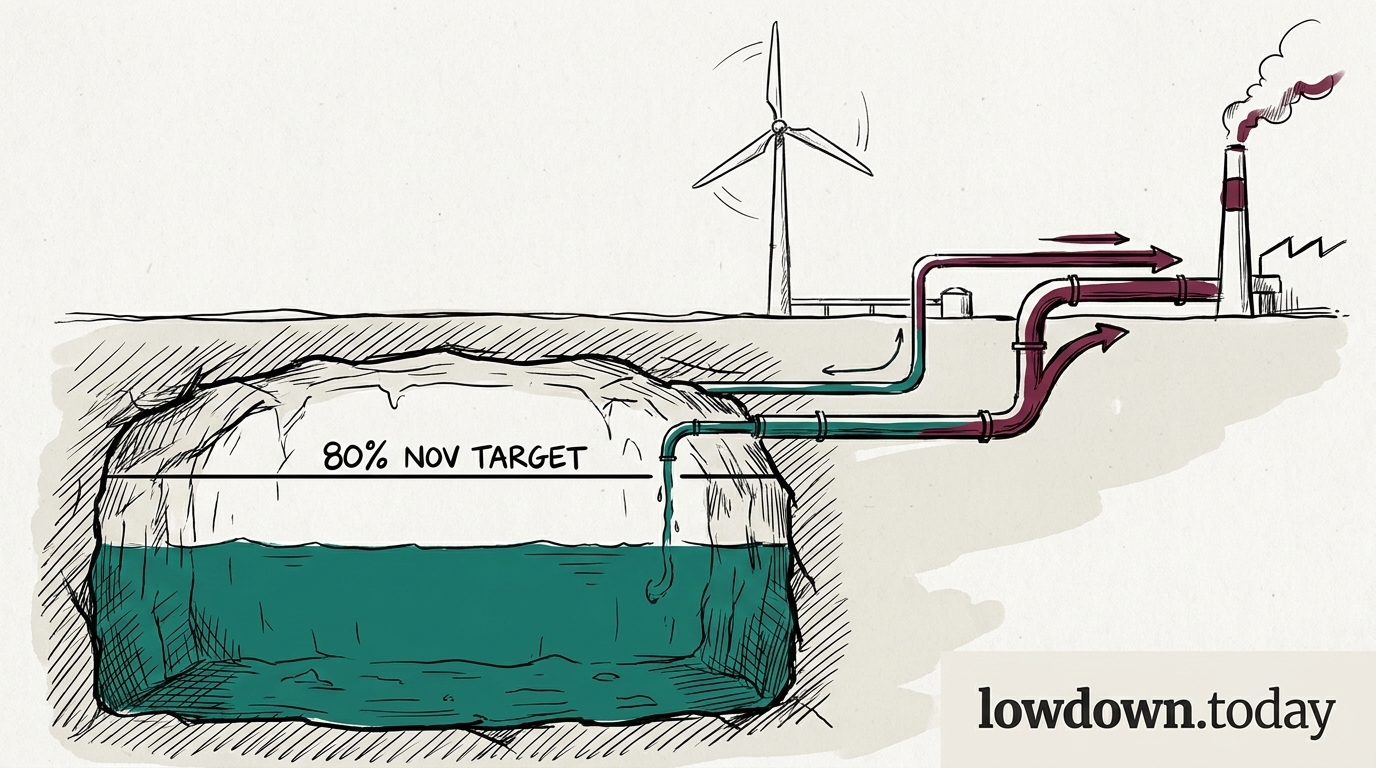
Brussels holds the bloc to 90% on a flexible window while Germany, holding roughly a quarter of EU storage capacity, tracks toward missing its own lower 80% figure by 21 points. A national shortfall this size in the anchor market matters more to bloc security than the flexible timetable alone can absorb.
French power exporters and CRE
French day-ahead rose in step with Germany but by less, reopening a EUR 7-17 premium that makes northward export flows commercially attractive again after the EUR 43.09 discount evaporated in days. CRE separately authorised RTE and Enedis to buy flexibility locally, betting the coming winter's binding constraint is grid congestion rather than a shortage of firm capacity.
TTF trading desk
TTF trading desk
A visible national shortfall like Germany's 21-point gap is a directional signal, not noise, for a desk holding the summer-winter spread. TTF's flat EUR 58-60 range through this week's German price swings says the market has not yet chosen to reprice refill risk into the front of the curve.
German cavern and CCGT operators
German caverns kept buying prompt gas at TTF near EUR 58-60 through the inversion; the wind collapse to 2.4 GW then flipped the spark spread to plus EUR 29 and put turbines back in the same queue. Every day turbines win that bid, injection at a third of the 877 GWh/day pace needed falls further behind.
Slovakia
Slovakia
Slovakia says it dropped its hold-out on the 21st sanctions package only after Ursula von der Leyen personally signed written gas-price and supply guarantees. The Council of the European Union's own 17,238-character release on the package names neither Slovakia nor any guarantee, leaving Bratislava's account unconfirmed by the institutional record.



