Skip to content
You can now search across every topic, entity and event.What's new
European Energy Markets
31JUL

30,000 flee Lebanon in Israeli advance

2 min read
09:44UTC

Thirty thousand people displaced from southern Lebanon in forty-eight hours, and the Israeli advance has no announced geographic limit.

EconomicDeveloping
Key takeaway

The 30,000 figure is the leading edge of a displacement curve that historically accelerates nonlinearly once ground operations expand, and Lebanon's pre-existing collapse means its absorption capacity is far lower than in 2006.

UNHCR reported 30,000 people newly displaced from southern Lebanon since Monday, as Israel's 91st Division pushed beyond initial positions under orders from Defence Minister Israel Katz to "advance and seize additional controlling areas." Overnight Israeli strikes had already raised Lebanon's casualty toll to 52 dead and 154 wounded , with two-thirds of the dead in the south. Highways out of the border zone are choked with civilian vehicles. Schools have been converted to emergency shelters.

Southern Lebanon's population has absorbed this before. In the 2006 war, approximately one million Lebanese were displaced in thirty-four days. The current rate — 30,000 in roughly forty-eight hours — is faster relative to the area affected. Many of the families now moving north fled the same villages in 2006 and returned to infrastructure rebuilt with international aid that is now under fire again. The "temporary security zone" Israel established in 1985 to protect its northern border lasted fifteen years and produced a generation of cyclical displacement.

Lebanon's capacity to absorb an internal refugee crisis has collapsed since 2006. The currency has lost more than 90% of its value since 2019. The banking system is frozen. The government, still managing the aftermath of the 2020 Beirut port explosion, has no fiscal reserves for emergency relief. International humanitarian access depends on roads now either cratered or under Israeli military control. The 30,000 figure will grow for as long as the advance continues — and Defence Minister Katz's orders contained no geographic limit.


Deep Analysis

In plain English

When soldiers advance, civilians flee — and 30,000 people moving in four days is only the start of what typically becomes a much larger wave. In Lebanon's 2006 war, a million people eventually fled their homes. The problem now is that Lebanon is already in deep economic crisis: its government is broke, its banks collapsed years ago, and it already hosts over a million Syrian refugees. There is almost no safety net for people who leave southern Lebanon, meaning international aid organisations will need to step in almost immediately with food, water, shelter, and medicine.

Deep Analysis
Root Causes

Southern Lebanese communities have absorbed three Israeli invasions since 1978 and an 18-year occupation, creating experienced displacement responses but exhausting the informal diaspora and family networks that historically funded recovery. Lebanon's economic collapse since 2019 has specifically devastated the Beirut middle class — the primary historical host for southern displacement — leaving no functioning domestic absorption system.

Escalation

Based on 2006 precedent, displacement is likely to reach 200,000–500,000 if ground operations extend beyond the current border strip and into the Litani River zone — a trajectory that would unfold over 1–2 weeks absent a ceasefire. The LAF's withdrawal (Event 7) removes any state presence that could manage civilian movement corridors.

What could happen next?
  • Consequence

    Displacement will accelerate nonlinearly if Israeli ground operations extend beyond the current border strip, reaching hundreds of thousands within 1–2 weeks based on 2006 operational precedent.

    Short term · Assessed
  • Risk

    Lebanon's collapsed state and critically underfunded UNHCR operation cannot absorb a displacement surge without emergency donor pledging that historically lags the acute phase by 2–4 weeks.

    Immediate · Assessed
  • Risk

    Large-scale displacement combined with Lebanon's existing 1.5 million Syrian refugees could trigger secondary migration flows toward Cyprus and southern Europe, exceeding current EU migration management capacity.

    Medium term · Suggested
First Reported In

Update #15 · Iran rejects ceasefire; embassies close

The National· 3 Mar 2026
Read original
Causes and effects
This Event
30,000 flee Lebanon in Israeli advance
The displacement rate — 30,000 in roughly forty-eight hours — exceeds the early pace of the 2006 war and is hitting a state with no fiscal reserves, a frozen banking system, and a currency worth less than a tenth of its 2019 value.
Different Perspectives
Spain's LNG terminal operators
Spain's 9,145 GWh terminal inventory is the largest single stock in the EU LNG network, an option value that can reroute cargoes wherever the winter strip pays best rather than a cavern gas obligation tied to a fixed date. That flexibility matters more as Germany's cavern shortfall pushes more of the winter security question onto import infrastructure.
European Commission
European Commission
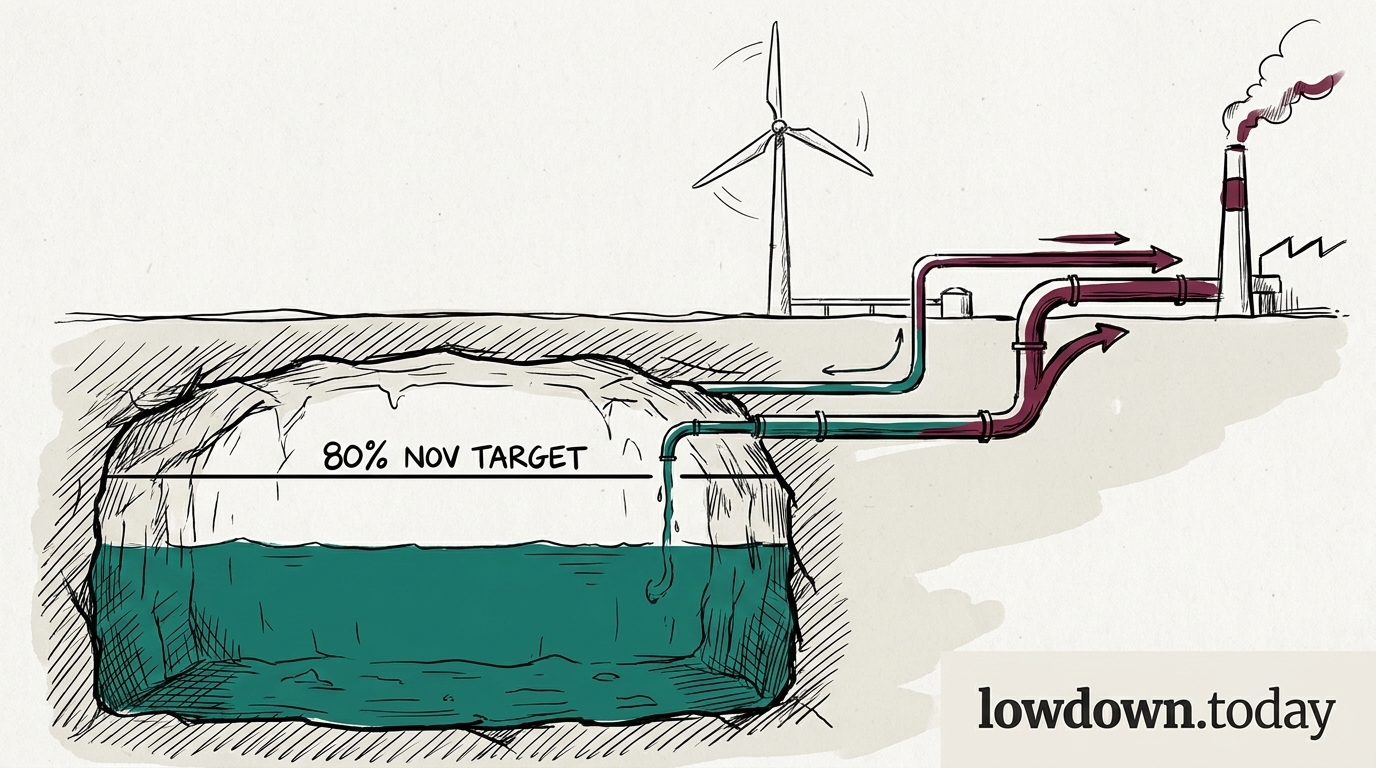
Brussels holds the bloc to 90% on a flexible window while Germany, holding roughly a quarter of EU storage capacity, tracks toward missing its own lower 80% figure by 21 points. A national shortfall this size in the anchor market matters more to bloc security than the flexible timetable alone can absorb.
French power exporters and CRE
French day-ahead rose in step with Germany but by less, reopening a EUR 7-17 premium that makes northward export flows commercially attractive again after the EUR 43.09 discount evaporated in days. CRE separately authorised RTE and Enedis to buy flexibility locally, betting the coming winter's binding constraint is grid congestion rather than a shortage of firm capacity.
TTF trading desk
TTF trading desk
A visible national shortfall like Germany's 21-point gap is a directional signal, not noise, for a desk holding the summer-winter spread. TTF's flat EUR 58-60 range through this week's German price swings says the market has not yet chosen to reprice refill risk into the front of the curve.
German cavern and CCGT operators
German caverns kept buying prompt gas at TTF near EUR 58-60 through the inversion; the wind collapse to 2.4 GW then flipped the spark spread to plus EUR 29 and put turbines back in the same queue. Every day turbines win that bid, injection at a third of the 877 GWh/day pace needed falls further behind.
Slovakia
Slovakia
Slovakia says it dropped its hold-out on the 21st sanctions package only after Ursula von der Leyen personally signed written gas-price and supply guarantees. The Council of the European Union's own 17,238-character release on the package names neither Slovakia nor any guarantee, leaving Bratislava's account unconfirmed by the institutional record.



