Skip to content
You can now search across every topic, entity and event.What's new
European Energy Markets
31JUL

IRGC declares Hormuz shut a second time

3 min read
09:44UTC

The IRGC's Khatam al-Anbia command declared the Strait of Hormuz closed on 20 June, its second such order of the war. CENTCOM rejected it within hours.

EconomicDeveloping
Key takeaway

Iran shut Hormuz over a deal Israel never signed, making the closure leverage on Washington.

Iran's Khatam al-Anbia Central Headquarters, the operational command of the Islamic Revolutionary Guard Corps (IRGC), declared the Strait of Hormuz closed on Saturday 20 June and called the move "the first step of response to the enemy's breach of trust" 1. The order came from the corps, not from Iran's Foreign Ministry. IRGC boats told all commercial shipping to stay clear. The stated grounds were that Israeli strikes in Lebanon broke Article 1 of the Islamabad Memorandum of Understanding (MoU), the deal Iran and the US signed on 15 June under Pakistani and Qatari mediation.

This is the IRGC's second Hormuz closure declaration of the war. The first came on 11 June, an order US Central Command (CENTCOM) also rejected at the time. CENTCOM rejected this one too: spokesman Navy Captain Tim Hawkins said "Iran does not control the strait of Hormuz" 2, and reported commercial traffic continuing to move. The pattern is now set across two declarations in nine days, with the corps closing the waterway by announcement and the transit data answering back.

The closure exposes the same fracture visible at the Switzerland talks the next day, where Araghchi and Ghalibaf were negotiating the MOU even as the corps declared its central provision void. Khamenei has not appeared in public since 8 March and communicates by sealed courier, so the corps runs the war while the civilian ministry runs the diplomatic track. The two arms of the Iranian state point in opposite directions on the same calendar day.

Article 1 of the MOU governs the ceasefire, and Iran's case is that Israel's Lebanon offensive broke it. Yet Israel never signed the MOU and rejected its terms outright . Iran is invoking a breach of a deal by a government that is not party to it, which makes the closure a pressure instrument aimed at Washington over Lebanon rather than a maritime measure with a legal spine.


Deep Analysis

In plain English

The Strait of Hormuz is a narrow waterway between Iran and Oman. About 20% of the world's oil passes through it. Iran's military, the Islamic Revolutionary Guard Corps, or IRGC, declared the strait closed on 20 June. This was the second time during the current conflict that the IRGC had made this declaration; the first was on 11 June. The US military (called CENTCOM) rejected the declaration and said shipping continued. This is possible because most vessels are now using a different route, through waters controlled by Oman, not Iran. The IRGC's closing order does not physically stop ships from using that Omani corridor. The declaration functions as a political and legal threat more than a physical barrier.

Deep Analysis
Root Causes

The IRGC's Khatam al-Anbia HQ cited Article 1 of the Islamabad MOU as breached by Israeli Lebanon strikes. Israel never signed the MOU. The structural root cause is a treaty architecture that binds Iran and the US but cannot bind Israel, creating a legal trigger Iran can pull whenever Israel acts in Lebanon without Washington's ability to prevent the trigger from firing.

Khatam al-Anbia HQ's second closure also serves an internal purpose. Hardline IRGC factions needed visible evidence that the corps did not capitulate when the civilian government signed the MOU. Each closure declaration, whether enforced or not, preserves the corps's institutional standing inside Iran's war leadership.

Escalation

Two closures in ten days, both rejected by CENTCOM, both failing to affect the price of Brent materially. The IRGC's closure declarations are losing credibility with oil markets even if they retain legal and political weight for the diplomats. The risk of a third closure, or one that targets the Omani corridor specifically, remains.

What could happen next?
  • Risk

    A third IRGC closure declaration specifically threatening the Omani corridor, rather than the TSS lanes, would force CENTCOM into a direct confrontation with Iran over a route it has publicly cleared.

    Short term · Suggested
  • Precedent

    The MOU's Article 1 mechanism, which lets Iran cite Israeli Lebanon actions as a US obligation breach, creates a legal architecture Iran can activate as long as Israel operates in Lebanon.

    Medium term · Assessed
  • Consequence

    Washington must now either pressure Israel to halt Lebanon operations, which Netanyahu has refused, or accept that Iran will periodically re-close Hormuz under MOU cover.

    Short term · Reported
First Reported In

Update #134 · Hormuz shuts as Vance flies to Geneva

Tasnim News Agency· 21 Jun 2026
Read original
Different Perspectives
Spain's LNG terminal operators
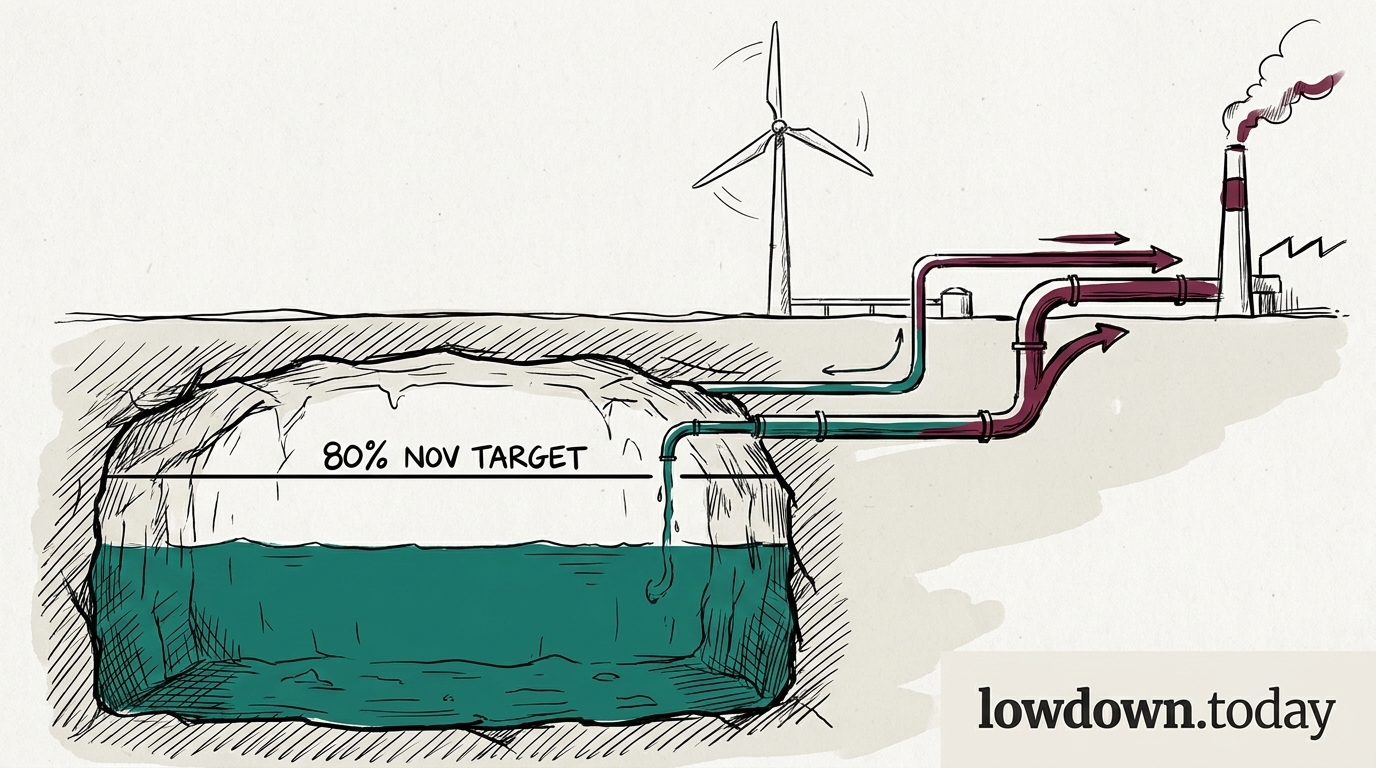
Spain's 9,145 GWh terminal inventory is the largest single stock in the EU LNG network, an option value that can reroute cargoes wherever the winter strip pays best rather than a cavern gas obligation tied to a fixed date. That flexibility matters more as Germany's cavern shortfall pushes more of the winter security question onto import infrastructure.
European Commission
European Commission
Brussels holds the bloc to 90% on a flexible window while Germany, holding roughly a quarter of EU storage capacity, tracks toward missing its own lower 80% figure by 21 points. A national shortfall this size in the anchor market matters more to bloc security than the flexible timetable alone can absorb.
French power exporters and CRE
French day-ahead rose in step with Germany but by less, reopening a EUR 7-17 premium that makes northward export flows commercially attractive again after the EUR 43.09 discount evaporated in days. CRE separately authorised RTE and Enedis to buy flexibility locally, betting the coming winter's binding constraint is grid congestion rather than a shortage of firm capacity.
TTF trading desk
TTF trading desk
A visible national shortfall like Germany's 21-point gap is a directional signal, not noise, for a desk holding the summer-winter spread. TTF's flat EUR 58-60 range through this week's German price swings says the market has not yet chosen to reprice refill risk into the front of the curve.
German cavern and CCGT operators
German caverns kept buying prompt gas at TTF near EUR 58-60 through the inversion; the wind collapse to 2.4 GW then flipped the spark spread to plus EUR 29 and put turbines back in the same queue. Every day turbines win that bid, injection at a third of the 877 GWh/day pace needed falls further behind.
Slovakia
Slovakia
Slovakia says it dropped its hold-out on the 21st sanctions package only after Ursula von der Leyen personally signed written gas-price and supply guarantees. The Council of the European Union's own 17,238-character release on the package names neither Slovakia nor any guarantee, leaving Bratislava's account unconfirmed by the institutional record.



