Skip to content
You can now search across every topic, entity and event.What's new
European Energy Markets
31JUL

Iran admits enrichment capacity is destroyed

3 min read
09:44UTC

Iran's foreign minister disclosed that the country can no longer enrich uranium at any facility, meaning Islamabad's two-day deadlock over enrichment rights was partly a dispute over a capability Iran does not possess.

EconomicDeveloping
Key takeaway

Both sides at Islamabad negotiated over a capability Iran cannot currently exercise.

Abbas Araghchi, Iran's Foreign Minister, confirmed on Sunday that Iran "is no longer enriching uranium at any site in the country due to the strikes" 1. The US and Israeli campaign destroyed Natanz, damaged Esfahan, and struck Fordow. Iran's last verified stockpile, 440.9 kg of Weapons-Grade Uranium (at near weapons-grade purity), was recorded by the IAEA (International Atomic Energy Agency) in September 2025, before the war. That stockpile cannot grow without functioning centrifuges.

The IAEA has had no access since the Majlis (parliament) voted 221-0 to suspend all cooperation in early April . What both sides argued over in Islamabad, neither side can verify. JD Vance presented what he called a "final and best offer" at Islamabad before departing on Saturday with no agreement . Three structural deadlocks blocked the text: Iran's refusal to forswear weapons, its refusal to surrender its stockpile, and its demand for Hormuz toll-collection authority .

Araghchi described the talks as "the most intensive engagement between the two countries in 47 years" and claimed discussions reached "the brink of a potential memorandum of understanding." Vance called the breakdown "bad news for Iran much more than for the US." The two accounts cannot both be accurate. Neither can be independently verified.


Deep Analysis

In plain English

Iran has been enriching uranium , the process of concentrating a specific form of uranium , for years. This matters because highly enriched uranium is the primary material needed to build a nuclear weapon. The US and Israel bombed Iran's enrichment facilities in the war. Iran's Foreign Minister now says the bombing worked: Iran cannot currently enrich uranium at any facility because all of them were damaged or destroyed. Here is the strange part: at the Islamabad peace talks, the main disagreement was over whether Iran would agree to stop enriching uranium. But both sides were apparently negotiating over something Iran cannot currently do anyway. The real dispute is about whether Iran should have the right to start enriching again once it rebuilds , which is a political question, not a technical one.

Deep Analysis
Root Causes

The enrichment deadlock at Islamabad was partly a dispute over a capability Iran cannot currently exercise, and partly a dispute over the right to exercise it in future. The structural root cause is the gap between Tehran's declared position (enrichment is a sovereign right enshrined in the NPT's Article IV) and Washington's demand (zero enrichment commitment).

Araghchi's admission does not resolve that structural gap. Even a country with zero current enrichment capability can insist on the right to resume enrichment, and Iran's 10-point plan explicitly includes enrichment rights as non-negotiable. The deadlock is therefore political, not technical , which is why Araghchi's disclosure, rather than resolving the Islamabad breakdown, merely makes the political nature of it transparent.

What could happen next?
  • Consequence

    The US demand for 'zero enrichment commitment' is no longer about stopping active enrichment , it is about preventing future reconstruction. This shifts the negotiating frame from arms control to political submission, making a deal structurally harder.

    Short term · 0.82
  • Meaning

    Araghchi's framing of talks as 'the most intensive engagement in 47 years' and 'on the brink of an MOU' is Tehran's diplomatic record-setting , establishing a narrative that the US walked away from a near-deal, not that Iran refused.

    Immediate · 0.78
  • Risk

    With IAEA access suspended, there is no mechanism to verify whether the 440.9 kg HEU stockpile has been moved, dispersed, or partially weaponised , meaning the enrichment pause provides no verifiable security benefit without inspection access.

    Medium term · 0.85
First Reported In

Update #67 · Trump blockades Iran on a tweet

Times of Israel / Arms Control Association· 13 Apr 2026
Read original
Different Perspectives
Spain's LNG terminal operators
Spain's 9,145 GWh terminal inventory is the largest single stock in the EU LNG network, an option value that can reroute cargoes wherever the winter strip pays best rather than a cavern gas obligation tied to a fixed date. That flexibility matters more as Germany's cavern shortfall pushes more of the winter security question onto import infrastructure.
European Commission
European Commission
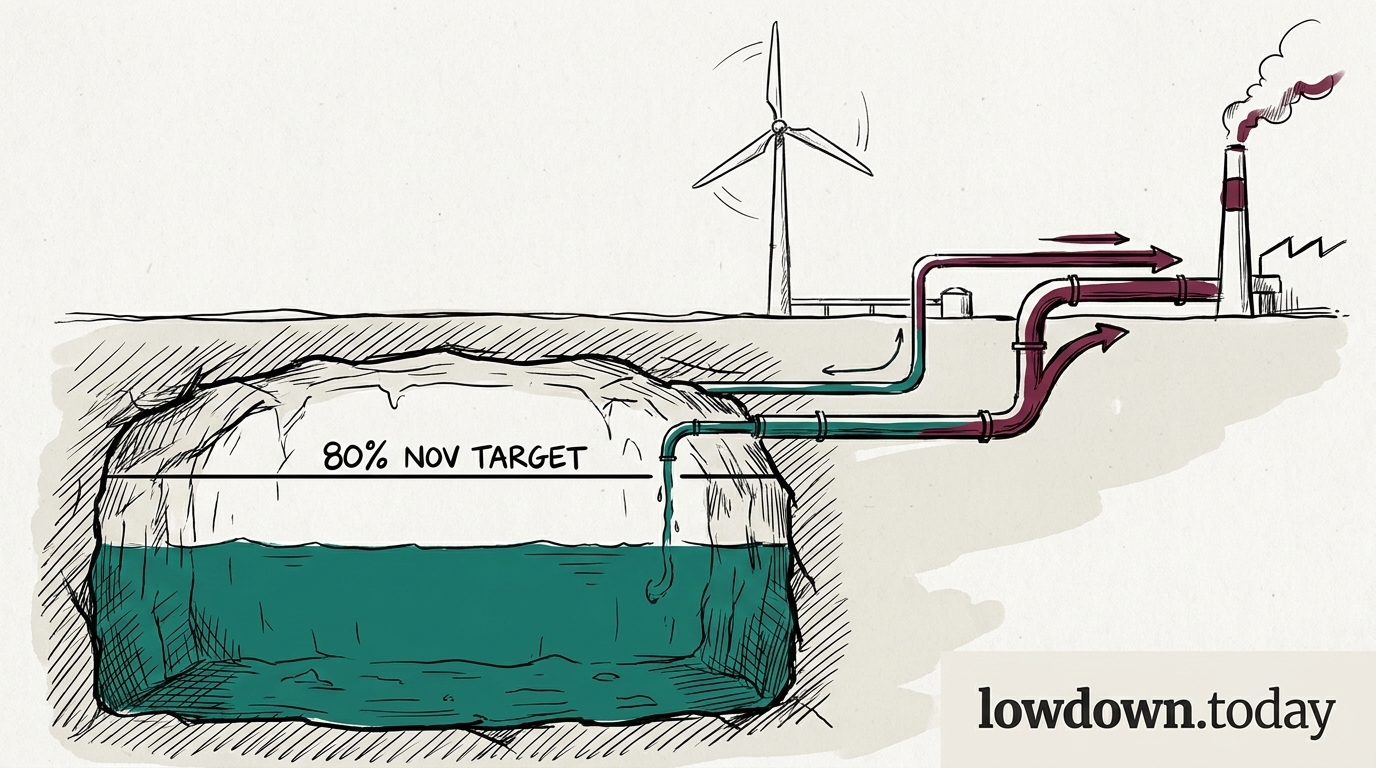
Brussels holds the bloc to 90% on a flexible window while Germany, holding roughly a quarter of EU storage capacity, tracks toward missing its own lower 80% figure by 21 points. A national shortfall this size in the anchor market matters more to bloc security than the flexible timetable alone can absorb.
French power exporters and CRE
French day-ahead rose in step with Germany but by less, reopening a EUR 7-17 premium that makes northward export flows commercially attractive again after the EUR 43.09 discount evaporated in days. CRE separately authorised RTE and Enedis to buy flexibility locally, betting the coming winter's binding constraint is grid congestion rather than a shortage of firm capacity.
TTF trading desk
TTF trading desk
A visible national shortfall like Germany's 21-point gap is a directional signal, not noise, for a desk holding the summer-winter spread. TTF's flat EUR 58-60 range through this week's German price swings says the market has not yet chosen to reprice refill risk into the front of the curve.
German cavern and CCGT operators
German caverns kept buying prompt gas at TTF near EUR 58-60 through the inversion; the wind collapse to 2.4 GW then flipped the spark spread to plus EUR 29 and put turbines back in the same queue. Every day turbines win that bid, injection at a third of the 877 GWh/day pace needed falls further behind.
Slovakia
Slovakia
Slovakia says it dropped its hold-out on the 21st sanctions package only after Ursula von der Leyen personally signed written gas-price and supply guarantees. The Council of the European Union's own 17,238-character release on the package names neither Slovakia nor any guarantee, leaving Bratislava's account unconfirmed by the institutional record.



