Skip to content
You can now search across every topic, entity and event.What's new
European Energy Markets
31JUL

Four mediators table a ten-day truce

2 min read
09:44UTC

Qatar, Egypt, Pakistan and Oman submitted a ten-day ceasefire proposal to Washington and Tehran, its core term the reopening of the Strait of Hormuz.

EconomicDeveloping
Key takeaway

Four mediators put a ten-day truce on the table built around reopening Hormuz, and Washington wants longer.

Qatar, Egypt, Pakistan and Oman submitted a ten-day ceasefire proposal to Washington and Tehran, its core term the resumption of Strait of Hormuz navigation alongside talks on a longer agreement 1. The four are the region's standing intermediaries, and the text puts a fixed clock on a war that has run without one.

The proposal reaches an administration holding out for a longer pause than ten days, which has urged Israel to keep the diplomatic window open. Qatar files it from the same seat where it lodged a dated compensation claim against Iran at the UN Security Council on 21 July , mediating and litigating at once. The core term reaches for the one lever that moves everything else: reopening Hormuz would unwind the blockade and the price spike together, which is why it sits at the centre of the text rather than the nuclear file or the strikes.


Deep Analysis

In plain English

Four countries, Qatar, Egypt, Pakistan and Oman, have proposed a ten-day ceasefire to both the United States and Iran. The main idea is to reopen the Strait of Hormuz, the narrow waterway ships use to move Gulf oil, while the two sides talk about a longer-term deal. This is not a done deal. It is a proposal put forward by countries that are not directly fighting but have a strong interest in the war ending, or at least in ships being able to move safely again.

Deep Analysis
Root Causes

The proposal's ten-day window reflects a structural constraint Qatar cannot avoid: its own gas exports and the CENTCOM basing it hosts sit inside the same Gulf waters the ceasefire is meant to reopen, giving Doha a direct material stake beyond diplomatic goodwill.

Pakistan's role rests on being the only channel both Washington and Tehran have kept open since the spring proposals, a position it holds not through leverage but through being the last venue neither side has formally closed.

What could happen next?
  • Meaning

    A joint four-country proposal signals the mediators believe Washington and Tehran are close enough to a deal that sequencing, who reopens Hormuz first, is now the main obstacle.

  • Precedent

    Every prior Pakistan-brokered ceasefire text since May has traded Hormuz access for a US drawdown demand Washington rejected; if this proposal drops that demand, it marks a real shift in the mediators' approach.

First Reported In

Update #160 · Houthis hit Saudi tankers; Brent tops $100

The Jerusalem Post· 23 Jul 2026
Read original
Different Perspectives
Spain's LNG terminal operators
Spain's 9,145 GWh terminal inventory is the largest single stock in the EU LNG network, an option value that can reroute cargoes wherever the winter strip pays best rather than a cavern gas obligation tied to a fixed date. That flexibility matters more as Germany's cavern shortfall pushes more of the winter security question onto import infrastructure.
European Commission
European Commission
Brussels holds the bloc to 90% on a flexible window while Germany, holding roughly a quarter of EU storage capacity, tracks toward missing its own lower 80% figure by 21 points. A national shortfall this size in the anchor market matters more to bloc security than the flexible timetable alone can absorb.
French power exporters and CRE
French day-ahead rose in step with Germany but by less, reopening a EUR 7-17 premium that makes northward export flows commercially attractive again after the EUR 43.09 discount evaporated in days. CRE separately authorised RTE and Enedis to buy flexibility locally, betting the coming winter's binding constraint is grid congestion rather than a shortage of firm capacity.
TTF trading desk
TTF trading desk
A visible national shortfall like Germany's 21-point gap is a directional signal, not noise, for a desk holding the summer-winter spread. TTF's flat EUR 58-60 range through this week's German price swings says the market has not yet chosen to reprice refill risk into the front of the curve.
German cavern and CCGT operators
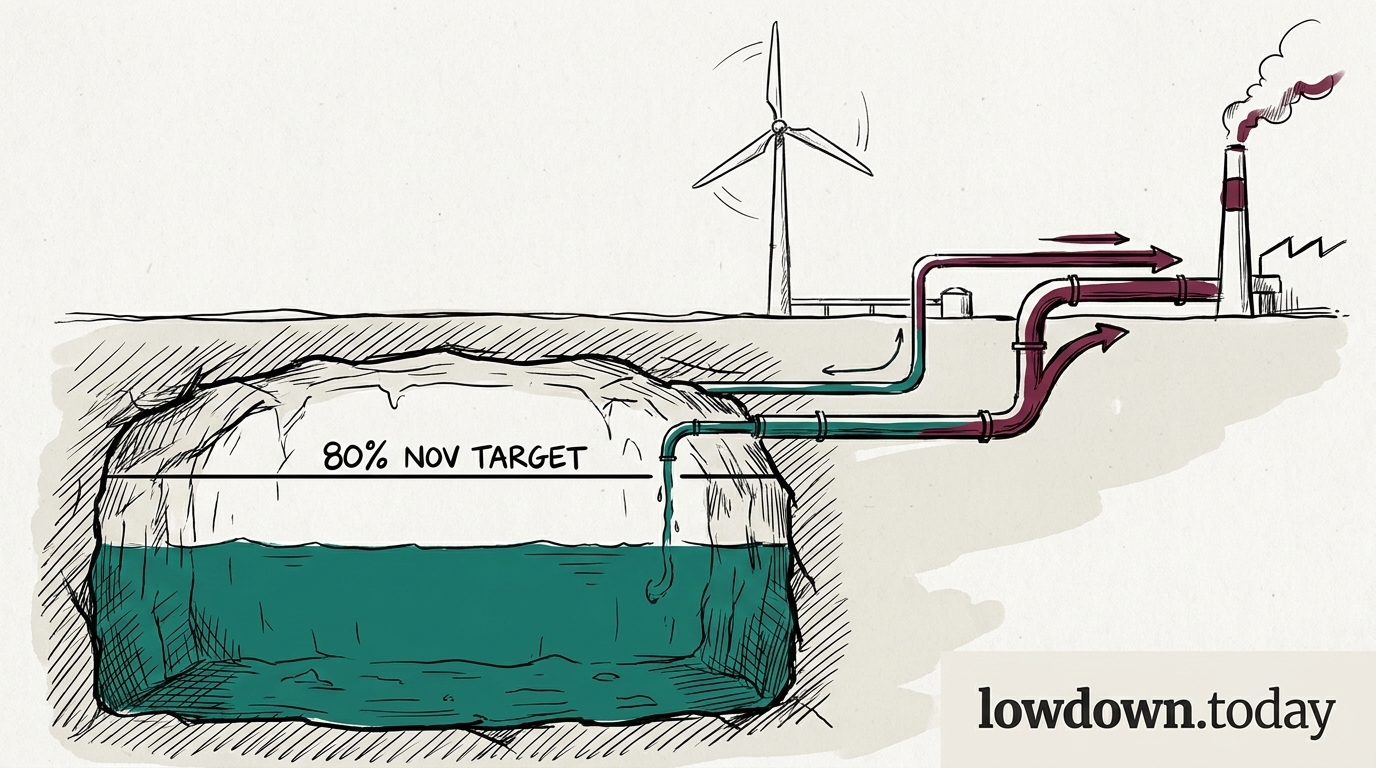
German caverns kept buying prompt gas at TTF near EUR 58-60 through the inversion; the wind collapse to 2.4 GW then flipped the spark spread to plus EUR 29 and put turbines back in the same queue. Every day turbines win that bid, injection at a third of the 877 GWh/day pace needed falls further behind.
Slovakia
Slovakia
Slovakia says it dropped its hold-out on the 21st sanctions package only after Ursula von der Leyen personally signed written gas-price and supply guarantees. The Council of the European Union's own 17,238-character release on the package names neither Slovakia nor any guarantee, leaving Bratislava's account unconfirmed by the institutional record.



