Skip to content
You can now search across every topic, entity and event.What's new
European Energy Markets
31JUL

Arab League condemns Iran's attacks

3 min read
09:44UTC

The 2023 rapprochement is dead. Every Gulf state that rebuilt ties with Tehran now calls Iran's conduct treacherous.

EconomicDeveloping
Key takeaway

Arab League unanimity destroys the political foundation of the 2023 rapprochement and simultaneously removes the primary diplomatic constraint on bilateral Gulf-US and Gulf-Israel defence cooperation that had operated since Saudi Arabia restored relations with Tehran.

Arab League Secretary-General Ahmed Aboul Gheit convened an emergency virtual meeting of Arab foreign ministers on Sunday. "Iran's attacks cannot be justified under any pretext or excuse." He called Tehran's strikes "treacherous" (غادرة) and a "massive strategic mistake."

The word غادرة in Arabic diplomatic register does not mean hostile or aggressive. It means faithless — the act of someone who betrayed a trust extended in good faith. The trust in question is specific: the 2023 Saudi-Iran rapprochement, which China brokered at considerable political cost. Gulf States reopened embassies, resumed trade dialogues, and moderated their alignment with Washington's maximum-pressure campaign. Saudi officials had been using the diplomatic backchannel established during that rapprochement with "increased urgency" as recently as last week . Iran's stated justification — that it struck only countries hosting US military operations — was directly contradicted by its targeting of Qatar, Kuwait, Oman, and the UAE, none of which hosted US launch operations . The strikes hit airports, oil infrastructure , residential buildings , and now water desalination plants.

The Arab League has no enforcement mechanism. But every state that spent 2023–2025 rebuilding relations with Tehran — work that required domestic political capital and concessions to Beijing's mediation framework — now describes Iran's conduct as a betrayal. The diplomatic capital Iran accumulated through the rapprochement has been spent. Beijing, which invested its own credibility in brokering that agreement, watches its primary Middle Eastern diplomatic achievement described as a fraud by the parties it brought together.

The consequences outlast any military outcome. The Gulf states' willingness to rebuild relations a second time — having been struck while the first rapprochement was still nominally in effect — approaches zero. Whatever political order emerges from this war, Iran faces a Gulf consensus that treats Tehran's diplomatic commitments as structurally unreliable. That is a strategic loss no ceasefire can reverse.


Deep Analysis

In plain English

The Arab League — representing 22 Arab nations — held an emergency meeting and condemned Iran's attacks on Gulf states in unusually strong terms, calling them 'treacherous.' In Arabic diplomatic usage, that specific word means betrayal of trust, not mere disagreement — it implies that a relationship of good faith existed and was deliberately violated. These same countries had spent years rebuilding their relationship with Iran through a 2023 peace deal brokered by China. Iran has now struck their airports, oil facilities, and water infrastructure in return. Years of diplomatic investment have been destroyed in a single week.

Deep Analysis
Synthesis

The Arab League condemnation and China's simultaneous diplomatic defence of Iran (Event 10) eliminate any unified external diplomatic pressure pathway: the two most influential external actors are pulling in opposite directions, and the actor whose political investment in the rapprochement was greatest — China — is now defending the state that destroyed it. No brokered de-escalation is structurally available while this divergence holds.

Root Causes

The 2023 rapprochement was structurally fragile because it assumed Iran's IRGC external operations could be constrained by diplomatic agreements concluded at the Foreign Ministry level. The IRGC answers to the Supreme Leader and operates on ideological rather than diplomatic logic; Gulf states and Beijing both misread where Iranian decision-making authority actually resides — the same misreading that Event 2 (Pezeshkian's ignored halt order) illustrates at the domestic level.

Escalation

Arab League condemnation historically provides political cover for two concrete military consequences: member states formally requesting external military assistance, and removal of the diplomatic constraint on sharing targeting data with external powers. Bahrain (hosting the US Fifth Fleet), the UAE (Al Dhafra Air Base), and Qatar (Al Udeid Air Base) hosting US military facilities now face substantially reduced domestic political risk in actively facilitating US operations against Iran — a constraint that had been operative since 2023.

What could happen next?
  • Consequence

    Gulf state military facilities hosting US forces are now politically available for active use in operations against Iran, removing a diplomatic constraint operative since the 2023 rapprochement without requiring any new formal authorisation.

    Immediate · Assessed
  • Consequence

    Chinese diplomatic credibility as a Gulf-Iran broker — the centrepiece of Beijing's 2023 regional prestige gain — is materially damaged by Iran's own conduct, creating a bilateral tension between Beijing and Riyadh that did not exist before this week.

    Short term · Assessed
  • Risk

    Reactivation of financial pressure tools — sanctions enforcement, currency interdiction, funding restoration — by UAE and Saudi Arabia would compound the economic stress on Iran at a moment of simultaneous military overextension and leadership transition.

    Short term · Suggested
  • Precedent

    The failure of the 2023 rapprochement demonstrates that Chinese brokerage cannot bind parties whose military structures are insulated from diplomatic commitments, a lesson that will reduce confidence in future Chinese mediation offers in other conflicts — Yemen, Sudan, Taiwan adjacents.

    Long term · Suggested
First Reported In

Update #29 · New leader kept secret; Bahrain water hit

Al Jazeera· 8 Mar 2026
Read original
Causes and effects
This Event
Arab League condemns Iran's attacks
The unanimous Arab condemnation using the language of personal betrayal signals the destruction of the 2023 China-brokered Saudi-Iran rapprochement — Iran's primary diplomatic gain of the past three years. Gulf states that rebuilt ties with Tehran now treat Iranian diplomatic commitments as structurally unreliable.
Different Perspectives
Spain's LNG terminal operators
Spain's 9,145 GWh terminal inventory is the largest single stock in the EU LNG network, an option value that can reroute cargoes wherever the winter strip pays best rather than a cavern gas obligation tied to a fixed date. That flexibility matters more as Germany's cavern shortfall pushes more of the winter security question onto import infrastructure.
European Commission
European Commission
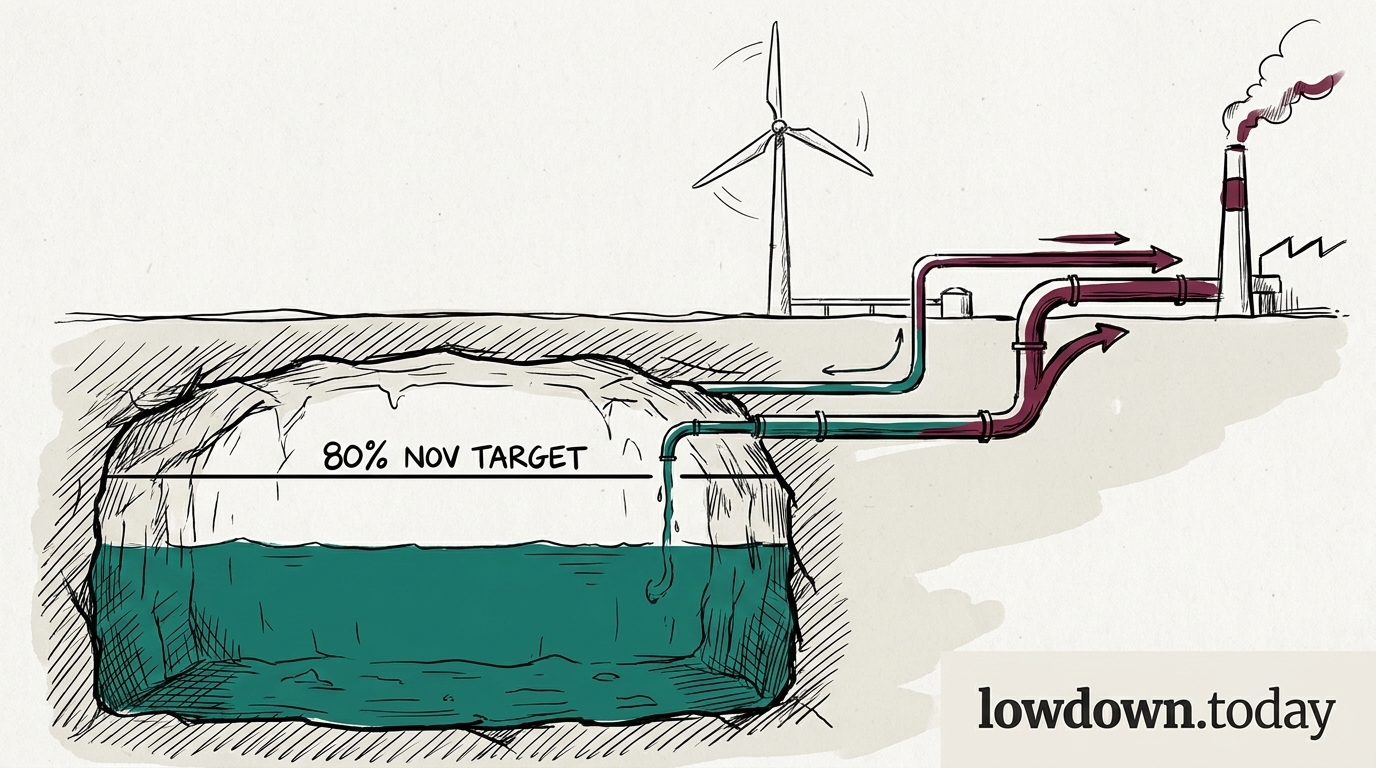
Brussels holds the bloc to 90% on a flexible window while Germany, holding roughly a quarter of EU storage capacity, tracks toward missing its own lower 80% figure by 21 points. A national shortfall this size in the anchor market matters more to bloc security than the flexible timetable alone can absorb.
French power exporters and CRE
French day-ahead rose in step with Germany but by less, reopening a EUR 7-17 premium that makes northward export flows commercially attractive again after the EUR 43.09 discount evaporated in days. CRE separately authorised RTE and Enedis to buy flexibility locally, betting the coming winter's binding constraint is grid congestion rather than a shortage of firm capacity.
TTF trading desk
TTF trading desk
A visible national shortfall like Germany's 21-point gap is a directional signal, not noise, for a desk holding the summer-winter spread. TTF's flat EUR 58-60 range through this week's German price swings says the market has not yet chosen to reprice refill risk into the front of the curve.
German cavern and CCGT operators
German caverns kept buying prompt gas at TTF near EUR 58-60 through the inversion; the wind collapse to 2.4 GW then flipped the spark spread to plus EUR 29 and put turbines back in the same queue. Every day turbines win that bid, injection at a third of the 877 GWh/day pace needed falls further behind.
Slovakia
Slovakia
Slovakia says it dropped its hold-out on the 21st sanctions package only after Ursula von der Leyen personally signed written gas-price and supply guarantees. The Council of the European Union's own 17,238-character release on the package names neither Slovakia nor any guarantee, leaving Bratislava's account unconfirmed by the institutional record.



