Skip to content
You can now search across every topic, entity and event.What's new
European Energy Markets
4JUN

TTF closes at EUR 42.39 after Hormuz swing

3 min read
10:45UTC

Dutch front-month gas settled EUR 4.12 above its 17 April seven-week low, pricing one variable against a three-variable supply calendar.

EconomicDeveloping
Key takeaway

TTF at 42.39 prices Hormuz signal noise, not the Hammerfest and Russian-ban removals this week.

TTF front-month settled at EUR 42.39/MWh on 22 April, recovering EUR 4.12 from a 17 April intraday low of EUR 38.27 1. The low printed after Donald Trump declared on Truth Social that the strait of Hormuz was 'completely open and ready for business', a declaration Iran repudiated by re-closing the strait on 18 April. The 14 loaded LNG cargoes that had been waiting to transit on 17 April have not moved.

The curve has repriced that signal almost entirely. What it has not priced is the compound arrival of two deterministic supply removals landing this week. Equinor shut Hammerfest LNG the same morning for a minimum 80 days of maintenance , and Friday's EU short-term Russian LNG framework change lands this week. Neither sits in the EUR 4.12 range; the market is treating Hormuz as the only active variable.

The composition of the 42.39 print is single-variable price action against a three-variable supply calendar. A clean Hammerfest 10 July return, a Hormuz reopening releasing the 14 queued cargoes, or an Arc7-mediated backfill of Russian volumes would each reduce the stack to a sequence and validate the current print. Absent those, the forward curve is priced on one assumption the market knows it is making.


Deep Analysis

In plain English

TTF is the main European gas price benchmark, similar to a stock index for gas. After US President Trump incorrectly said the Strait of Hormuz was open for shipping on 17 April, the price dropped sharply. Iran's own re-closure of the strait on 18 April drove prices back up to EUR 42.39 by 22 April. Two further supply problems arriving this week, a major Norwegian gas plant shutting for maintenance and a new EU ban on Russian gas contracts, have not yet fed through to the price.

Deep Analysis
Root Causes

TTF's single-variable pricing reflects a structural feature of European gas markets: the benchmark trades on narrative momentum faster than on cargo-level data. The 17 April low of EUR 38.27 was driven by a single social media post from the US President, not by any confirmed cargo transit.

Market microstructure, with extended trading hours now running 10-21 hours daily per Bloomberg, amplifies signal noise by giving momentum traders more session time to react to unverified geopolitical statements.

The deeper structural cause is that Europe's gas curve has no effective futures-market mechanism to separate geopolitical risk from physical supply. The forward curve prices both simultaneously, which means a credible diplomatic statement compresses the risk premium regardless of whether molecules have actually moved.

What could happen next?
  • Risk

    If Hammerfest and the Russian short-term ban are not priced in within the next two trading sessions, a catch-up repricing of EUR 5-10/MWh is structurally plausible as compliance teams update forward positions from 25 April.

    Immediate · 0.72
  • Opportunity

    A sustained Asian demand weakness persisting through June would provide Europe a cargo-routing window that the current spread geometry does not offer, potentially allowing Atlantic cargoes to redirect without a material TTF premium.

    Short term · 0.55
  • Risk

    The EUR 80/MWh Standard Chartered ceiling remains a live scenario if all three removals (Hormuz, Hammerfest, Russian ban) remain unresolved at the 1 June injection season peak.

    Medium term · 0.6
First Reported In

Update #4 · AccelerateEU skips gas; three removals land

World Pipelines· 22 Apr 2026
Read original
Different Perspectives
Marine insurers and AIS trackers covering Hormuz
AIS data shows severe curtailment on 20 July, 479 vessels anchored, 36 dark, 123 still broadcasting inside the strait, not the closure the IRGC claims. War-risk premiums move on the unresolved CENTCOM-IRGC contest itself, since underwriters price the dispute as much as the count.
QatarEnergy
QatarEnergy
Ras Laffan has run at minimum output under force majeure into August since 9 July, a constraint already priced before this week's claim. The 17-20 July move is risk premium stacked on that standing loss, not a new physical loss at the plant.
ACER and the European Commission
ACER opened the REMIT reporting consultation on schedule on 16 July, giving firms to 11 September before a quarter to build systems against Regulation 648/2012. Brussels' separate silence on StromVKG state-aid clearance leaves Berlin's own capacity mechanism without legal authorisation.
EDF and French grid operator RTE
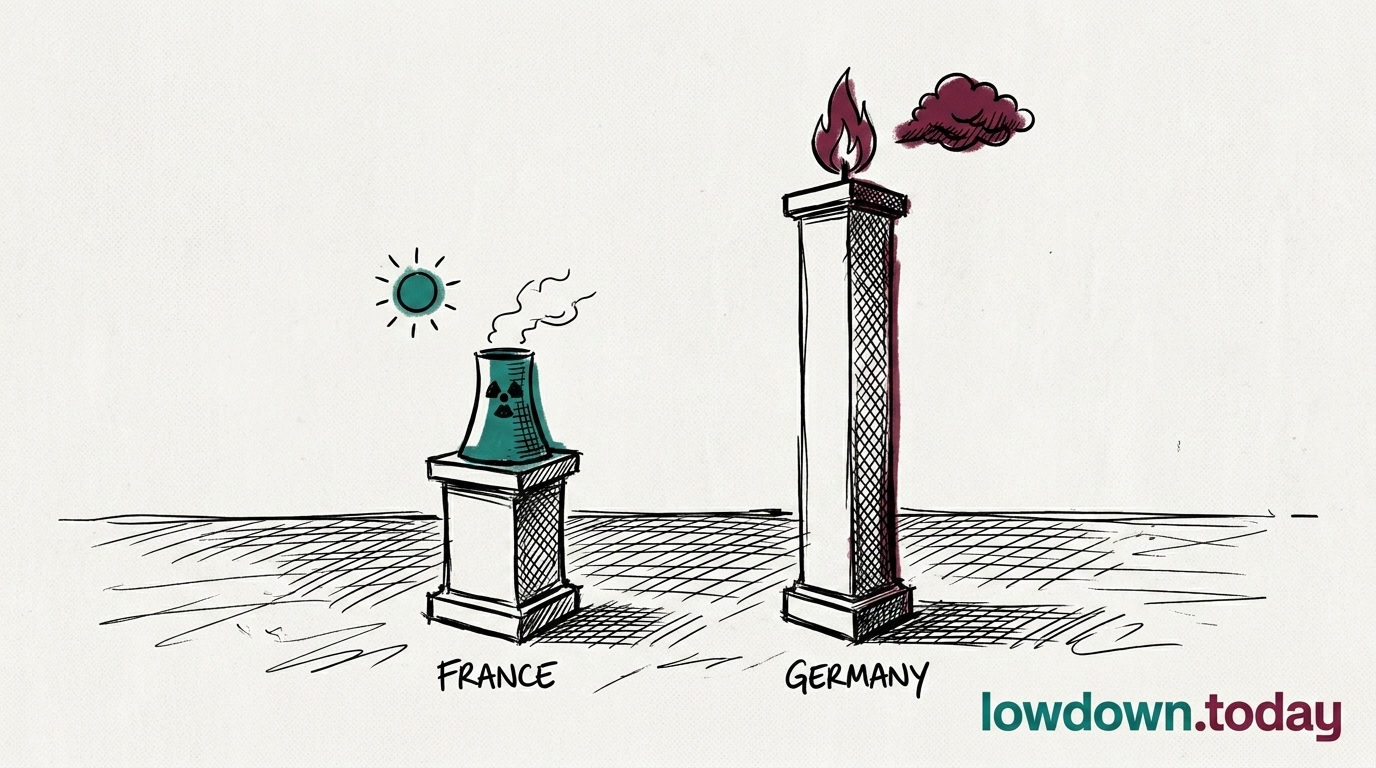
France's discount to Germany rests on an ASNR derogation from the 28C river-cooling limit at Bugey that expires today, not on a nuclear recovery; Chooz, Golfech and Bugey restarts run to 25 July. The cheap leg holds only as long as regulators keep waiving the limit each heatwave.
German CCGT operators and grid balancers
German gas plants went off-merit on 20 July as the clean spark spread inverted to minus EUR 15 to minus EUR 21/MWh, sidelining the flexible capacity storage injection needs. Operators are pricing 2027-28 capacity revenue against Bundesnetzagentur's own admission that Brussels has not cleared the 9 GW StromVKG auctions.
LNG spreads desk
LNG spreads desk
The JKM-TTF arb flipped to a TTF premium of roughly USD 0.6/MMBtu on 15 July, the first time this cycle Europe has outbid Asia, yet no Atlantic cargo has rerouted west. Until a cargo actually moves, the desk reads the Hormuz premium as unconfirmed and the EUR 55 print as vulnerable to a fast reversal.
