Skip to content
You can now search across every topic, entity and event.What's new
European Energy Markets
4JUN

EU Russian LNG ban begins; TTF barely flinches

3 min read
10:45UTC

The European Union's short-term ban on Russian liquefied natural gas (LNG) entered force on Saturday 25 April, removing 2.8 to 3.5 million tonnes per year of spot supply. TTF front-month settled at EUR 44.86/MWh, only 5.8% above the 22 April close.

EconomicDeveloping
Key takeaway

Russian LNG ban entered force at TTF EUR 44.86, only 5.8% above the 22 April close.

The European Union's short-term ban on Russian LNG spot contracts entered force on Saturday 25 April , removing roughly 2.8 to 3.5 million tonnes per year of supply, around 3% of EU LNG imports 1. The benchmark Dutch TTF (Title Transfer Facility) front-month contract, the European gas price of record, settled the same day at EUR 44.86/MWh, only 5.8% above the 22 April close of EUR 42.39 2. Long-term contracts held by TotalEnergies, Naturgy and SEFE remain grandfathered to 1 January 2027 3.

The convergence had been on the calendar for weeks: ban day, Hammerfest LNG offline through at least 10 July, and Hormuz still physically closed, three independent supply removals inside one week. Wood Mackenzie's Tom Marzec-Manser told Bloomberg there was "no risk to supply just yet, but that could change in a couple of months" 4, and the EUR 2.46 settle change between 22 April and ban day was within normal weekly volatility. Bloomberg attributed the year-to-date 40% TTF rise to the Middle East conflict rather than the ban itself 5.

The muted print reflects pre-positioning more than slack. Russian LNG flows had already dropped to roughly one third of normal volumes since February, the Hormuz closure was already in the curve, and Germany flipped to net injection three days before ban day at a season-high pace. The TTF settle below EUR 45 puts Bruegel's base refill scenario at EUR 26 billion as the operative number, EUR 9 billion under the political consensus. The bearish read: Hammerfest historical overruns put 10 July at risk, the Arc7 ice-class shipping carve-out is unresolved, and Italy-France day-ahead cleared a EUR 153/MWh spread on Sunday 26 April that the gas curve does not reflect.

Deep Analysis

In plain English

The European Union banned the purchase of short-term, or "spot", contracts for Russian liquefied natural gas (LNG) on 25 April 2026. LNG is natural gas that has been chilled to liquid form so it can be shipped by tanker, rather than piped. The ban removes roughly 3% of the EU's LNG imports. The reason gas prices barely moved is that markets knew the ban was coming for weeks and adjusted in advance. Some companies, including TotalEnergies and Naturgy, have existing long-term deals with Russian suppliers that are exempt until 1 January 2027, so the immediate effect is limited.

Deep Analysis
Root Causes

Russia's LNG export infrastructure was built to bypass pipeline-route political risk, a design choice made after the 2006 and 2009 Ukraine transit disputes. Yamal LNG and Arctic LNG projects were structured to reach both European and Asian buyers via independent maritime routes, which is why a European spot ban cannot eliminate Russian supply but only reroute it.

The grandfathering of long-term contracts to January 2027 reflects the EU's inability to expropriate private contractual rights under member-state and EU commercial law. TotalEnergies and Naturgy have valid take-or-pay obligations; forcing early termination would expose member states to arbitration claims under Energy Charter Treaty successor provisions.

What could happen next?
  • Risk

    The January 2027 long-term contract cliff creates a second, larger substitution event when TotalEnergies, Naturgy and SEFE must simultaneously replace grandfathered Russian volumes in a tighter Atlantic LNG market.

    Medium term · 0.75
  • Consequence

    Russian spot LNG rerouted to Asian buyers displaces volumes Asian buyers would otherwise have purchased on Atlantic spot markets, indirectly tightening the Atlantic pool available to European importers.

    Short term · 0.7
  • Precedent

    The grandfathering structure sets a template for future EU energy sanctions: self-imposed supply removal with a pre-announced date, allowing price pre-positioning and reducing acute market shock at the cost of a deferred cliff.

    Long term · 0.65
First Reported In

Update #5 · Ban day muted; Germany doubles injection rate

OilPriceAPI· 26 Apr 2026
Read original
Different Perspectives
Marine insurers and AIS trackers covering Hormuz
AIS data shows severe curtailment on 20 July, 479 vessels anchored, 36 dark, 123 still broadcasting inside the strait, not the closure the IRGC claims. War-risk premiums move on the unresolved CENTCOM-IRGC contest itself, since underwriters price the dispute as much as the count.
QatarEnergy
QatarEnergy
Ras Laffan has run at minimum output under force majeure into August since 9 July, a constraint already priced before this week's claim. The 17-20 July move is risk premium stacked on that standing loss, not a new physical loss at the plant.
ACER and the European Commission
ACER opened the REMIT reporting consultation on schedule on 16 July, giving firms to 11 September before a quarter to build systems against Regulation 648/2012. Brussels' separate silence on StromVKG state-aid clearance leaves Berlin's own capacity mechanism without legal authorisation.
EDF and French grid operator RTE
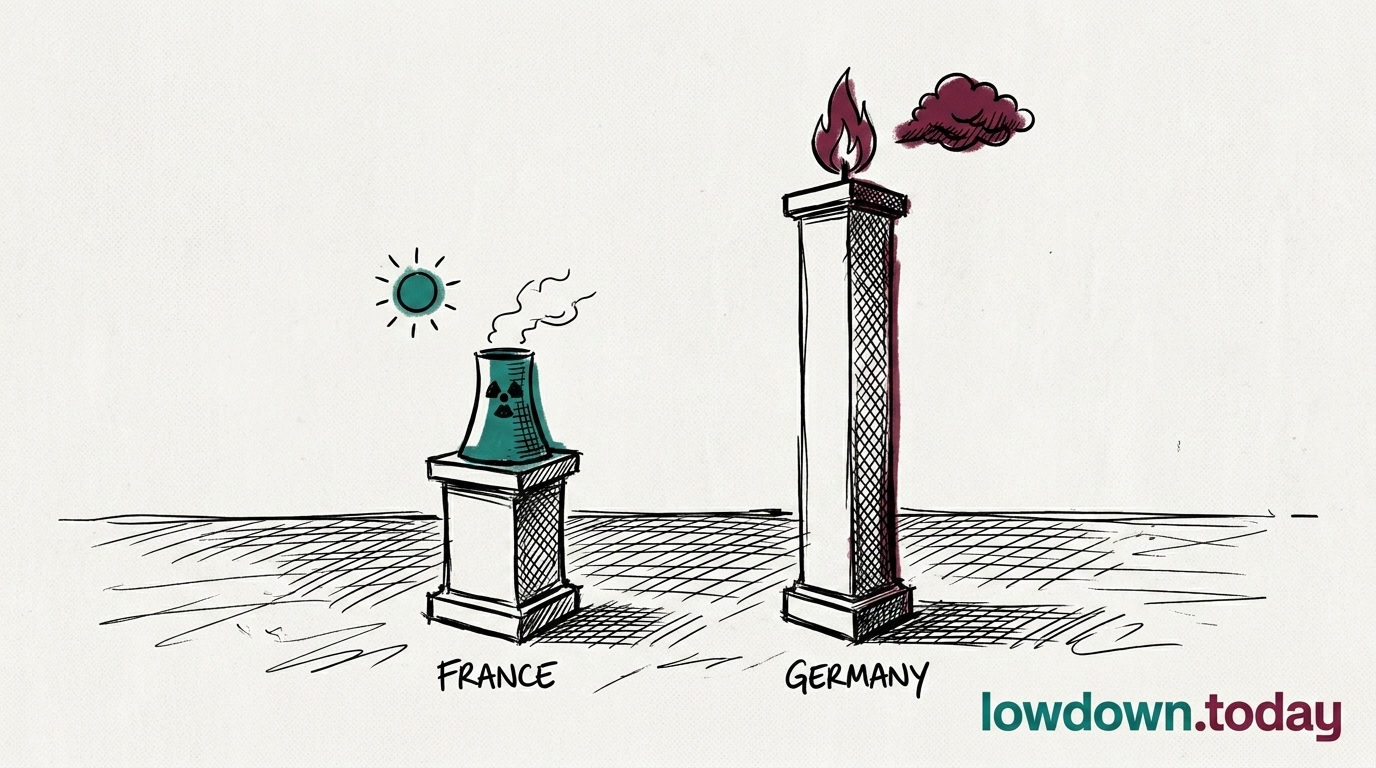
France's discount to Germany rests on an ASNR derogation from the 28C river-cooling limit at Bugey that expires today, not on a nuclear recovery; Chooz, Golfech and Bugey restarts run to 25 July. The cheap leg holds only as long as regulators keep waiving the limit each heatwave.
German CCGT operators and grid balancers
German gas plants went off-merit on 20 July as the clean spark spread inverted to minus EUR 15 to minus EUR 21/MWh, sidelining the flexible capacity storage injection needs. Operators are pricing 2027-28 capacity revenue against Bundesnetzagentur's own admission that Brussels has not cleared the 9 GW StromVKG auctions.
LNG spreads desk
LNG spreads desk
The JKM-TTF arb flipped to a TTF premium of roughly USD 0.6/MMBtu on 15 July, the first time this cycle Europe has outbid Asia, yet no Atlantic cargo has rerouted west. Until a cargo actually moves, the desk reads the Hormuz premium as unconfirmed and the EUR 55 print as vulnerable to a fast reversal.

