Skip to content
You can now search across every topic, entity and event.What's new
European Energy Markets
4JUN

TTF trades EUR 41.67 intraday, extending six-week low

3 min read
10:45UTC

The Dutch Title Transfer Facility front-month was trading at EUR 41.67/MWh intraday on 17 April with markets still open, a further 1.3% below the 15 April midday level, as ceasefire-optimism kept a single diplomatic variable in control of the screen.

EconomicDeveloping
Key takeaway

TTF at EUR 41.67 prices one diplomatic variable while the 22-29 April calendar carries three independent supply reductions.

TTF front-month was trading at EUR 41.67/MWh intraday on 17 April, down 1.3% from the 15 April midday print of EUR 42.26 and 11.8% below the 13 April close of EUR 47.27 1. The figure is an in-market-hours reading (markets remained open through publication); the daily settle will print at end of session. The contract has fallen 23.77% over the preceding month while still trading 17.80% higher year-on-year 2. The screen is extending a ceasefire-optimism bid that has held rather than reversed.

TTF is the Dutch Title Transfer Facility, the virtual trading hub whose front-month settlement on ICE Endex serves as the continental benchmark for every European utility procurement desk and industrial hedge book. The 17 April intraday print sits in the lower half of the post-Hormuz trading range without signalling a structural easing of the underlying supply position. What the price carries, and what it does not, matters more than the headline number.

The physical calendar behind the screen has not softened alongside it. Three independent supply reductions converge into the 22-29 April window: Equinor's Hammerfest LNG planned maintenance from 22 April, the EU Council's short-term Russian LNG contract ban from 25 April, and Germany still net-withdrawing from storage four days into April when it should have flipped to injection. Two of those three have no diplomatic off-ramp. A ceasefire that holds does not close Hammerfest or reverse the Reden cavern booking failure. A ceasefire that fails compounds all three.

Implied option volatility on the late-April contract does not reflect the physical state of the system, because two-thirds of the stack is non-diplomatic. Industrial hedgers sizing Q3 exposure off EUR 41.67 are short gamma into a calendar they have not priced. At the JKM (Japan Korea Marker, the Asian LNG spot benchmark) parity level currently prevailing, flexible Atlantic cargoes see no commercial reason to bias toward European terminals, so the marginal supply that would cushion any broken leg is not queued to arrive. Standard Chartered's EUR 80+ upper-bound scenario remains on the table if any of the three independent supply legs breaks before the ceasefire question is even resolved.

Deep Analysis

In plain English

TTF is the price benchmark that European gas companies use to buy and sell natural gas think of it like a stock index but for gas. When it falls, it suggests traders believe the supply situation is improving, often because they expect a conflict affecting deliveries to wind down. On 17 April, the price dropped because traders were optimistic about a ceasefire in the Middle East that has been blocking gas tanker routes. The problem is that several other reasons gas supply will be tight in late April have nothing to do with that ceasefire, and the price has not fully reflected them yet.

Deep Analysis
Root Causes

TTF's ceasefire sensitivity is structurally asymmetric. The contract responds to diplomatic news because a Hormuz reopening is the one variable large enough to matter roughly 2 bcm per week of Qatari supply removed but the non-Hormuz constraints are inelastic to diplomacy. The gas storage levy abolition on 1 January 2026 removed the injection-cost insurance that previously kept forward-curve incentives aligned with physical storage build targets.

The JKM-TTF spread geometry means Atlantic flexible cargoes have no commercial reason to bias toward European terminals at current hub levels. The option market is therefore pricing only the diplomatic binary, not the independent supply constraints, creating a disconnect between screen-level signals and the physical injection economics that will become visible in the AGSI+ data inside two weeks.

What could happen next?
  • Risk

    If any of the three non-diplomatic supply constraints breaks in the 22-29 April window while the ceasefire premium is still embedded in TTF, the repricing would be rapid and unhedged for late-movers.

    Immediate · 0.82
  • Consequence

    Industrial procurement desks using EUR 41.67 as Q3 hedge anchor are implicitly running an uncovered diplomatic position.

    Short term · 0.75
  • Opportunity

    If the ceasefire holds and Hormuz traffic normalises, the EUR 41 print becomes a reasonable medium-term floor and long-dated injection contracts become viable at current economics.

    Medium term · 0.6
First Reported In

Update #3 · TTF holds six-week low as supply stack hardens

Trading Economics / ICE· 17 Apr 2026
Read original
Different Perspectives
Marine insurers and AIS trackers covering Hormuz
AIS data shows severe curtailment on 20 July, 479 vessels anchored, 36 dark, 123 still broadcasting inside the strait, not the closure the IRGC claims. War-risk premiums move on the unresolved CENTCOM-IRGC contest itself, since underwriters price the dispute as much as the count.
QatarEnergy
QatarEnergy
Ras Laffan has run at minimum output under force majeure into August since 9 July, a constraint already priced before this week's claim. The 17-20 July move is risk premium stacked on that standing loss, not a new physical loss at the plant.
ACER and the European Commission
ACER opened the REMIT reporting consultation on schedule on 16 July, giving firms to 11 September before a quarter to build systems against Regulation 648/2012. Brussels' separate silence on StromVKG state-aid clearance leaves Berlin's own capacity mechanism without legal authorisation.
EDF and French grid operator RTE
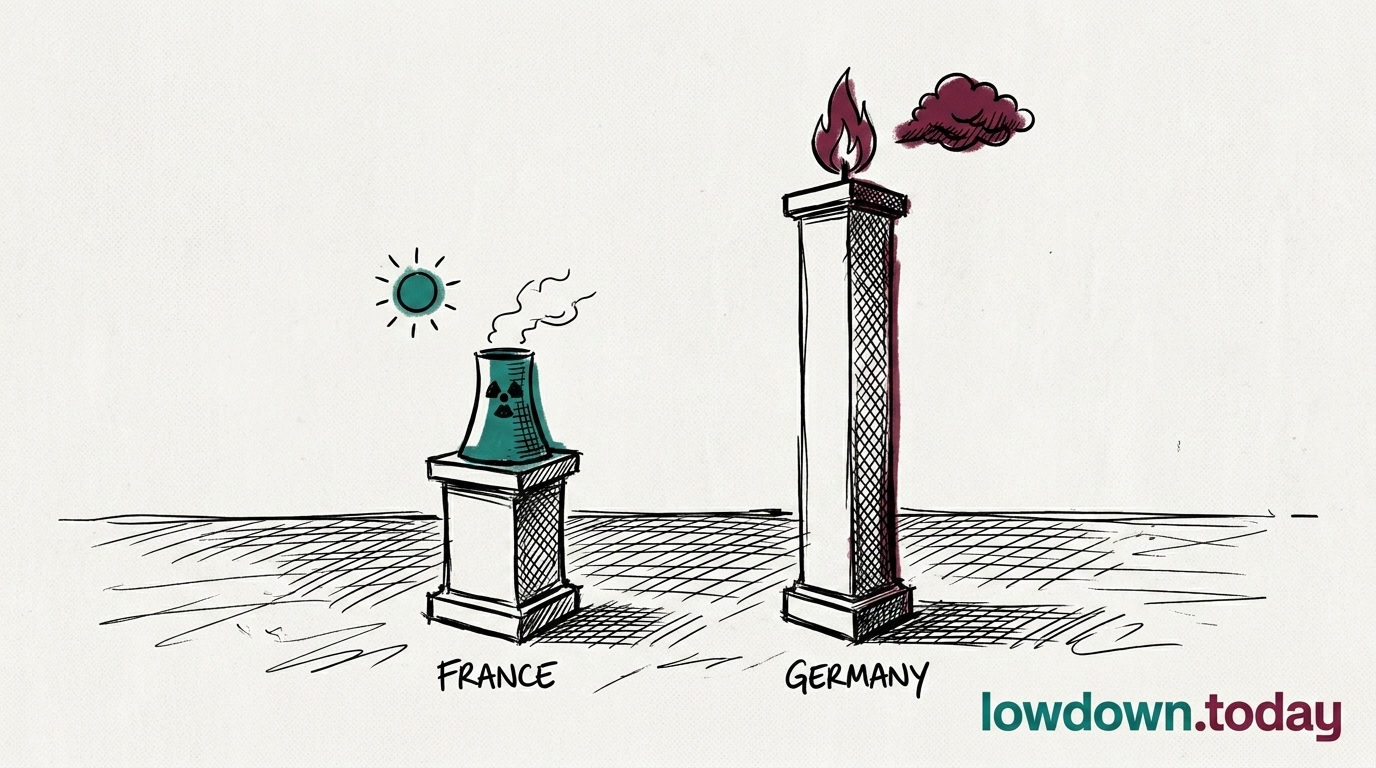
France's discount to Germany rests on an ASNR derogation from the 28C river-cooling limit at Bugey that expires today, not on a nuclear recovery; Chooz, Golfech and Bugey restarts run to 25 July. The cheap leg holds only as long as regulators keep waiving the limit each heatwave.
German CCGT operators and grid balancers
German gas plants went off-merit on 20 July as the clean spark spread inverted to minus EUR 15 to minus EUR 21/MWh, sidelining the flexible capacity storage injection needs. Operators are pricing 2027-28 capacity revenue against Bundesnetzagentur's own admission that Brussels has not cleared the 9 GW StromVKG auctions.
LNG spreads desk
LNG spreads desk
The JKM-TTF arb flipped to a TTF premium of roughly USD 0.6/MMBtu on 15 July, the first time this cycle Europe has outbid Asia, yet no Atlantic cargo has rerouted west. Until a cargo actually moves, the desk reads the Hormuz premium as unconfirmed and the EUR 55 print as vulnerable to a fast reversal.

