Skip to content
Briefings are running a touch slower this week while we rebuild the foundations.See roadmap
European Energy Markets
4JUN

Hungary infringed over MOL ECT arbitration

3 min read
10:45UTC

The European Commission issued a reasoned opinion against Hungary on 29 April over MOL's investor-state arbitration against EU member states under Energy Charter Treaty Article 26, the second infringement leg of the same package.

EconomicAssessed
Key takeaway

MOL is the Commission's test case for whether intra-EU Energy Charter arbitration survives Brussels enforcement.

The European Commission's 29 April infringements package included a reasoned opinion against Hungary over MOL's use of Energy Charter Treaty Article 26 investor-state arbitration against EU member states 1. The reasoned opinion is the second separate infringement proceeding touching Hungary in the same package, alongside Hungary's broader exposure across the week's regulatory file.

MOL is the Hungarian multinational oil and gas company, state-affiliated, operator of the Százhalombatta refinery and the principal Hungarian crude buyer on the Druzhba pipeline that restarted on 22 April. Energy Charter Treaty Article 26 is the investor-state dispute mechanism the Commission has formally argued cannot be used between EU member states following the Achmea and Komstroy judgments at the Court of Justice. the Commission's position is that intra-EU ECT arbitration is incompatible with EU law; Hungary's failure to prevent MOL's Article 26 cases is the conduct the reasoned opinion targets.

The MOL infringement lands on a politically shifted baseline. Hungary's 12 April parliamentary election delivered Péter Magyar as the new Hungarian leader, on a platform that included releasing the EUR 90 billion EU-Ukraine loan facility from Hungarian blocking, which Magyar delivered the same week (covered separately in this briefing). The MOL infringement, the Druzhba restart, the windfall debate the five finance ministers raised in their letter to Wopke Hoekstra and Hungary's reported blocking of the full maritime services ban in the 20th sanctions package now all sit on the same shifted political terrain.

MOL faces procedural exposure first. The reasoned opinion starts a two-month clock for Hungary to respond, after which Brussels can take Budapest to Luxembourg. If the case reaches Luxembourg and Hungary loses, the Commission gains precedent for treating future intra-EU ECT arbitration as itself a Treaty breach by the host state, beyond any liability of the corporate claimant. That tightens Brussels' enforcement perimeter on a framework the Commission has argued has no legal force inside the bloc since the Achmea ruling but which has continued in practice through cases like MOL's. EU energy investment dispute resolution now turns on whether reasoned opinions of this kind survive Member State response.


Deep Analysis

In plain English

The Energy Charter Treaty is a 1994 international agreement that allows energy companies to sue governments when new laws damage their investments. The EU has decided this mechanism conflicts with European law when it is used by companies from one EU country suing another EU country; a position the EU's top court has confirmed twice. MOL, Hungary's state-controlled oil company, has been using this mechanism to bring arbitration claims against other EU member states. Brussels says Hungary should have stopped MOL from doing this. The infringement proceeding tells Budapest: you have two months to take action, or we refer this to the Court of Justice. Hungary's new government, under Péter Magyar, is more EU-aligned than its predecessor; but stopping an active arbitration case is a complex legal procedure that executive action alone cannot complete.

Deep Analysis
Root Causes

The ECT's withdrawal process; which the EU initiated formally in 2023; leaves a gap during which the treaty remains legally binding for existing disputes. MOL's Article 26 claims were filed before the EU's formal withdrawal decision, placing them in a contested zone between the ECT's binding arbitration clause and the Court of Justice's Achmea/Komstroy doctrine.

The Hungarian state's majority ownership of MOL creates a direct channel between Budapest's energy policy choices and the arbitration strategy. Under Orbán, Hungary did not prevent MOL from pursuing claims; the infringement proceeding asks Magyar's government to take active steps to halt or withdraw those claims, which requires parliamentary or executive action that has not yet been taken.

What could happen next?
  • Precedent

    A Court of Justice referral would test whether the Achmea/Komstroy intra-EU arbitration doctrine applies when the claimant is a state-controlled entity; a factual variant the Court has not ruled on directly.

  • Consequence

    Magyar's government must take executive or legislative action to halt MOL's arbitration claims within the two-month response window, creating an early domestic political test on EU alignment versus state-company interests.

First Reported In

Update #6 · REMIT II live; storage instrument absent

European Commission DG Energy· 29 Apr 2026
Read original
Causes and effects
This Event
Hungary infringed over MOL ECT arbitration
The Commission is testing whether intra-EU investor-state arbitration under the Energy Charter Treaty survives Brussels enforcement, with a Hungarian state-affiliated oil major as the test case.
Different Perspectives
TTF traders / Amsterdam hub desks
TTF broke its 38-session EUR 46-47 band on 2 June to EUR 48.9 on stalled Iran diplomacy and an unconfirmed Troll A restart; Dutch EBN mandates carry storage trajectory while commercial injection books nothing. The 17 June pipeline expiry is the next binary level: Central European hub premium above EUR 2/MWh widens sharply on any physical step-down.
Red Electrica / Spanish grid operators
Spain logged 397 negative-price hours in Q1 2026, eight times the 48 hours of Q1 2025, documenting midday solar surplus now embedding structurally into Continental pricing. Spain is four to six quarters ahead of France and Germany on the solar-penetration curve, making it the clearest forward indicator of where Continental midday clearing is heading.
Equinor
Equinor
Equinor issued no Troll A restart notice through 4 June despite extending the combined outage to 31 May, keeping up to 51 mcm/day of Norwegian supply offline alongside Hammerfest LNG dark since 22 April. The company's silence follows its 2025 Hammerfest pattern, which ran 24 days past target, and each day without a notice sustains the TTF supply premium.
European Commission / GMTF
SWD(2026)147 found EU gas spot and derivatives markets functioning well on 2 June, recommending MiFID-REMIT legislative alignment rather than emergency intervention. The GMTF verdict addressed derivatives-market integrity, not the physical injection mechanism FNB Gas declared broken five days earlier: the Commission's immediate next step is a legislative proposal, not an emergency storage order.
FNB Gas / Bundesnetzagentur
FNB Gas declared the storage-refill mechanism broken on 27 May after zero bookings in January 2026 auctions, and German day-ahead cleared EUR 102.64 on 3 June on a CCGT stack set by TTF near EUR 49 plus EUA near EUR 78. Winter storage fill now depends on state mandates with no commercial self-correction.
EDF / French government
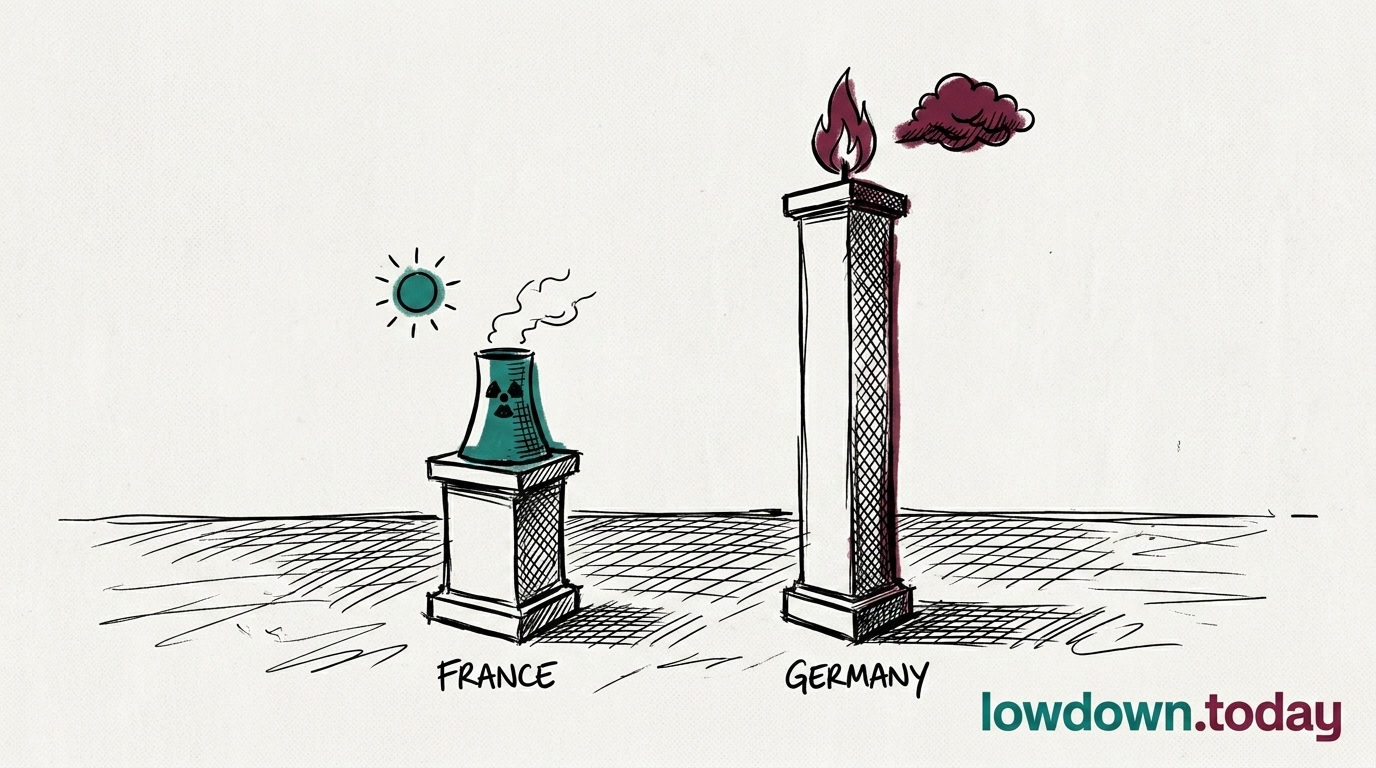
EDF held full-year nuclear guidance at 350-370 TWh after April output of 29.3 TWh, anchoring the surplus that collapsed French day-ahead to EUR 8.96 on 3 June and passed that price to VNU industrials. Flamanville-3's September overhaul removes 1.6 GW at heating-season onset, reversing the nuclear surplus that made VNU pricing competitive.
