Skip to content
Briefings are running a touch slower this week while we rebuild the foundations.See roadmap
European Energy Markets
4JUN

Five finance ministers push windfall levy on energy

3 min read
10:45UTC

Germany, Italy, Spain, Portugal and Austria wrote jointly to Commissioner Wopke Hoekstra on 4 April calling for a new EU-wide contribution modelled on the 2022-23 solidarity levy.

EconomicDeveloping
Key takeaway

Five capitals have put a windfall levy on the table before the Commission's April energy calendar closes.

Finance ministers of Germany, Italy, Spain, Portugal and Austria wrote jointly to EU Climate Commissioner Wopke Hoekstra on 4 April calling for a new EU-wide windfall contribution on energy company profits, modelled on the 2022-23 solidarity levy 1. Eurozone inflation rose to 2.5% in March from 1.9% in February, largely on energy.

The political mechanism is familiar from the 2022 solidarity levy: governments facing renewed household cost-of-living pressure look for a revenue instrument that does not require direct fiscal transfer and lands on politically visible corporate profits. The signatories are the five member states running the highest consumer-facing gas tariffs relative to pre-2022 baselines, and the Ember analysis showed EU household gas bills still 16% above 2021 levels .

the Commission's position is more constrained than the 2022 moment. The reduced 80% November storage target is already a concession to the supply-side difficulty of the Bruegel EUR 35 billion refill ; stacking a windfall contribution on top of a Russian LNG ban implementation in the same fortnight compresses the room for negotiation with industry. If adopted, the levy redistributes cost from consumer to energy-profit balance sheets; if deferred, it becomes a campaign issue in member states with 2026 elections on the calendar.

The operational read for energy-sector finance leads is that the 4 April letter is a forward commitment, not a proposal. It places a funded position on the table before the 40th Gas Regulatory Forum convenes in Madrid on 29 April context, which means the Forum's agenda now includes a redistribution argument the Commission did not choose to open.


Deep Analysis

In plain English

When gas prices spike, energy companies making much higher profits than normal on existing contracts and assets receive what are called 'windfall profits'. In 2022-23, during the last major energy crisis, the EU introduced a one-off levy on energy companies to capture some of these extra profits and use them to support consumers. On 4 April 2026, the finance ministers of Germany, Italy, Spain, Portugal, and Austria jointly wrote to the EU's Climate Commissioner calling for a new version of this levy. They cited a rise in eurozone inflation from 1.9% to 2.5% in March, largely driven by energy costs. The proposal faces the same design challenge as last time: if the levy reduces the financial incentive for energy companies to invest in new supply infrastructure, it could worsen the very shortage that is causing the high prices.

What could happen next?
  • Risk

    A hastily designed levy repeating 2022-23's national divergence would face legal challenge across multiple member states, delaying any consumer relief by 12-18 months.

  • Opportunity

    If designed with the UK EPL's investment allowance structure, a 2026 levy could fund consumer relief while preserving incentives for LNG terminal expansion investment that Europe requires to close the 180-cargo structural gap.

First Reported In

Update #2 · TTF EUR 42 as Russian LNG ban enters range

European Commission· 15 Apr 2026
Read original
Different Perspectives
TTF traders / Amsterdam hub desks
TTF broke its 38-session EUR 46-47 band on 2 June to EUR 48.9 on stalled Iran diplomacy and an unconfirmed Troll A restart; Dutch EBN mandates carry storage trajectory while commercial injection books nothing. The 17 June pipeline expiry is the next binary level: Central European hub premium above EUR 2/MWh widens sharply on any physical step-down.
Red Electrica / Spanish grid operators
Spain logged 397 negative-price hours in Q1 2026, eight times the 48 hours of Q1 2025, documenting midday solar surplus now embedding structurally into Continental pricing. Spain is four to six quarters ahead of France and Germany on the solar-penetration curve, making it the clearest forward indicator of where Continental midday clearing is heading.
Equinor
Equinor
Equinor issued no Troll A restart notice through 4 June despite extending the combined outage to 31 May, keeping up to 51 mcm/day of Norwegian supply offline alongside Hammerfest LNG dark since 22 April. The company's silence follows its 2025 Hammerfest pattern, which ran 24 days past target, and each day without a notice sustains the TTF supply premium.
European Commission / GMTF
SWD(2026)147 found EU gas spot and derivatives markets functioning well on 2 June, recommending MiFID-REMIT legislative alignment rather than emergency intervention. The GMTF verdict addressed derivatives-market integrity, not the physical injection mechanism FNB Gas declared broken five days earlier: the Commission's immediate next step is a legislative proposal, not an emergency storage order.
FNB Gas / Bundesnetzagentur
FNB Gas declared the storage-refill mechanism broken on 27 May after zero bookings in January 2026 auctions, and German day-ahead cleared EUR 102.64 on 3 June on a CCGT stack set by TTF near EUR 49 plus EUA near EUR 78. Winter storage fill now depends on state mandates with no commercial self-correction.
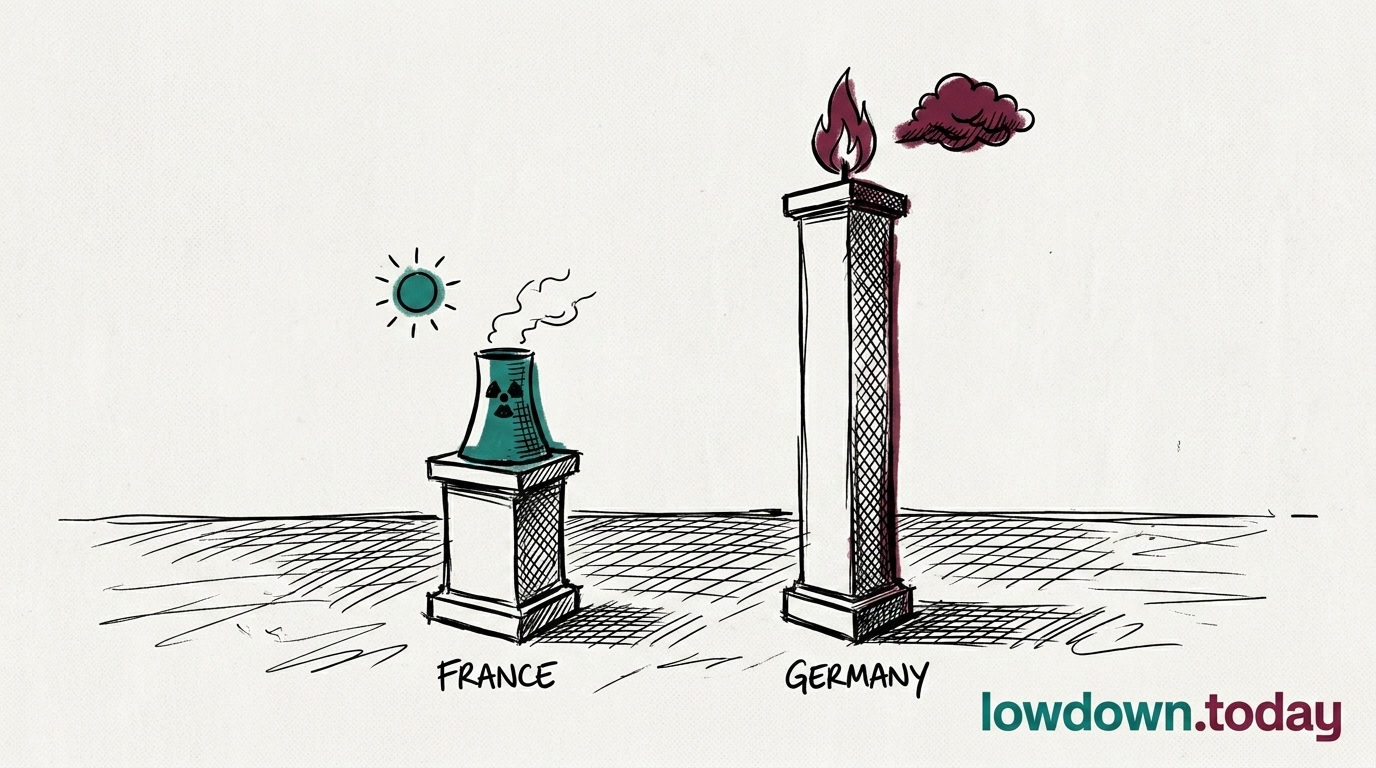
EDF / French government
EDF held full-year nuclear guidance at 350-370 TWh after April output of 29.3 TWh, anchoring the surplus that collapsed French day-ahead to EUR 8.96 on 3 June and passed that price to VNU industrials. Flamanville-3's September overhaul removes 1.6 GW at heating-season onset, reversing the nuclear surplus that made VNU pricing competitive.
