Skip to content
You can now search across every topic, entity and event.What's new
European Energy Markets
4JUN

AccelerateEU skips gas storage injection mechanism entirely

3 min read
10:45UTC

Brussels published a consumer-relief package on 22 April with no gas storage injection incentive, 72 hours before the Russian LNG short-term ban takes effect.

EconomicDeveloping
Key takeaway

Brussels picked consumer relief over a storage mechanism, leaving the 469 TWh target to an unsubsidised market.

The European Commission published the AccelerateEU energy package on 22 April, confirming the template Bruegel had assessed as inadequate for storage security 1. The package delivers energy vouchers, a temporary disconnection ban, an electricity tax reduction Recommendation, a one-day-a-week remote-working recommendation, nuclear retention guidance, and state aid covering up to 50% of extra costs for agriculture, fishing, transport and energy-intensive industry through 31 December 2026. No storage-injection incentive, no mandatory refill mechanism, and no replacement for the storage levy abolished on 1 January 2026.

The five-finance-minister windfall letter is acknowledged but not converted into an instrument. A Power Purchase Agreement (PPA) Recommendation landed the same day, but multi-year PPA lead times make it a post-2027 investment signal rather than a summer 2026 fix. Consumer-relief is itself a political-constraint signal: The Commission picked the tools compatible with current coalition arithmetic rather than the tools that would have closed the injection gap.

The informal European Council in Cyprus on 23-24 April is the only remaining venue where the storage question could be reopened before Friday's Russian LNG short-term ban and the REMIT recast entry both land. DG Energy's 20 April explainer, which still reads 'no immediate security of oil or gas supply concerns' from Hormuz, was not updated after Tehran's re-closure. With no storage instrument and stale supply framing as the regulatory calendar tightens, the hedge against the three removals sits entirely on member state balance sheets.


Deep Analysis

In plain English

Europe needs to refill its underground gas tanks over the summer so there is enough gas to heat homes next winter. The EU's new energy package came out on 22 April but skipped any mechanism to subsidise or require that refilling, meaning gas companies have no financial reason to inject when it costs more to store than the gas is currently worth.

Deep Analysis
Root Causes

Two structural decisions created the conditions for AccelerateEU's storage gap. First, the Council voted to abolish the gas storage levy on 1 January 2026, removing the only cross-member mechanism for sharing injection costs, on the assumption that the 2022-2025 storage infrastructure build had solved the adequacy problem.

Second, the Commission's decision to lower the mandatory fill target from 90% to 80% in April 2026 reduced the headline gap but did not adjust the injection incentive structure. With the levy gone and the target reduced, operators at the Reden cavern and comparable sites face a rational disincentive: pay injection costs today against a summer-winter spread that does not cover them, and sit on a stranded gas position if TTF falls before winter.

What could happen next?
  • Risk

    If the European Council in Cyprus on 23-24 April does not reopen the storage question, the EU enters summer with no fiscal mechanism to close the injection deficit, leaving member state balance sheets as the only backstop.

    Immediate · 0.85
  • Consequence

    The PPA Recommendation published alongside AccelerateEU will only affect power procurement economics from approximately 2028 at the earliest, given multi-year contract lead times.

    Long term · 0.9
  • Risk

    With the windfall levy option still unresolved after the five-minister letter, forward gas contracts face an uncertainty premium until the Commission formally closes or opens that instrument, likely at or after the Cyprus summit.

    Short term · 0.75
First Reported In

Update #4 · AccelerateEU skips gas; three removals land

European Commission DG Energy· 22 Apr 2026
Read original
Causes and effects
This Event
AccelerateEU skips gas storage injection mechanism entirely
A consumer-relief template with no supply-side instrument leaves the 469 TWh summer injection arithmetic to the unaided market at a moment when summer-winter spreads are inverted.
Different Perspectives
Marine insurers and AIS trackers covering Hormuz
AIS data shows severe curtailment on 20 July, 479 vessels anchored, 36 dark, 123 still broadcasting inside the strait, not the closure the IRGC claims. War-risk premiums move on the unresolved CENTCOM-IRGC contest itself, since underwriters price the dispute as much as the count.
QatarEnergy
QatarEnergy
Ras Laffan has run at minimum output under force majeure into August since 9 July, a constraint already priced before this week's claim. The 17-20 July move is risk premium stacked on that standing loss, not a new physical loss at the plant.
ACER and the European Commission
ACER opened the REMIT reporting consultation on schedule on 16 July, giving firms to 11 September before a quarter to build systems against Regulation 648/2012. Brussels' separate silence on StromVKG state-aid clearance leaves Berlin's own capacity mechanism without legal authorisation.
EDF and French grid operator RTE
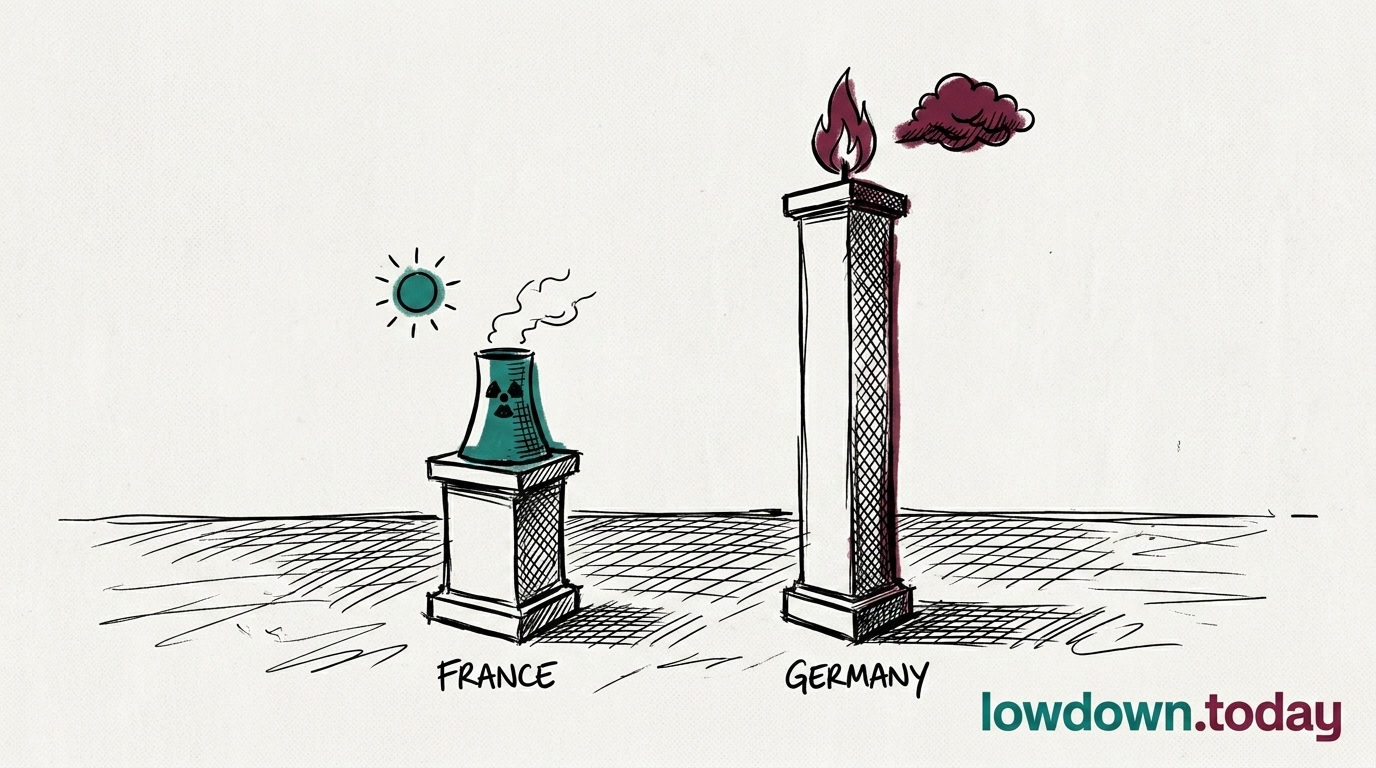
France's discount to Germany rests on an ASNR derogation from the 28C river-cooling limit at Bugey that expires today, not on a nuclear recovery; Chooz, Golfech and Bugey restarts run to 25 July. The cheap leg holds only as long as regulators keep waiving the limit each heatwave.
German CCGT operators and grid balancers
German gas plants went off-merit on 20 July as the clean spark spread inverted to minus EUR 15 to minus EUR 21/MWh, sidelining the flexible capacity storage injection needs. Operators are pricing 2027-28 capacity revenue against Bundesnetzagentur's own admission that Brussels has not cleared the 9 GW StromVKG auctions.
LNG spreads desk
LNG spreads desk
The JKM-TTF arb flipped to a TTF premium of roughly USD 0.6/MMBtu on 15 July, the first time this cycle Europe has outbid Asia, yet no Atlantic cargo has rerouted west. Until a cargo actually moves, the desk reads the Hormuz premium as unconfirmed and the EUR 55 print as vulnerable to a fast reversal.
