Skip to content
Briefings are running a touch slower this week while we rebuild the foundations.See roadmap
European Energy Markets
4JUN

Bruegel: Spain bears 45% of EUR 11bn cost

4 min read
10:45UTC

Bruegel's 5 May tracker update put total EU+UK fiscal commitments above EUR 11 billion, with Spain at EUR 5 billion (~45%) and 72% of the spend untargeted general VAT and excise cuts.

EconomicDeveloping
Key takeaway

Spain at 45% of EUR 11bn shielding cost reveals the price of skipping a storage injection mechanism.

Bruegel's 2026 European energy crisis fiscal response tracker, updated on 5 May, reports total EU+UK fiscal commitments above EUR 11 billion. Spain accounts for EUR 5 billion (~45% of the total), Germany EUR 1.62 billion, the Netherlands EUR 967 million, Greece EUR 800 million, Ireland EUR 755 million. 72% of the spend (EUR 8.3 billion) is untargeted: general VAT and excise cuts with no conditionality.

Bruegel is the Brussels-based independent European economics think tank that maintains the bloc's most-cited fiscal-response dataset for the energy crisis. The tracker covers measures notified across EU member states plus the UK, with conditionality flagged on each line. Untargeted spending in this taxonomy means the support reaches all consumers regardless of income, rather than only energy-poor households or exposed industrial users.

The asymmetry tracks against day-ahead power in the wrong direction. Spain held the cheapest day-ahead print of any major EU market on 7 May, yet still carries the bloc's largest consumer-shielding bill. The structure makes sense once household power and gas tariffs are treated as separable from wholesale clearing: Spain's exposure runs through retail and indirect taxation, not the merit-order print.

The companion paper, "The fiscal fault lines of Europe's energy shock," reinforces the AccelerateEU critique that Brussels chose untargeted shielding over a storage-injection mechanism. The earlier refill cost work priced the November target on the assumption the floor is delivered. The fiscal tracker is what the cost looks like when the storage tool is skipped and the price work falls on national treasuries instead.


Deep Analysis

In plain English

EU governments have been spending public money to protect households and businesses from high energy bills. Bruegel, a respected European economics research organisation, tracks how much each country is spending and how they are targeting that spending. The latest update shows Spain is spending about EUR 5 billion, nearly half of the total EUR 11 billion-plus that the EU and UK have committed. Oddly, Spain actually has some of the cheapest electricity in Europe right now. The reason is historical: Spain ran a special programme earlier that capped gas prices, and the government is still paying compensation to energy companies for the losses that cap created. Meanwhile, 72% of all EU+UK spending goes out as broad tax cuts, money that reaches everyone, rich or poor, rather than focusing on the households that most need help.

Deep Analysis
Root Causes

The 72% untargeted share reflects three structural causes operating simultaneously. First, the gas storage levy that previously incentivised injection and reduced the need for consumer shielding was abolished on 1 January 2026, removing a supply-side mechanism that would have reduced the demand for fiscal shielding by holding prices lower through higher storage fill.

Second, EU state aid rules permit untargeted VAT and excise reductions under the Temporary Crisis and Transition Framework with minimal administrative pre-approval, while targeted cash-transfer instruments require notified state aid with longer approval timelines. The regulatory pathway directly incentivises untargeted spending.

Third, AccelerateEU's consumer-relief template explicitly validated the untargeted approach at Commission level, signalling to national treasuries that Brussels was not going to penalise the choice.

What could happen next?
  • Consequence

    Spain's CNMC settlement process for Iberian Exception generator compensation continues to land on Spanish public accounts through 2026 independently of current clearing prices, meaning Spain's fiscal exposure does not self-correct even if wholesale prices normalise.

    Medium term · 0.82
  • Risk

    The 72% untargeted spending share locks in fiscal commitments that deliver no storage-injection benefit, unlike a storage levy that would reduce supply-side costs, concentrating the fiscal burden in consumer shielding while the injection-pace gap accumulates without a policy response.

    Short term · 0.85
  • Precedent

    AccelerateEU's consumer-relief template (ID:2683) validated the untargeted approach at Commission level, creating a precedent that incentivises national treasuries toward broad VAT cuts over targeted cash transfers in future energy emergencies, even when the administrative capacity for targeting exists.

    Long term · 0.78
First Reported In

Update #8 · Storage 34.3 as 12 May test nears; Hammerfest silent

Bruegel· 8 May 2026
Read original
Different Perspectives
TTF traders / Amsterdam hub desks
TTF broke its 38-session EUR 46-47 band on 2 June to EUR 48.9 on stalled Iran diplomacy and an unconfirmed Troll A restart; Dutch EBN mandates carry storage trajectory while commercial injection books nothing. The 17 June pipeline expiry is the next binary level: Central European hub premium above EUR 2/MWh widens sharply on any physical step-down.
Red Electrica / Spanish grid operators
Spain logged 397 negative-price hours in Q1 2026, eight times the 48 hours of Q1 2025, documenting midday solar surplus now embedding structurally into Continental pricing. Spain is four to six quarters ahead of France and Germany on the solar-penetration curve, making it the clearest forward indicator of where Continental midday clearing is heading.
Equinor
Equinor
Equinor issued no Troll A restart notice through 4 June despite extending the combined outage to 31 May, keeping up to 51 mcm/day of Norwegian supply offline alongside Hammerfest LNG dark since 22 April. The company's silence follows its 2025 Hammerfest pattern, which ran 24 days past target, and each day without a notice sustains the TTF supply premium.
European Commission / GMTF
SWD(2026)147 found EU gas spot and derivatives markets functioning well on 2 June, recommending MiFID-REMIT legislative alignment rather than emergency intervention. The GMTF verdict addressed derivatives-market integrity, not the physical injection mechanism FNB Gas declared broken five days earlier: the Commission's immediate next step is a legislative proposal, not an emergency storage order.
FNB Gas / Bundesnetzagentur
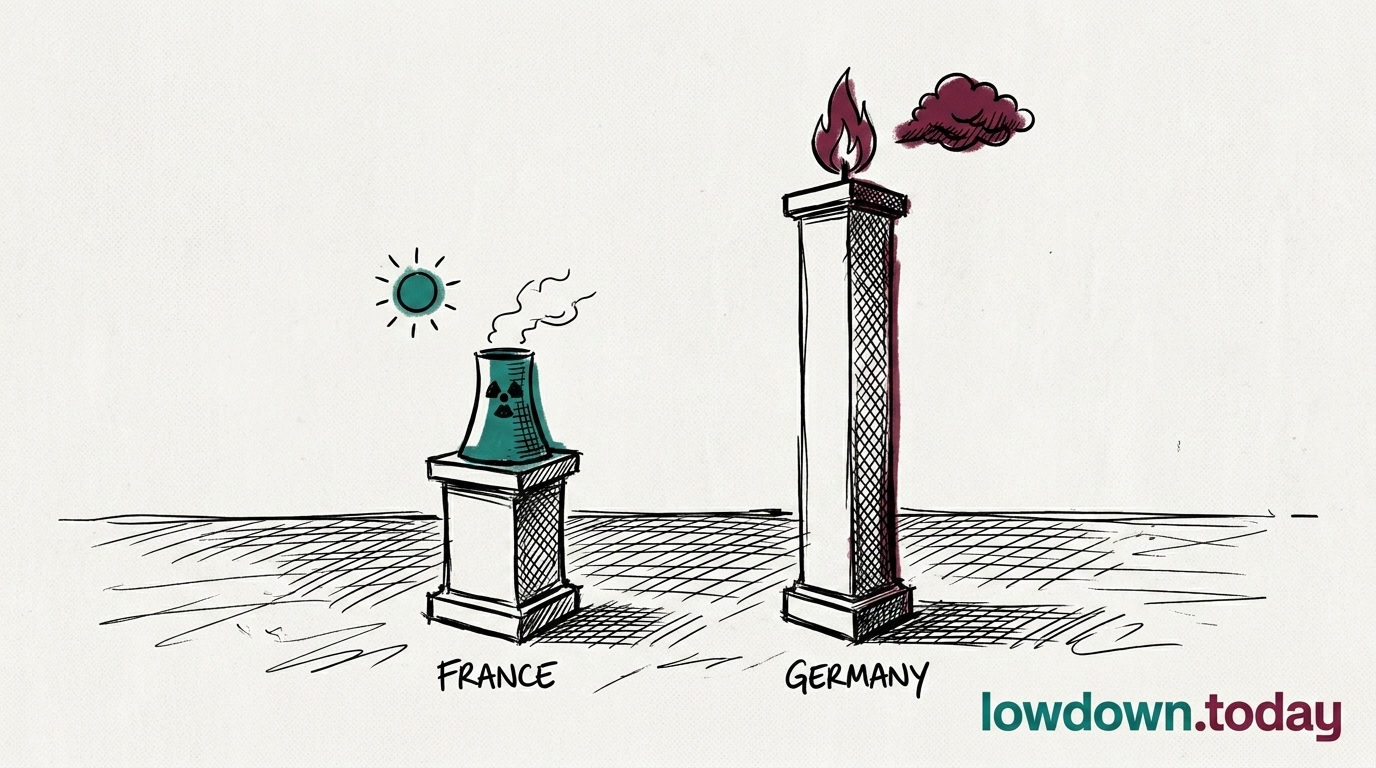
FNB Gas declared the storage-refill mechanism broken on 27 May after zero bookings in January 2026 auctions, and German day-ahead cleared EUR 102.64 on 3 June on a CCGT stack set by TTF near EUR 49 plus EUA near EUR 78. Winter storage fill now depends on state mandates with no commercial self-correction.
EDF / French government
EDF held full-year nuclear guidance at 350-370 TWh after April output of 29.3 TWh, anchoring the surplus that collapsed French day-ahead to EUR 8.96 on 3 June and passed that price to VNU industrials. Flamanville-3's September overhaul removes 1.6 GW at heating-season onset, reversing the nuclear surplus that made VNU pricing competitive.
