Skip to content
Briefings are running a touch slower this week while we rebuild the foundations.See roadmap
Drones: Industry & Defence
7JUN

Iran used Ukraine Patriots in 3 days

4 min read
11:27UTC

More Patriot missiles were fired in three days of the Iran war than Ukraine received in three years. Reuters sources warn supply delays are imminent — while Russia launches 60 Iskander ballistic missiles per month against targets Ukraine can no longer fully defend.

TechnologyDeveloping
Key takeaway

Three years of Ukrainian allotment consumed in three Iranian days reveals chronic under-supply relative to actual threat, not merely a temporary shock.

Zelenskyy stated that more Patriot interceptors were used in three days of the Iran war than Ukraine received in three years 1. Reuters sources have warned that delays in Patriot supplies to Ukraine are imminent. The shortfall is not hypothetical — it is arriving.

Lockheed Martin produces roughly 600 PAC-3 interceptors per year. Euromaidan Press calculated that Ukraine already lacked sufficient PAC-3 rounds to intercept the approximately 60 Russian Iskander ballistic missiles launched per month 2 — the Iran conflict is draining a stockpile that was already inadequate. Military Watch Magazine reported US Patriot expenditure of $2.4 billion in five days of Iran operations 3. An estimated 100–150 THAAD interceptors — roughly a quarter of the global inventory — were expended in the first week 4.

The production gap cannot be closed quickly. Lockheed's agreement to quadruple THAAD output from 96 to 400 interceptors per year will take years to deliver at the new rate. PAC-3 production faces similar constraints — semiconductor components, solid rocket motor propellant, and seeker assemblies all carry multi-year lead times. The US defence industrial base was sized for peacetime replenishment, not simultaneous theatre-level air defence operations in the Middle East and Eastern Europe. The 2011 Libya campaign exposed a similar production shortfall when NATO exhausted its precision-guided munition stocks in weeks; the interceptor bind is the same structural problem at a larger scale and higher unit cost.

For Ukraine, the consequence is direct. Russian oil and gas revenues have already fallen 65% year-on-year , and the EU's phased gas import ban beginning 25 April will tighten Moscow's fiscal position further — but revenue pressure takes months to constrain military output. The interceptor shortage operates on a faster clock. Each PAC-3 round allocated to CENTCOM is one fewer available to defend Kharkiv's power stations, Kramatorsk's rail junctions, or the thermal generation capacity that keeps Ukrainian cities heated through March. The Pentagon's allocation of the next production batch — to CENTCOM or to European Command — will reveal which theatre Washington prioritises when it cannot supply both.

Deep Analysis

In plain English

The Patriot system fires interceptor missiles worth $4–6 million each to shoot down incoming ballistic missiles. Ukraine has been receiving these missiles in carefully rationed quantities over three years of war. The Iran conflict burned through more of them in three days than Ukraine received in all that time. This exposes two things simultaneously: how intense the Iran war is, and how severely Ukraine has been undersupplied relative to the actual scale of the Russian missile threat it faces. With deliveries now delayed, the gaps in Ukraine's defensive umbrella protecting cities, power stations, and military infrastructure will widen before they narrow.

Deep Analysis
Synthesis

The three-year versus three-day comparison also reveals an internal policy contradiction: if Iran warranted that burn rate in three days, either Ukraine was chronically under-supplied relative to its actual threat environment, or the Iran war is consuming interceptors at a rate that cannot be sustained economically or politically. The comparison makes the rationing regime's inadequacy undeniable in a way that technical reporting has not previously achieved.

Root Causes

PAC-3 production was calibrated during the 1990s and 2000s for peacetime replacement and limited theatre deployments, not simultaneous multi-theatre warfare. The post-1991 'peace dividend' hollowed US defence manufacturing surge capacity over three decades. Lockheed Martin's Patriot production line cannot be surged without 18–36 months of upstream supply chain investment — particularly in solid rocket motors and guidance seekers manufactured by specialist sub-tier suppliers who face their own capacity ceilings.

What could happen next?
  • Risk

    Ukrainian ballistic missile defences face critical gaps within weeks as Iran operations delay the next PAC-3 production batch shipment.

    Immediate · Reported
  • Consequence

    Russia has direct operational incentive to surge Iskander ballistic missile usage precisely during the window when PAC-3 stocks are lowest, maximising penetration rates.

    Short term · Assessed
  • Meaning

    The three-year versus three-day comparison permanently reframes the Ukraine aid debate — the binding constraint was industrial capacity, not political will.

    Medium term · Assessed
  • Risk

    Simultaneous US commitments to Ukraine, Israel, Gulf states, and Taiwan create interceptor allocation conflicts that no current production plan resolves before 2028.

    Long term · Assessed
First Reported In

Update #3 · Iran war halts talks, drains air defences

Al Jazeera· 9 Mar 2026
Read original
Different Perspectives
Denmark (host nation)
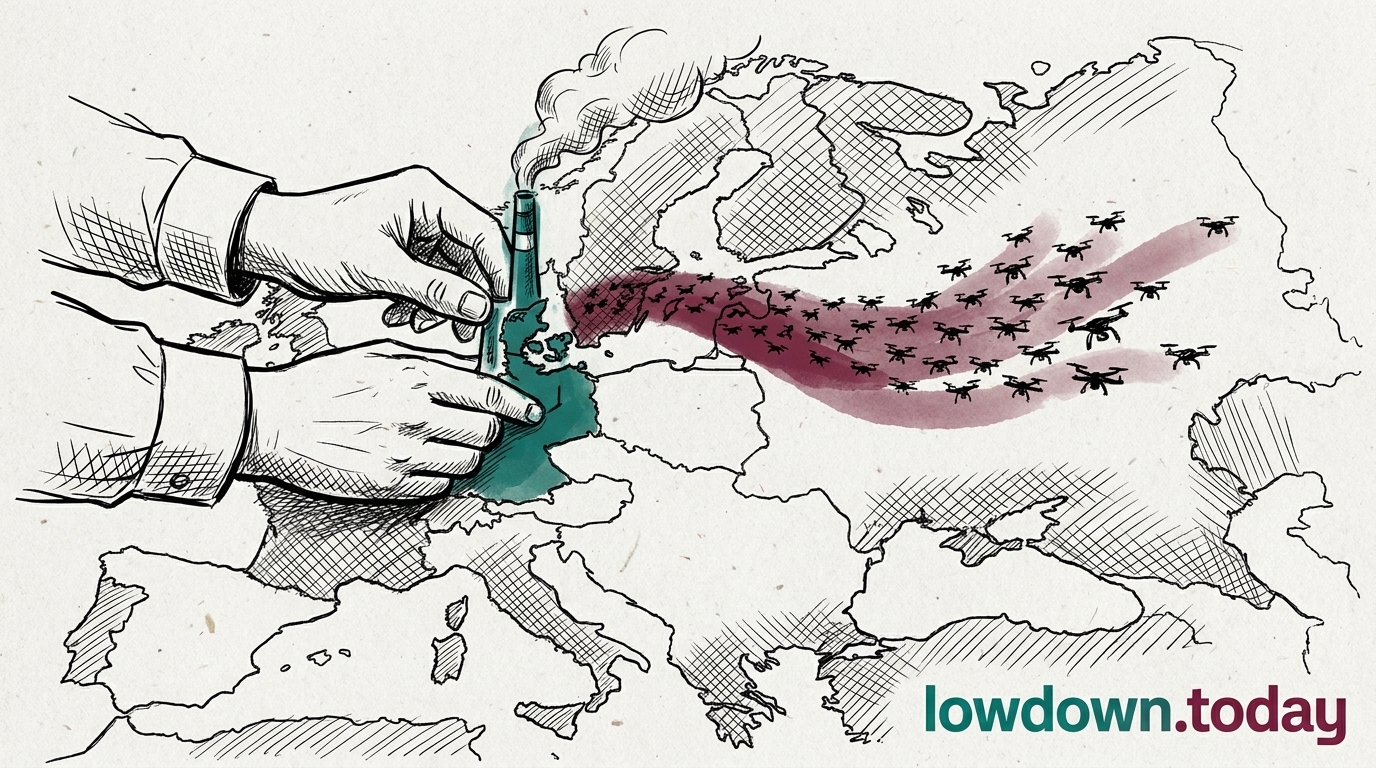
Denmark accepted Fire Point's Skrydstrup plant after committing to bilateral defence co-production at the B9 Nordic summit in May; the facility sits beside a Danish F-35 base, sharing security perimeters. NATO has published no legal guidance on whether hosting Ukrainian weapons production converts Denmark into a co-belligerent, leaving the host-state obligation unresolved.
Russian Ministry of Defence
Russia's 117% YoY drone-output rise in April, accelerating from a 68% full-year 2025 baseline, validates the FPV mass-production doctrine and hands Moscow a cleaner targeting argument for the Skrydstrup plant than any hidden production line offered; a Ukrainian weapons facility on NATO sovereign territory is a legitimate military target under the laws of armed conflict.
Baltic NATO states (Latvia, Estonia, Lithuania)
Latvia deployed mobile drone-intercept teams on 29 May using domestic Origin Robotics and Eraser interceptors, the first kinetic Baltic border response to Russia's 117% output surge. The Baltic states are the primary target market for Ukraine's ten EU export offices, giving them direct commercial access to combat-tested interceptors their own manufacturers have not yet matched.
Pentagon / Joint Interagency Task Force 401
Two Ukrainian entrants in Drone Dominance Phase 2 and Red Cat's SEC-filed STE partnership bring combat-iterated Ukrainian designs into US procurement without triggering Foreign Military Sale approvals; the programme's performance-scoring methodology does not require US-origin hardware. Northrop holding the Common UAS Payload standard means a heritage prime captures interface revenue regardless of which startup airframe wins.
Ukrainian defence industry (Fire Point / Spetstechnoexport)
Fire Point's Skrydstrup construction start and Spetstechnoexport's Red Cat partnership execute Zelensky's 13 May Bucharest proposal: converting wartime production surplus into a state export apparatus, independent of US approval chains. For Ukraine, embedded manufacturing on NATO soil protects propellant supply from Russian strikes while generating hard currency the war effort needs.
Chinese drone manufacturers (DJI, Autel)
Autel's Ralls Corp Fifth Amendment filing and DJI's Ninth Circuit quantification of USD 1.56 billion in 2026 losses are parallel constitutional attacks on a classified-evidence exclusion mechanism; neither company can contest the intelligence allegations directly, so both are betting on due-process doctrine to reopen the FCC authorisation route.
