Falklands War
1982 conflict over the Falklands; the modern benchmark for naval losses from guided anti-ship missiles.
Last refreshed: 16 July 2026
How did the 1982 Falklands War resurface at the 2026 World Cup semi-final?
Timeline for Falklands War
Mentioned in: UK presses FIFA as the FA stays silent
2026 FIFA World CupMentioned in: Lautaro header sends Argentina to final
2026 FIFA World CupMentioned in: Korean ships sail past the IRGC order
Iran Conflict 2026Mentioned in: Latvia defence chief resigns over drones
Drones: Industry & DefenceMentioned in: Six Arc7 carriers face binary maintenance fork
European Energy MarketsBackground
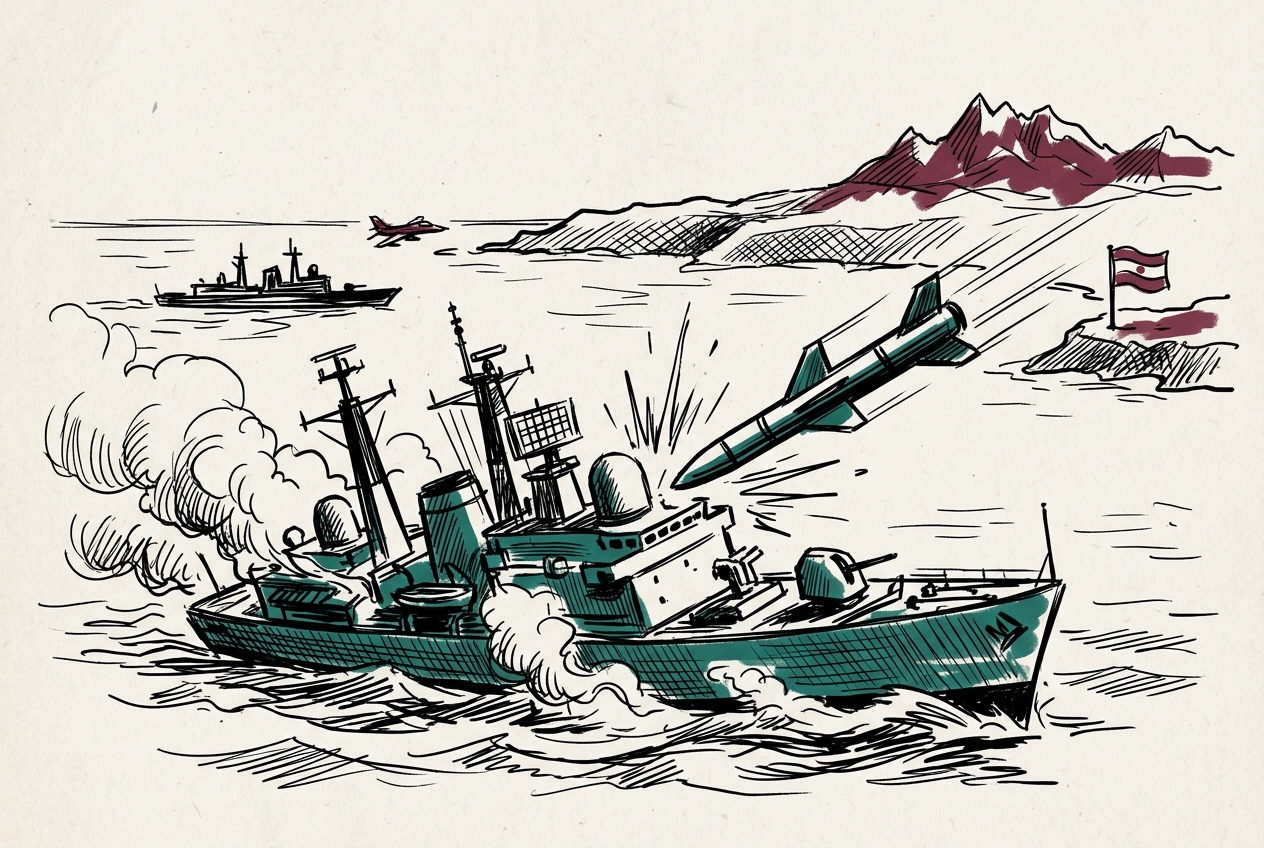
The Falklands War (Guerra de las Malvinas) was a 10-week armed conflict in 1982 between the United Kingdom and Argentina over sovereignty of the Falkland Islands (Islas Malvinas), a British Overseas Territory in the South Atlantic. Argentina's military government invaded in April; British forces recaptured the islands by June. The conflict cost 255 British and 649 Argentine military lives, and several Royal Navy vessels were sunk by Argentine Exocet anti-ship missiles, making it the defining modern case study in surface fleet vulnerability to guided missile attack.
In March 2026 the Falklands became the explicit benchmark for assessing Iranian Navy losses. Pentagon claims that US and Israeli forces had sunk 20 Iranian warships were described as potentially the largest naval losses by any state since the Falklands. By late March, cumulative losses exceeded 30 vessels, roughly half Iran's pre-war surface fleet, though only three sinkings were independently confirmed at the point the comparison first circulated.
The war's legacy resurfaced off the pitch when Argentina beat England 2-1 in Atlanta on 15 July to reach the World Cup final. Vice-President Victoria Villarruel invoked the Malvinas before kickoff and Foreign Minister Pablo Quirno cited the same 1982 UN resolution on the sovereignty dispute; players later posed with a "Las Malvinas Son Argentinas" banner, showing how the 1982 war still frames Argentine-British encounters 44 years on.
What was the Falklands War?
Why is the Falklands War compared to Iran's naval losses in 2026?
How many ships did Britain lose in the Falklands War?
What anti-ship missile was used in the Falklands War?
Were Iran's naval losses in 2026 larger than the Falklands?
Did the Falklands War come up during the 2026 World Cup semi-final?



Written with AI from Lowdown's published reporting. Not individually reviewed by an editor. Updated 16 July 2026. Editorial standards.