Skip to content
Briefings are running a touch slower this week while we rebuild the foundations.See roadmap
Cuba Dispatch
28MAY

Sanctions reach Cuba's ministries and party

4 min read
08:42UTC

The State Department named eleven Cuban officials and three security institutions under Executive Order 14404, extending asset-blocking from the military economy into the interior ministry, the police and the National Assembly.

PoliticsDeveloping
Key takeaway

Naming the energy minister who admitted the fuel crisis turns a sanctions list into a personal message.

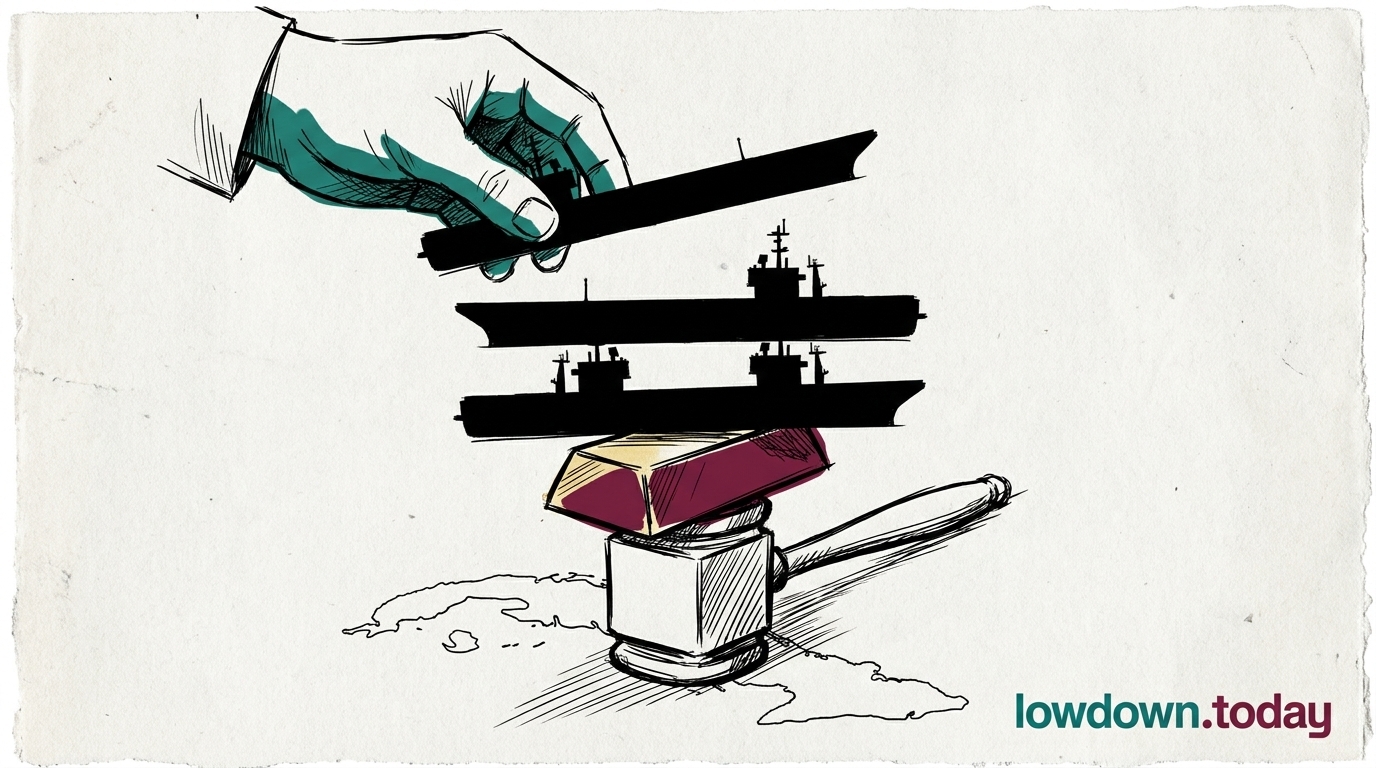
The US State Department announced a second designation wave under Executive Order 14404 on Monday 18 May, naming eleven Cuban officials and three institutions: the Ministry of the Interior (MININT), the National Revolutionary Police (PNR) and the Directorate of Intelligence (DGI) 1. The officials reported across multiple outlets include Energy and Mines Minister Vicente de la O Levy, Justice Minister Rosabel Gamon Verde and National Assembly President Juan Esteban Lazo Hernandez 2 3. Executive Order 14404 is the US instrument authorising asset-blocking and travel bans against designated Cuban officials. The eleven-name roster is reported, not confirmed verbatim from the primary list, and is attributed accordingly.

Where the first wave hit the military economy, this one reaches the state itself. The opening designation on 7 May named a single official and GAESA, the military conglomerate that handles most of Cuba's hard-currency trade . Eleven days later the list extends to the interior ministry, the police, intelligence, the justice and energy ministries and the head of the National Assembly. That progression follows the architecture Donald Trump set on 1 May, when an order first pulled officials' adult relatives inside the US Treasury's reach . The personal-sanctions machine is scaling from the security apparatus into the party and government leadership.

The instrument has a known ceiling worth naming. Asset-blocking bites on wealth held offshore in dollars, and much of Cuba's leadership holds its position in peso-denominated state office rather than foreign accounts. De la O Levy carries the sharpest political charge of any name on the list. He is the minister who conceded on 13 May that the island was out of fuel and that Venezuelan crude had been cut since November 2025 , and he is now personally sanctioned by the government he had been negotiating fuel relief around.

Deep Analysis

In plain English

When the US government 'designates' or 'sanctions' someone, it adds them to a list called the Specially Designated Nationals (SDN) list, maintained by a Treasury bureau called OFAC (the Office of Foreign Assets Control). Being on this list means that any person or company anywhere in the world that does business with you risks being cut off from the US financial system ; which handles the vast majority of international dollar transactions. In practice this is a powerful tool, because even companies with no US operations often depend on dollar clearing through US correspondent banks. The 18 May wave went further than previous Cuba designations in one important way: it named entire institutions ; the Interior Ministry (MININT), the national police (PNR), and the intelligence service (DGI). Individual officers were named in the first wave; this wave targets the institutions themselves. Naming an institution means that any foreign firm supplying it with anything, from police boots to prison surveillance equipment, could also end up on the list. European and Asian companies that do business with Cuban state security bodies now face a choice: keep the contracts and risk US sanctions exposure, or walk away.

Deep Analysis
Root Causes

Two structural factors explain why the second wave extended from security services into civilian ministries rather than adding more MININT officers.

EO 14404's operative text authorises designations targeting persons 'responsible for or complicit in' repression of Cuban citizens, or who 'materially supported' any such person.

The Justice Ministry under Rosabel Gamon Verde administers the prison system through which political prisoners are held under the Penal Code's 'crimes against authority' basket (Articles 142-149). Designating the Justice Minister is legally coherent with the EO's mandate in a way that, say, designating an agricultural ministry official would not be.

Second, the designation of Juan Esteban Lazo Hernandez as National Assembly President signals a deliberate choice to target the legislature's presiding figure despite Cuba's National Assembly having no independent legislative function ; it ratifies party decisions rather than initiating them.

The selection makes sense only as a signal: the US is treating the entire formal constitutional structure as complicit in repression; the security apparatus alone was insufficient as the target. The FIU Václav Havel Program for Democracy and Freedom has characterised this as a 'constitutional illegitimacy designation' strategy, previously applied only to Belarus after 2020.

What could happen next?
  • Consequence

    MININT's SDN entity designation triggers the 50% ownership rule, automatically co-designating any MININT-majority subsidiary, potentially affecting the CIMEX hard-currency retail chain and prison-supply procurement networks that intersect with GAESA.

    Immediate · Assessed
  • Risk

    European and Asian firms with security-equipment contracts in Cuba face a six-to-twelve month compliance review cycle before they can determine whether continued business breaches OFAC rules, creating a de facto procurement freeze for Cuban police and prison systems.

    Short term · Assessed
  • Opportunity

    Cuba's private-sector operators (cuentapropistas) who can credibly demonstrate independence from MININT may attract increased US interest in expanded private-to-private licensing as the designation architecture bifurcates the Cuban economy further.

    Medium term · Assessed
First Reported In

Update #5 · Washington stacks three instruments at Cuba

US State Department· 28 May 2026
Read original
Different Perspectives
Holy See and WOLA engagement-track analysts
Caritas Cuba distributed 82 per cent of a $3M tranche to 8,800 families via the Church channel Rubio proposed at his 9 May Vatican audience. WOLA analysts note that personal sanctions on peso-denominated officeholders carry limited coercive effect; the Church track is the one instrument that reaches ordinary Cubans directly.
Sovcomflot and Russia
Moscow has announced no replacement for the Universal after it diverted on 26 May, and Sovcomflot's failure to activate Russia's National Reinsurance Company cover as a substitute for the expired P&I insurance signals that Russian fuel deliveries to Cuba now depend on OFAC-compatible licensing rather than on an unconditional bilateral commitment.
Prisoners Defenders and OCDH human rights monitors
Prisoners Defenders' April 2026 census of 1,260 political prisoners, its highest on record, documents the caseload rising by ten in a month despite repeated Cuban pardon announcements. Maykel Osorbo's refusal of the State Security exile-or-2030 ultimatum in May kept a high-profile name inside the registry Havana would need cleared before any prisoner-release negotiation proceeds.
MINREX and Cuban government
Cuba's foreign ministry condemned the indictment as 'political coercion' and filed a formal protest met by the US Deputy Secretary of State on 24 May. Diaz-Canel offered dialogue 'on equal terms' but ruled political prisoners off the table, while Cuba's pardon decrees structurally exclude crimes-against-authority charges from every amnesty wave, leaving the 1,260-prisoner count unchanged.
Trump administration and Florida delegation
The administration framed the 18 May designation wave and 20 May indictment as accountability for Cuba's security apparatus; Florida Republicans Gimenez, Diaz-Balart, and Salazar credited constituent pressure for the EO 14404 architecture. Senate Democrats Kaine, Schiff, and Gallego, having lost S.J.Res.124 51-47 on 29 April, called the Nimitz deployment under Operation Southern Spear a constitutional overreach.
OCDH and dissident coalition (Otero Alcántara, Osorbo proxies)
The Madrid-based OCDH coordinated the 13 May Brussels handover after the Cuban Supreme Popular Court rejected Otero Alcántara's early-release appeal in late April. The coalition's pivot to the EU restrictive-measures track follows procedural closure of the early-release vector before the 24 April US deadline lapsed.

